- Maths
- Ready-made model
- Class 1 to 9
Probability in Coin Toss Mathematics Working Model Educational Electronic Hobby Kit
Code B0G2T8WLCC
- Paid for and delivered by Amazon. The current price and the delivery date for your PIN code are shown there.
- Sold by Gurukul Technicals Institute, Delhi.
- Need a different topic, a custom version or a school order? Ask on WhatsApp.
In this project guide
Ready-made model
About this model
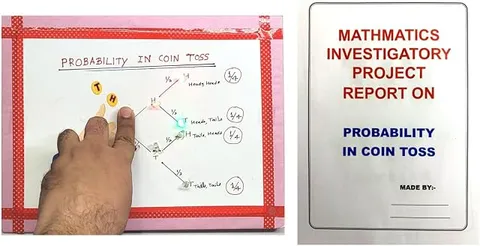
This maths working model is for experimenting with the probability of heads and tails when a coin is tossed. It helps students compare the theoretical chance of 1/2 with the results they actually get after many tosses.
How it works
The science behind it
The idea the model demonstrates, in words you can use in your report and when you explain it.
Probability measures how likely an event is, on a scale from 0 (impossible) to 1 (certain). For equally likely outcomes, P(E) = number of favourable outcomes ÷ total number of outcomes. A fair coin has two equally likely outcomes, so P(head) = P(tail) = 1/2, and P(E) + P(not E) = 1. Experimental probability comes from actual trials: if 10 tosses give 7 heads, the experimental probability of a head is 7/10. With only a few tosses the result can be far from 1/2, but as the number of tosses grows, the experimental value tends to come closer to 1/2; this is the law of large numbers. With two coins, the sample space is HH, HT, TH and TT, so P(two heads) = 1/4, P(exactly one head) = 2/4 = 1/2 and P(at least one head) = 3/4. A cricket toss is fair because each captain has an equal chance of winning it.
Make it yourself
Make a coin toss probability model yourself
Build your own version from scratch, or use the steps to understand how the ready-made model is put together before you present it.
What you need 9
Step by step 9 steps
Divide the board into three areas: the tossing tray, the tally tables, and the graph with the formula for probability.
Line the shoebox lid with felt and fix it to the board, so the coin lands flat and does not roll away.
Draw tally tables for 10, 50 and 100 tosses, each with columns for heads, tails and the fraction of heads.
Toss the coin 100 times, recording each result as a tally, and pause after 10 and 50 tosses to fill in those tables.
Work out the experimental probability of a head after each set and write it as a fraction and as a decimal.
Plot the fraction of heads against the number of tosses, with a dotted line at 0.5, to show how the results move closer to it.
For the electronic coin, wire the 555 as a fast astable that runs only while the push button is held, and connect its output to pin 14 of the 4017.
Connect the 4017's Q0 (pin 3) and Q1 (pin 2) to the H and T LEDs through resistors, join Q2 (pin 4) to reset (pin 15), connect pins 8 and 13 to negative and pin 16 to positive.
Press and release the button 100 times, record which LED stays lit each time, and compare these results with the real coin.
Read this first
Safety first
Go through these points before you build or switch anything on. Younger students should do this with an adult.
- Keep coins and small parts away from younger children, as they can be swallowed.
- Ask an adult to cut the foam board with a cutter and to use any glue gun.
- Use only the 9 V battery for the electronic coin, and disconnect it when you are not demonstrating.
Troubleshooting
If something does not work
The usual problems with this model and how to fix them. Open a problem to see the fix.
After 10 tosses I got 8 heads. Is my coin unfair?
Not necessarily: a small number of tosses often gives a result far from 1/2. Carry on to 100 tosses, or combine results with classmates, and the fraction usually settles near 0.5.
The coin keeps rolling off the tray
Line the tray with thicker cloth, raise its edges, and toss from a lower height.
The electronic coin always stops on the same LED
The 555 may be running too slowly, or the button is not controlling it. Use a smaller timing capacitor so it runs faster, and check that the button switches the 555's supply.
Both LEDs look lit while the button is held
That is expected, because the count switches faster than the eye can follow. Only one LED should stay lit after you release the button.
Exhibition day
How to present it
A running order for the exhibition table or the practical, step by step.
Record the results of 10, 50 and 100 tosses in a table and show how the fraction of heads moves towards 1/2.
Let visitors toss and add their results to a running tally on a chart.
List the sample space for two coins and work out the probabilities of a few events.
Explain the difference between experimental and theoretical probability clearly.
Practice
Viva questions
Practice questions on this model, with short answers. Try each one aloud before you open the answer.
What is the probability of getting a head when a fair coin is tossed?
1/2, because there are two equally likely outcomes and one of them is a head.
What is the sample space when two coins are tossed together?
{HH, HT, TH, TT}, which has four equally likely outcomes.
Can a probability be greater than 1?
No. A probability always lies between 0 and 1, including both.
If you get 7 heads in 10 tosses, does it mean the coin is unfair?
Not necessarily; with only 10 tosses such variation is normal, and many more tosses are needed to judge whether a coin is fair.
Project file
Project file outline
The headings of the project file, in order. Give each heading its own section and write it in your own words.
Free ebook: Writing a Science Project FileContents
- Aim: to compare the experimental probability of getting a head with the theoretical probability of 1/2
- Materials
- Key terms: experiment, trial, outcome, event and sample space
- Procedure for the coin tosses and for the electronic coin
- Observation tables for 10, 50 and 100 tosses
- Calculation of experimental probability
- Graph of the fraction of heads against the number of tosses
- Conclusion
- Uses of probability in daily life, such as weather forecasts and the toss at a cricket match
Buying checklist
Before you buy
What to check before you order the model.
1Check these first
- Probability is part of the Class 10 maths book and appears earlier in some syllabuses; check whether your teacher wants one coin only or two coins as well.
- Check in the listing whether the electronic part needs a battery and whether one is included.
- Check in the listing whether a report or chart is included; your own toss results will still be needed.
- Try the model at home a few days before the exhibition and keep a spare battery.
- Keep the box so the board and any circuit reach school undamaged.
- Check the delivery date for your PIN code on the marketplace, and order well before the exhibition or practical.
- Practise explaining it. Judges ask what the model shows and why; knowing the science matters as much as the model. The viva questions above are a good place to start.
Next steps
Take it further
Ways to turn this model into a bigger investigation or a stronger exhibition entry.
Toss two coins together 100 times and compare the results for two heads, one head and no head with 1/4, 1/2 and 1/4.
Add a die and compare the experimental and theoretical probabilities of each number.
Pool the whole class's results to reach 1,000 tosses, or simulate 10,000 tosses with a random number function in a spreadsheet.
Audience
Who it suits
Suits Class 9 and 10 maths exhibitions and lessons on probability, and Class 11 revision.
- ClassClass 1 to 9
- SubjectMaths
- TypeReady-made model
Free to read
Free ebooks for this topic
Free PDF ebooks from Gurukul Technicals Institute on the science, the making and the presenting of projects like this one.
- Free PDF ebook
Maths Working Models and Activities
Make maths visible: models for number, geometry, algebra and data
- Free PDF ebook
Your Science Exhibition Guide
Choose a project, build it, present it and answer the judges with confidence
- Free PDF ebook
Writing a Science Project File
How to write the report, from the cover page to the bibliography
- Free PDF ebook
Viva Questions for Science Projects
How to answer examiner questions, with sample questions for popular projects