- Maths
- Ready-made model
- Class 1 to 9
- Printed report included
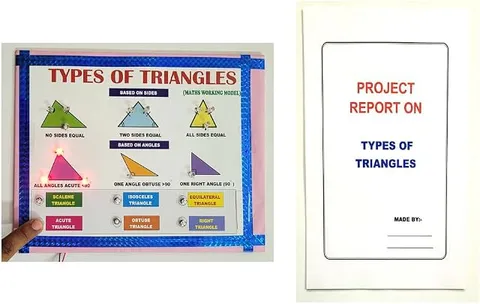
Types of Triangle on The Basis of Angles and Properties Educational Maths Working Project Model with Printed Report
Code B0DK264HJ7
- Paid for and delivered by Amazon. The current price and the delivery date for your PIN code are shown there.
- Sold by Gurukul Technicals Institute, Delhi.
- Need a different topic, a custom version or a school order? Ask on WhatsApp.
In this project guide
Ready-made model
About this model
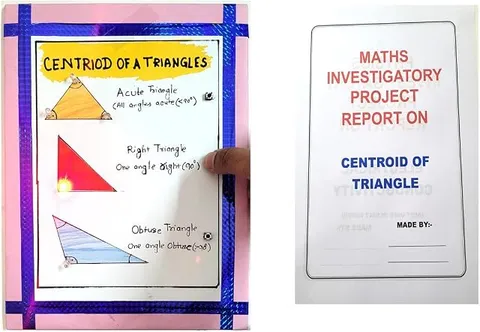
This maths model sorts triangles by their angles into acute-angled, right-angled and obtuse-angled triangles, and shows the main properties every triangle follows. The listing says a printed report is included, which helps with the written part of a school project.
How it works
The science behind it
The idea the model demonstrates, in words you can use in your report and when you explain it.
By its angles, a triangle is acute-angled (all three angles less than 90°), right-angled (one angle exactly 90°) or obtuse-angled (one angle more than 90°). By its sides, it can be equilateral, isosceles or scalene. The most important property is the angle sum: the three interior angles always add up to 180°, which is why a triangle can have at most one right or obtuse angle. An exterior angle equals the sum of the two opposite interior angles. In a right-angled triangle, the side opposite the right angle is the hypotenuse, the longest side, and Pythagoras' theorem says hypotenuse² = base² + perpendicular². Also, any two sides of a triangle together are always longer than the third side. The two set squares in a school geometry box are right-angled triangles: one has angles of 45°, 45° and 90°, and the other 30°, 60° and 90°.
Make it yourself
Make a types of triangles model yourself
Build your own version from scratch, or use the steps to understand how the ready-made model is put together before you present it.
What you need 8
Step by step 8 steps
Draw and cut out an acute-angled triangle (for example 50°, 60°, 70°), a right-angled triangle (90°, 60°, 30°) and an obtuse-angled triangle (120°, 35°, 25°), checking every angle with the protractor.
Stick them in a row, colour the largest angle of each one, and write its type and measured angles beside it.
For the angle sum, cut a spare paper triangle, mark each corner with an arc, tear the three corners off and stick them side by side on a straight line to show they make 180°.
- Make the adjustable triangle
Hook the rubber band between the free ends of the two hinged strips. As you open the hinge, show the triangle changing from acute to right (check with a set square) to obtuse.
- Show the exterior angle property
Extend one side of a triangle and place two coloured cut-outs of the opposite interior angles inside the exterior angle to show they fill it exactly.
On graph paper, draw a 3-4-5 right-angled triangle with a square on each side, and count the small squares: 9 + 16 = 25.
- Make a quiz
Fasteners beside cards of angle sets such as 40°, 50°, 90°, and beside the three type names; join correct pairs at the back and test with the LED tester.
Label everything clearly and check every quiz pair before the exhibition.
Read this first
Safety first
Go through these points before you build or switch anything on. Younger students should do this with an adult.
- Use sharp scissors or a cutter only with an adult nearby.
- Keep the resistor in the LED tester so the LED does not burn out.
- Bend and tape the fastener legs flat at the back.
- Fix the rubber band securely so it cannot snap towards someone's face.
Troubleshooting
If something does not work
The usual problems with this model and how to fix them. Open a problem to see the fix.
The torn corners do not make a straight line
The triangle was not drawn accurately or the corners were torn unevenly. Draw it carefully, mark each corner with an arc before tearing, and line the three arcs up at one point.
The measured angles add up to 178° or 182°
Small errors come from thick pencil lines and reading the protractor's wrong scale. Use a sharp pencil and read from the scale that starts at 0° on your base line; a difference of one or two degrees is measurement error.
The adjustable triangle will not stay at one angle
The paper fastener is loose. Add a small washer of card under its head, or hold the strips with a paper clip while presenting.
The quiz LED stays dark for a correct pair
Check the LED is the right way round, the back wire is tight under both fasteners and the battery is fresh.
Exhibition day
How to present it
A running order for the exhibition table or the practical, step by step.
Tear the three corners off a paper triangle and place them side by side to show they make a straight angle of 180°.
Classify each triangle on the model aloud, asking the visitor to guess its type first.
Use the two set squares from your geometry box as ready examples of right-angled triangles.
Keep a 3-4-5 triangle example ready to show Pythagoras' theorem with numbers.
Practice
Viva questions
Practice questions on this model, with short answers. Try each one aloud before you open the answer.
Can a triangle have two right angles?
No. Two right angles already add up to 180°, leaving nothing for the third angle.
What is each angle of an equilateral triangle?
Each angle is 60°, because three equal angles share 180°.
Can an obtuse-angled triangle also be isosceles?
Yes. A triangle with angles of 120°, 30° and 30° is both obtuse-angled and isosceles.
Which is the longest side of a right-angled triangle?
The hypotenuse, which is the side opposite the right angle.
Project file
Project file outline
The headings of the project file, in order. Give each heading its own section and write it in your own words.
The listing includes a printed project report: use this outline to check that your own file covers every part.
Free ebook: Writing a Science Project FileContents
- Aim: to classify triangles by their angles and verify their main properties
- Classification of triangles by angles: acute, right and obtuse
- Classification of triangles by sides: equilateral, isosceles and scalene
- Angle sum property, shown with the torn-corner activity
- Exterior angle property
- Pythagoras' theorem for right-angled triangles
- Construction of the model and the quiz
- Observations: table of triangles, their angles and types
- Conclusion and references
Buying checklist
Before you buy
What to check before you order the model, and what to do when it arrives.
1Before you order
- Check that the triangle topics on the model match your class syllabus.
- Read the listing to see what is mentioned with the model, such as the printed report, and plan your own observation pages anyway.
- Practise drawing and measuring one triangle in front of a friend, since examiners like a live demonstration.
- Keep the box to carry the model safely.
- Check the delivery date for your PIN code on the marketplace, and order well before the exhibition or practical.
2When it arrives
- Check the model when it arrives for loose pieces and try any lights or switches.
Next steps
Take it further
Ways to turn this model into a bigger investigation or a stronger exhibition entry.
Explain with the adjustable triangle why a triangle can have at most one right or obtuse angle.
Show the triangle inequality with straws of different lengths: three lengths make a triangle only if any two together are longer than the third.
Add the congruence rules (SSS, SAS, ASA, RHS) with pairs of cut-out triangles.
Find the area of a scalene triangle with Heron's formula and compare with half × base × height.
Audience
Who it suits
Suits Class 6 to 9 maths exhibitions and geometry lessons on triangles and their properties.
- ClassClass 1 to 9
- SubjectMaths
- TypeReady-made model
- Project reportPrinted report included
Free to read
Free ebooks for this topic
Free PDF ebooks from Gurukul Technicals Institute on the science, the making and the presenting of projects like this one.
- Free PDF ebook
Maths Working Models and Activities
Make maths visible: models for number, geometry, algebra and data
- Free PDF ebook
Your Science Exhibition Guide
Choose a project, build it, present it and answer the judges with confidence
- Free PDF ebook
Writing a Science Project File
How to write the report, from the cover page to the bibliography
- Free PDF ebook
Viva Questions for Science Projects
How to answer examiner questions, with sample questions for popular projects