- Maths
- Ready-made model
- Class 1 to 9
Centroid of Triangle Working Model
Code B0G2TGRKMC
- Paid for and delivered by Amazon. The current price and the delivery date for your PIN code are shown there.
- Sold by Gurukul Technicals Institute, Delhi.
- Need a different topic, a custom version or a school order? Ask on WhatsApp.
In this project guide
Ready-made model
About this model
This maths working model shows how the three medians of a triangle meet at a single point, the centroid. It helps a student demonstrate the 2:1 property of the centroid and why it is the balancing point of a triangular sheet.
What the listing says
- Median Intersection Mathematics Project
How it works
The science behind it
The idea the model demonstrates, in words you can use in your report and when you explain it.
A median of a triangle is the line segment joining a vertex to the midpoint of the opposite side. Every triangle has three medians, and they always meet at one point called the centroid, usually written G. The centroid divides each median in the ratio 2:1, with the longer part towards the vertex. In coordinate geometry, if the vertices are (x₁, y₁), (x₂, y₂) and (x₃, y₃), then G = ((x₁ + x₂ + x₃) ÷ 3, (y₁ + y₂ + y₃) ÷ 3); for vertices (0, 0), (6, 0) and (0, 9), G is (2, 3). Each median splits the triangle into two triangles of equal area, and the three medians together make six small triangles of equal area. The centroid always lies inside the triangle, and it is the centre of mass of a uniform triangular sheet, so a triangle cut from cardboard balances on a pencil tip placed at its centroid.
Make it yourself
Make a centroid of a triangle model yourself
Build your own version from scratch, or use the steps to understand how the ready-made model is put together before you present it.
What you need 9
Step by step 8 steps
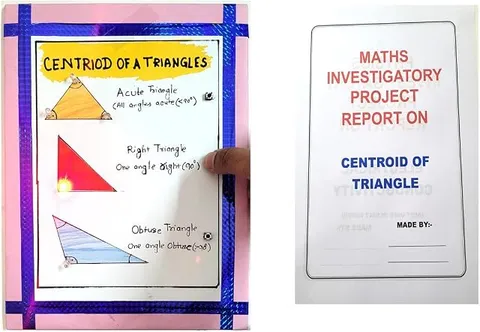
Draw and cut out an acute, a right-angled and an obtuse triangle, each with sides of 15 to 25 cm, so you can show the result holds for every type.
On the first triangle, measure each side, mark its midpoint, and join each midpoint to the opposite corner: these are the three medians. They meet at one point; label it G.
Stretch coloured thread along each median between drawing pins at the corner and the midpoint, so the three threads visibly cross at G.
Measure both parts of each median, from the corner to G and from G to the midpoint, and write them on the triangle; each pair should be close to 2 : 1.
Balance the triangle on the stand's point at G: it stays level, because the centroid is the centre of mass of a uniform triangular sheet.
Find G on the second triangle without drawing medians: make a small hole near each corner, hang it from a pin on the cork board with the plumb line beside it, and draw along the thread. Repeat from the other two corners; the three lines meet at G.
Glue the right-angled triangle onto graph paper with its right angle at the origin, for example with corners at (0, 0), (15, 0) and (0, 18). Check that G = ((x₁ + x₂ + x₃) ÷ 3, (y₁ + y₂ + y₃) ÷ 3) = (5, 6) lands where its medians cross.
Mount all three triangles on a board with a heading, and add a card showing that the medians cut the triangle into six small triangles of equal area.
Read this first
Safety first
Go through these points before you build or switch anything on. Younger students should do this with an adult.
- Use the cutter only with an adult, on a cutting mat, keeping your other hand behind the blade.
- Fix the balancing nail or pencil so it cannot roll, and cover its point with an eraser when not in use.
- Push drawing pins fully in, and count them back into a box after the exhibition so none are left on the floor.
Troubleshooting
If something does not work
The usual problems with this model and how to fix them. Open a problem to see the fix.
The triangle tips over when balanced on G
The sheet may be uneven in thickness, have heavy labels on one side, or the medians were drawn from wrong midpoints. Re-measure the midpoints and use a sheet of even thickness.
The three medians do not meet at one point
A midpoint was marked slightly wrong or the ruler slipped. Bisect each side accurately with the compasses and redraw; with care the lines meet within a millimetre.
The ratio comes out as 1.8 : 1 or 2.2 : 1
Small measuring errors are normal. Measure to the nearest millimetre, average the three medians, and mention the error in your report.
The plumb lines do not cross at the drawn centroid
The holes may be too tight, so the triangle cannot swing freely. Widen them slightly and let the triangle settle before drawing each line.
Exhibition day
How to present it
A running order for the exhibition table or the practical, step by step.
Cut a triangle from thick cardboard, mark its centroid and balance it on a pencil tip in front of the judges.
Measure the two parts of one median with a ruler to show the 2:1 ratio.
Show that the result holds for acute, right and obtuse triangles, since the centroid is always inside.
Solve one example with coordinates on a chart to connect the model with the centroid formula.
Practice
Viva questions
Practice questions on this model, with short answers. Try each one aloud before you open the answer.
What is a median of a triangle?
A median is a line segment that joins a vertex of a triangle to the midpoint of the opposite side.
In what ratio does the centroid divide each median?
In the ratio 2:1, with the longer part between the vertex and the centroid.
Find the centroid of the triangle with vertices (0, 0), (6, 0) and (0, 9).
G = ((0 + 6 + 0) ÷ 3, (0 + 0 + 9) ÷ 3) = (2, 3).
Does the centroid always lie inside the triangle?
Yes. Unlike the orthocentre and the circumcentre, the centroid lies inside every triangle.
Project file
Project file outline
The headings of the project file, in order. Give each heading its own section and write it in your own words.
Free ebook: Writing a Science Project FileContents
- Aim: to show that the three medians of a triangle meet at one point, the centroid, which divides each median in the ratio 2 : 1
- Introduction: medians of a triangle and the centroid
- Materials and construction of the three triangles
- Verification of the 2 : 1 ratio, with a table of measurements
- The centroid as the balancing point, and the plumb-line method
- The coordinate formula for the centroid, with a worked example
- How the medians divide the triangle into six triangles of equal area
- Applications: centre of mass in engineering and design
- Conclusion and bibliography
Buying checklist
Before you buy
What to check before you order the model, and what to do when it arrives.
1Before you order
- Check where the centroid appears in your syllabus (triangles, or coordinate geometry in Class 10) and what your teacher expects you to show.
- Look at the listing photos to see whether the model shows one triangle or several types, and plan to make the others yourself.
- Prepare a worked coordinate example of your own, since examiners often ask for a fresh one.
- Keep the box to carry the model flat.
- Check the delivery date for your PIN code on the marketplace, and order well before the exhibition or practical.
2When it arrives
- When it arrives, check the medians and the 2 : 1 markings with a ruler, and practise the balancing demonstration.
Next steps
Take it further
Ways to turn this model into a bigger investigation or a stronger exhibition entry.
Mark the circumcentre and orthocentre on the same triangle and show that they and the centroid lie on one straight line, the Euler line.
Prove the centroid formula with the section formula, using the 2 : 1 division of a median.
Find the centre of mass of an L-shaped card by the plumb-line method and compare it with a calculation that splits it into two rectangles.
Audience
Who it suits
Suits Class 7 to 10 maths exhibitions on triangles and coordinate geometry, and classroom demonstrations of concurrent lines.
- ClassClass 1 to 9
- SubjectMaths
- TypeReady-made model
Free to read
Free ebooks for this topic
Free PDF ebooks from Gurukul Technicals Institute on the science, the making and the presenting of projects like this one.
- Free PDF ebook
Maths Working Models and Activities
Make maths visible: models for number, geometry, algebra and data
- Free PDF ebook
Your Science Exhibition Guide
Choose a project, build it, present it and answer the judges with confidence
- Free PDF ebook
Writing a Science Project File
How to write the report, from the cover page to the bibliography
- Free PDF ebook
Viva Questions for Science Projects
How to answer examiner questions, with sample questions for popular projects