- Maths
- Ready-made model
- Class 1 to 9
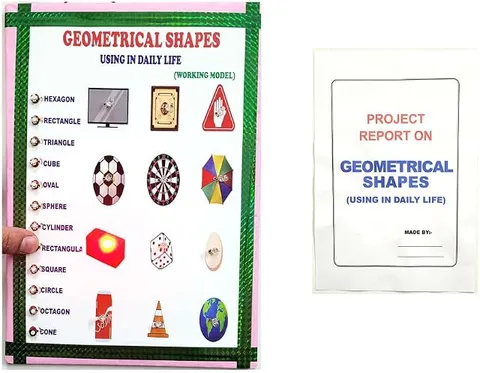
Mathematics Geometrical Shapes Working Model Project and Teaching Aid Educational Electronic Hobby Kit
Code B0DTYKT8MC
- Paid for and delivered by Amazon. The current price and the delivery date for your PIN code are shown there.
- Sold by Gurukul Technicals Institute, Delhi.
- Need a different topic, a custom version or a school order? Ask on WhatsApp.
In this project guide
Ready-made model
About this model
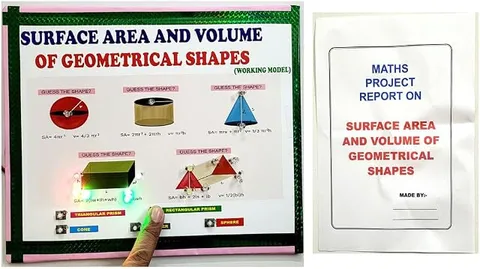
This maths model brings together common two-dimensional and three-dimensional shapes so students can identify each one and talk about its sides, angles, faces, edges and vertices. It is a handy aid for revising shape names, properties and mensuration formulas in one place.
How it works
The science behind it
The idea the model demonstrates, in words you can use in your report and when you explain it.
Plane (2D) shapes such as triangles, squares, rectangles, circles and other polygons have length and breadth only, so we measure their perimeter and area. A rectangle's perimeter is 2(l + b) and its area is l × b; a triangle's area is ½ × base × height; a circle's circumference is 2πr and its area πr². Solid (3D) shapes such as cubes, cuboids, cylinders, cones and spheres also have depth, so they have volume and surface area. Solids with only flat polygon faces, such as cubes and pyramids, are polyhedra, and they follow Euler's formula F + V − E = 2: a cube has 6 faces, 8 vertices and 12 edges, and 6 + 8 − 12 = 2. Curved solids like cylinders and spheres are not polyhedra. Everyday life in India is full of these shapes: a ludo dice is a cube, an LPG cylinder is close to a cylinder and an ice-cream cone is a cone.
Make it yourself
Make a geometrical shapes model yourself
Build your own version from scratch, or use the steps to understand how the ready-made model is put together before you present it.
What you need 9
Step by step 8 steps
Draw the plane shapes accurately with ruler and compass: an equilateral triangle, a square, a rectangle, a parallelogram, a rhombus, a trapezium, a regular hexagon and a circle. Cut them out.
Stick them on the left half of the board and write each shape's perimeter and area formula beneath it.
Draw nets of a cube, a cuboid, a square pyramid, a cylinder and a cone on card, adding glue flaps, then score the fold lines, fold and stick.
Build skeleton models of a cube and a pyramid from toothpicks and clay so visitors can count edges and vertices easily.
Fix the solids on the right half with a table of faces, vertices and edges, and check F + V − E = 2 for the cube, cuboid and pyramid.
For the quiz, put a paper fastener under each shape and beside each name strip, and join the correct pairs with wire at the back.
Make the LED tester from the battery, resistor and LED with two probe wires, and check every matching pair lights and every wrong pair stays dark.
Add a title and a formula corner, and cover the back wiring with card.
Read this first
Safety first
Go through these points before you build or switch anything on. Younger students should do this with an adult.
- Handle the compass point carefully and use a cutter only with an adult.
- Keep the resistor in the LED tester so the LED does not burn out.
- Flatten and tape the fastener legs on the back so no sharp points stick out.
- Keep loose clay balls and toothpicks away from small children at the exhibition.
Troubleshooting
If something does not work
The usual problems with this model and how to fix them. Open a problem to see the fix.
A folded net does not close properly
The sides were not measured equally, or the glue flaps are on the wrong edges. Redraw it with exact measurements, score the fold lines with a ruler and an empty pen, and put one flap on every edge that must join another.
The cone keeps opening up
The seam needs more support. Tape the inside of the seam as well as the outside, and glue the cone onto a circle of card for its base.
Euler's formula does not work for the cylinder or cone
That is correct: the formula is for polyhedra, solids made only of flat polygon faces. A cylinder and a cone have curved surfaces, so leave them out of the Euler table and explain why.
The quiz LED does not light for a correct pair
Check that the LED's long leg faces the battery positive, that the back wire is firmly under both fasteners, and that the battery is not weak.
Exhibition day
How to present it
A running order for the exhibition table or the practical, step by step.
Group the shapes into 2D and 3D first, then pick one from each group to explain in detail.
Count the faces, edges and vertices of a cube in front of the examiner and verify Euler's formula.
Keep a formula card for area, perimeter and volume ready for quick calculation questions.
Point to real objects nearby, such as a book, a glass or a ball, as examples of each shape.
Practice
Viva questions
Practice questions on this model, with short answers. Try each one aloud before you open the answer.
What is Euler's formula for polyhedra?
F + V − E = 2, where F is the number of faces, V the number of vertices and E the number of edges.
How is a square different from a rhombus?
Both have four equal sides, but every angle of a square is 90°, while a rhombus need not have right angles.
Is a cylinder a polyhedron?
No. A polyhedron has only flat polygon faces, and a cylinder has a curved surface.
What is the sum of the interior angles of a quadrilateral?
360°, because a diagonal divides any quadrilateral into two triangles of 180° each.
Project file
Project file outline
The headings of the project file, in order. Give each heading its own section and write it in your own words.
Free ebook: Writing a Science Project FileContents
- Aim: to identify common 2D and 3D shapes and explain their properties
- Plane shapes: sides, angles, perimeter and area
- Solid shapes: faces, edges, vertices, surface area and volume
- Nets of solids and how they fold
- Verification of Euler's formula for polyhedra
- Construction of the model and the matching quiz
- Shapes in daily life and buildings
- Conclusion and references
Buying checklist
Before you buy
What to check before you order the model, and what to do when it arrives.
1Before you order
- Check that the shapes and formulas on the model match your class syllabus.
- Read the listing to see what is mentioned with the model and whether you need to add a report or labels.
- Revise the formula for each shape on the model, because visitors usually point at one and ask.
- Keep the box and pack the 3D shapes carefully for the journey to school.
- Check the delivery date for your PIN code on the marketplace, and order well before the exhibition or practical.
- Practise explaining it. Judges ask what the model shows and why; knowing the science matters as much as the model. The viva questions above are a good place to start.
2When it arrives
- Inspect it when it arrives for bent or loose shapes and try any lights or switches.
Next steps
Take it further
Ways to turn this model into a bigger investigation or a stronger exhibition entry.
Measure your own nets and calculate the actual surface area and volume of each solid you made.
Add the five Platonic solids and show that Euler's formula holds for each one.
Show how a sector of a circle rolls into a cone and link the arc length to the base circumference.
Mark the lines of symmetry on each plane shape and count them in a table.
Audience
Who it suits
Suits Class 5 to 8 maths exhibitions and mensuration lessons, and works as a teaching aid in primary and middle school.
- ClassClass 1 to 9
- SubjectMaths
- TypeReady-made model
Free to read
Free ebooks for this topic
Free PDF ebooks from Gurukul Technicals Institute on the science, the making and the presenting of projects like this one.
- Free PDF ebook
Maths Working Models and Activities
Make maths visible: models for number, geometry, algebra and data
- Free PDF ebook
Your Science Exhibition Guide
Choose a project, build it, present it and answer the judges with confidence
- Free PDF ebook
Writing a Science Project File
How to write the report, from the cover page to the bibliography
- Free PDF ebook
Viva Questions for Science Projects
How to answer examiner questions, with sample questions for popular projects