- Maths
- Ready-made model
- Class 1 to 9
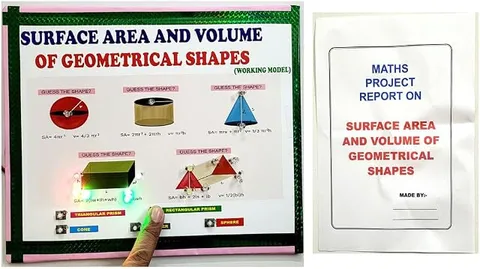
Surface Area and Volume of Geometrical Shapes Mathmatics Working Project Model Educational Electronic Hobby Kit
Code B0DTY4Y2B2
- Paid for and delivered by Amazon. The current price and the delivery date for your PIN code are shown there.
- Sold by Gurukul Technicals Institute, Delhi.
- Need a different topic, a custom version or a school order? Ask on WhatsApp.
In this project guide
Ready-made model
About this model
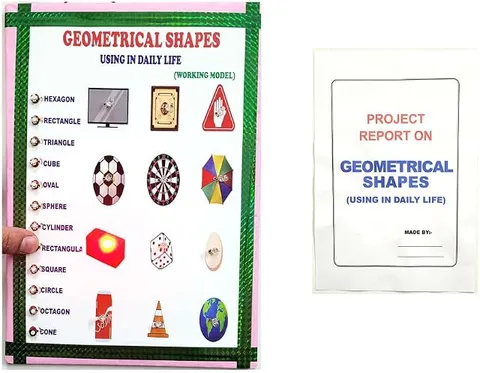
This maths working model is about the surface areas and volumes of solid geometrical shapes, the kind of solids, such as cubes, cylinders, cones and spheres, that students meet in school geometry. It helps a student show where each formula comes from and why area is measured in square units while volume is measured in cubic units.
How it works
The science behind it
The idea the model demonstrates, in words you can use in your report and when you explain it.
Surface area is the total area of all the faces of a solid, measured in square units, while volume is the space it occupies, measured in cubic units. For a cube of side a, surface area is 6a² and volume is a³. For a cuboid, surface area is 2(lb + bh + hl) and volume is l × b × h. A cylinder of radius r and height h has curved surface area 2πrh and volume πr²h. A cone with the same base and height holds exactly one third of the cylinder's volume, (1/3)πr²h, and a sphere has surface area 4πr² and volume (4/3)πr³. Curved surface area leaves out the flat ends, while total surface area includes them. Painters charge by the area of the walls, while the capacity of the water tank on your roof depends on its volume: 1 cubic metre holds 1000 litres.
Make it yourself
Make a surface area and volume model yourself
Build your own version from scratch, or use the steps to understand how the ready-made model is put together before you present it.
What you need 8
Step by step 8 steps
Draw the nets of a cube and a cuboid on the grid card, with small tabs on alternate edges.
Cut them out, crease every fold line and tape them so they can open out flat and fold back into a solid.
Count the 1 cm squares on each net and compare the total with the surface area formula.
Make an open cylinder from clear sheet, checking that the rectangle's length equals the circumference of the base circle.
Make a cone with the same base radius and height, using its slant height, found with Pythagoras, as the radius of the sector you cut, and a sector angle of 360° × r ÷ slant height, so its curved edge wraps exactly once round the base.
Fill the cone with rice, level it off, and pour it into the cylinder; count how many cones fill it.
Build a cube from unit cubes to show that volume is the number of unit cubes a solid holds.
Mount everything on the board with each formula and its units beside it: square units for area, cubic units for volume.
Read this first
Safety first
Go through these points before you build or switch anything on. Younger students should do this with an adult.
- Ask an adult to cut thick card or plastic sheet with a cutter.
- Keep rice or sand in a tray to avoid spills, and keep small cubes away from young children.
- Take care with the compass point.
Troubleshooting
If something does not work
The usual problems with this model and how to fix them. Open a problem to see the fix.
The nets do not close neatly
The tabs may be on the wrong edges, or the folds are not creased. Score each fold line lightly with a blunt pencil along a ruler before folding.
The cone does not fill the cylinder in exactly three goes
The cone's height or radius differs from the cylinder's, or the rice was heaped. Remake the cone to match and level each fill.
My counted area does not match the formula
Tabs or part squares were counted. Count only the faces, and measure every side in centimetres.
The cylinder's edges do not meet
The rectangle's length must equal 2πr. Recalculate it and add a small overlap for the tape.
Exhibition day
How to present it
A running order for the exhibition table or the practical, step by step.
Keep a formula card next to each shape and point out which measurements, such as radius, height or slant height, it needs.
Explain the one-third relation: a cone of water must be poured three times to fill a cylinder of the same base and height.
Solve one real problem live, such as the paint needed for a room's four walls or the litres a tank can hold.
Explain curved and total surface area with a tin: the label is the curved surface, and the label plus both lids is the total.
Practice
Viva questions
Practice questions on this model, with short answers. Try each one aloud before you open the answer.
What is the difference between curved surface area and total surface area?
Curved surface area covers only the curved part of a solid, while total surface area also includes the flat faces, such as the two circular ends of a cylinder.
How does the volume of a cone compare with that of a cylinder of the same base and height?
The cone's volume is exactly one third of the cylinder's volume.
If the radius of a sphere is doubled, what happens to its surface area and volume?
The surface area becomes 4 times, because it depends on r², and the volume becomes 8 times, because it depends on r³.
How many litres does a tank of volume 1 cubic metre hold?
It holds 1000 litres, since 1 litre is 1000 cm³ and 1 cubic metre is 1,000,000 cm³.
Project file
Project file outline
The headings of the project file, in order. Give each heading its own section and write it in your own words.
Free ebook: Writing a Science Project FileContents
- Aim: to show how the surface area and volume formulas of common solids are obtained
- Materials
- Difference between surface area and volume, and their units
- Nets of the cube, cuboid and cylinder
- Activity: comparing the volumes of a cone and a cylinder
- Observation table: measured and calculated values
- Real-life uses, such as painting walls and filling water tanks
- Conclusion
Buying checklist
Before you buy
What to check before you order the model.
1Check these first
- Surface areas and volumes come in middle-school and Class 9 and 10 maths; check which solids your class covers before buying.
- Check in the listing whether any parts light up or move and what batteries they need.
- Check whether the solids open out into nets or are fixed, depending on what your teacher wants to see.
- Practise explaining each formula on the model a few days before the exhibition.
- Keep the box so the solids are not crushed.
- Check the delivery date for your PIN code on the marketplace, and order well before the exhibition or practical.
Next steps
Take it further
Ways to turn this model into a bigger investigation or a stronger exhibition entry.
Add a frustum, such as a bucket shape, and a hemisphere, with their formulas.
Compare the surface area of one large cube with the total for the eight small cubes it can be cut into, and link it to why crushed ice melts faster.
Make a combined solid, such as a capsule or a tent, and calculate its total surface area.
Audience
Who it suits
Suits Class 8 to 10 maths exhibitions and classroom revision of surface areas and volumes.
- ClassClass 1 to 9
- SubjectMaths
- TypeReady-made model
Free to read
Free ebooks for this topic
Free PDF ebooks from Gurukul Technicals Institute on the science, the making and the presenting of projects like this one.
- Free PDF ebook
Maths Working Models and Activities
Make maths visible: models for number, geometry, algebra and data
- Free PDF ebook
Your Science Exhibition Guide
Choose a project, build it, present it and answer the judges with confidence
- Free PDF ebook
Writing a Science Project File
How to write the report, from the cover page to the bibliography
- Free PDF ebook
Viva Questions for Science Projects
How to answer examiner questions, with sample questions for popular projects