- Maths
- Ready-made model
- Class 1 to 9
Even and Odd Numbers Working Model
Code B0G2T9X75C
- Paid for and delivered by Amazon. The current price and the delivery date for your PIN code are shown there.
- Sold by Gurukul Technicals Institute, Delhi.
- Need a different topic, a custom version or a school order? Ask on WhatsApp.
In this project guide
Ready-made model
About this model
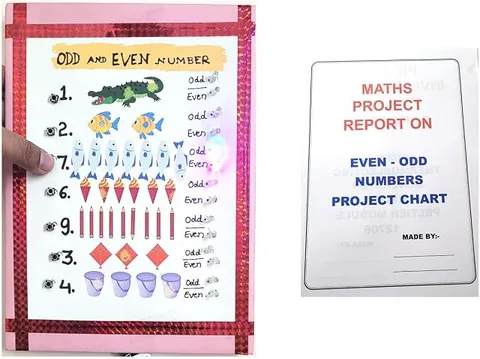
This number-system model is about how whole numbers divide into even and odd numbers, and it leads into the rules for adding and multiplying them. Testing those rules with real numbers, instead of only memorising them, makes it a good fit for a junior maths exhibition or a classroom activity.
What the listing says
- Number System Concept Demonstration
How it works
The science behind it
The idea the model demonstrates, in words you can use in your report and when you explain it.
An even number is a whole number that can be divided by 2 with no remainder, so it can be split into pairs with nothing left over: 0, 2, 4, 6, 8 and so on. An odd number leaves a remainder of 1 when divided by 2: 1, 3, 5, 7, 9. A quick test is the last digit: a number is even if it ends in 0, 2, 4, 6 or 8, however large it is. In algebra, an even number can be written as 2n and an odd number as 2n + 1, where n is a whole number. This explains the rules: even + even = even, odd + odd = even and even + odd = odd, while odd × odd = odd and any number multiplied by an even number gives an even answer. Delhi's odd-even traffic scheme used exactly this last-digit test on car number plates.
Make it yourself
Make an even and odd numbers model yourself
Build your own version from scratch, or use the steps to understand how the ready-made model is put together before you present it.
What you need 9
Step by step 8 steps
Divide the board into three parts: a pairing area, a number strip with contacts, and a rules table.
In the pairing area, draw two columns of circles so counters can be placed side by side in pairs. Explain that a number is even when its counters fill complete pairs with none left over.
Write the numbers 1 to 20 along the number strip, or mix in a few large numbers ending in different digits, and push a paper fastener beside each one.
On the back, join all the even-number fasteners with one wire and all the odd-number fasteners with another wire, keeping the two groups well apart.
Connect the even group through a 470 Ω resistor to the long leg of the green LED, and the odd group the same way to the red LED. Join both short legs to the battery negative.
Connect the probe wire to the battery positive. Touching the probe to any number now lights green for even and red for odd.
Make the rules table with flaps for even + even, odd + odd, even + odd, odd × odd and even × any number, with the answer and an example hidden under each flap.
Label the two LEDs 'Even' and 'Odd' and test every contact before the exhibition.
Read this first
Safety first
Go through these points before you build or switch anything on. Younger students should do this with an adult.
- Fix the battery firmly on the back so the probe cannot touch its terminals and short it.
- Keep a resistor in series with each LED, or the LEDs will burn out.
- Use the cutter only with an adult and bend the fastener legs flat at the back.
- Keep the bottle caps or buttons away from very young children at the exhibition.
Troubleshooting
If something does not work
The usual problems with this model and how to fix them. Open a problem to see the fix.
Both LEDs light for the same number
A wire from the even group is touching the odd group somewhere on the back. Separate the wires and tape each joint.
One LED never lights
That LED is probably the wrong way round, or its resistor or wire has come loose. Turn the LED round or re-make the joint.
The LEDs are very dim
The battery is weak or a joint is poor. Fit a fresh battery and make sure each wire is pressed tightly under its fastener.
Visitors argue about whether zero is even or odd
Zero is even: 0 ÷ 2 = 0 with no remainder, and zero counters leave nothing unpaired. Add a zero card with its own contact on the even line.
Exhibition day
How to present it
A running order for the exhibition table or the practical, step by step.
Invite visitors to pick any two numbers and predict whether their sum will be even or odd before checking.
Use buttons, bindis or counters in pairs to show that an odd number always leaves one item without a partner.
Be ready to explain why zero counts as an even number, since judges often ask this.
Show the addition and multiplication rules in a small table so the pattern is visible at a glance.
Practice
Viva questions
Practice questions on this model, with short answers. Try each one aloud before you open the answer.
Is 0 an even or an odd number?
Zero is even, because 0 ÷ 2 = 0 with no remainder.
What do you get when you add two odd numbers?
Always an even number; for example 7 + 9 = 16, because the two leftover ones join to make a pair.
How can you tell whether 4,58,327 is even or odd without dividing?
Look at the last digit; it ends in 7, so the number is odd.
Can the product of two numbers be odd if one of them is even?
No. If either number is even, the product is even; a product is odd only when both numbers are odd.
Project file
Project file outline
The headings of the project file, in order. Give each heading its own section and write it in your own words.
Free ebook: Writing a Science Project FileContents
- Aim: to show which whole numbers are even and which are odd, and to test the rules for adding and multiplying them
- Introduction: even numbers as complete pairs and odd numbers as pairs plus one
- Materials and construction of the pairing board
- Circuit of the even and odd indicator and how it works
- Rules for sums and products, tested with examples
- Algebraic proof of the rules using 2n and 2n + 1
- Observations: table of numbers tested and results
- Conclusion and bibliography
Buying checklist
Before you buy
What to check before you order the model, and what to do when it arrives.
1Before you order
- Check that the topic suits your class level; even and odd numbers are a junior-class topic, so senior students may need to add the algebra section.
- Read the listing to see what comes with the model and whether a battery or report is mentioned.
- Practise explaining the rules with numbers a visitor chooses, not only the ones printed on the model.
- Keep the box to carry the model to school without bending it.
- Check the delivery date for your PIN code on the marketplace, and order well before the exhibition or practical.
2When it arrives
- Test any lights or contacts as soon as it arrives and again a few days before the exhibition.
Next steps
Take it further
Ways to turn this model into a bigger investigation or a stronger exhibition entry.
Add a large-number test: a sliding window that shows only the last digit of a long number such as 4,57,893.
Prove the rules with algebra, for example 2m + 2n = 2(m + n), and show the proof on a flap.
Add a section showing that the sum of the first n odd numbers is n², using coloured counters.
Show parity in daily life, such as house numbers being even on one side of a street and odd on the other.
Audience
Who it suits
Best for Class 3 to 6 maths exhibitions and number-system lessons, and as a teaching aid for primary teachers.
- ClassClass 1 to 9
- SubjectMaths
- TypeReady-made model
Free to read
Free ebooks for this topic
Free PDF ebooks from Gurukul Technicals Institute on the science, the making and the presenting of projects like this one.
- Free PDF ebook
Maths Working Models and Activities
Make maths visible: models for number, geometry, algebra and data
- Free PDF ebook
Your Science Exhibition Guide
Choose a project, build it, present it and answer the judges with confidence
- Free PDF ebook
Writing a Science Project File
How to write the report, from the cover page to the bibliography
- Free PDF ebook
Viva Questions for Science Projects
How to answer examiner questions, with sample questions for popular projects