- Maths
- Ready-made model
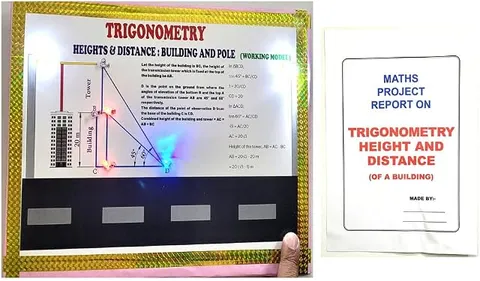
Trigonometry Building & Pole Height and Distance Working Model and Science Teaching Aid Educational Electronic Hobby Kit
Code B0DTY93Z7V
- Paid for and delivered by Amazon. The current price and the delivery date for your PIN code are shown there.
- Sold by Gurukul Technicals Institute, Delhi.
- Need a different topic, a custom version or a school order? Ask on WhatsApp.
In this project guide
Ready-made model
About this model
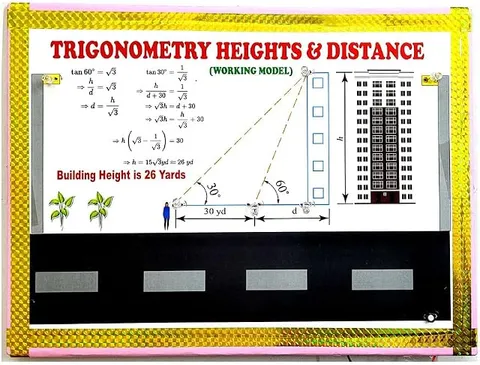
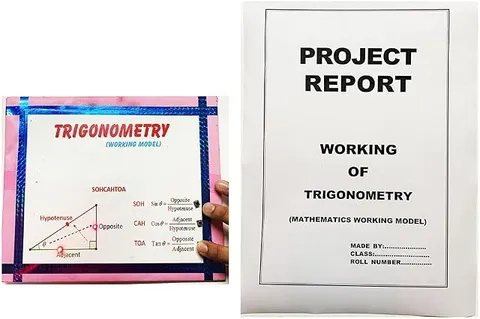
This heights-and-distances model features a building and a pole, as its title says, which makes it a natural fit for the two-object problems of the trigonometry chapter. These use angles of elevation and depression seen from one point to find the height of another object and the distance between them.
How it works
The science behind it
The idea the model demonstrates, in words you can use in your report and when you explain it.
In two-object problems, an observer on top of a building looks up at the top of a pole or tower (angle of elevation) and down at its foot (angle of depression). The angle of depression from the building's top equals the angle of elevation of that top seen from the pole's foot, because the two are alternate angles between parallel horizontal lines. Example: from the top of a 20 m building, the angle of depression of a tower's foot is 45° and the angle of elevation of its top is 30°. The distance between them is 20 ÷ tan 45° = 20 m. The part of the tower above the building's level is 20 × tan 30° = 20/√3 ≈ 11.55 m, so the tower is about 20 + 11.55 = 31.55 m tall. Engineers can use similar sightings from a nearby rooftop to estimate the height of an electricity pole or a mobile tower.
Make it yourself
Make a heights and distances model with a building and a pole yourself
Build your own version from scratch, or use the steps to understand how the ready-made model is put together before you present it.
What you need 9
Step by step 9 steps
Choose a scale and make the building and the pole to exact heights, for example a 15 cm building for 15 m and a 25 cm pole for 25 m.
Fix them on the base a measured distance apart, and mark that distance on the scale between their feet.
Draw a horizontal dashed line from the top of the building towards the pole, using the set square to keep it level.
Fix the protractor at the top of the building with its zero along the dashed line, and pivot the two straw pointers at its centre.
Stretch one thread from the top of the building to the top of the pole and another to its foot, and line the pointers up with them.
Read the angle of elevation of the pole's top and the angle of depression of its foot from the protractor.
Use the building's height and the angle of depression to calculate the distance between them, then the angle of elevation to find how much taller the pole is than the building. Add the building's height to get the pole's height, and compare with the real values.
Mark the equal alternate angles, at the top of the building and at the foot of the pole, in the same colour.
With an adult, use the clinometer in the school ground to find the height of a real flagpole.
Read this first
Safety first
Go through these points before you build or switch anything on. Younger students should do this with an adult.
- Ask an adult to cut the box and the dowel with a cutter or saw.
- Take care with paper fastener points, and with the compass if you draw your own protractor.
- When measuring outdoors, never look towards the sun through the clinometer, and stay well away from roads.
Troubleshooting
If something does not work
The usual problems with this model and how to fix them. Open a problem to see the fix.
My calculated height does not match the model
The protractor's zero may not be level with the horizontal line, or the distance was measured from the wrong point. Measure from foot to foot and level the protractor with a set square.
The thread sags and the angle keeps changing
Tie each thread tightly to pins at both ends so it stays straight.
The pointers will not stay in place
Tighten the paper fastener, or put a small card washer under it to give more friction.
A small reading error gives a big error in height
This happens when the angles are very small or close to 90°. Place the pole where the angles fall roughly between 20° and 60°.
Exhibition day
How to present it
A running order for the exhibition table or the practical, step by step.
Mark the horizontal line from the building's top clearly so the angles of elevation and depression are not mixed up.
Solve the two-angle example step by step on a chart, splitting the tower into two right triangles.
Show why the angle of depression equals the matching angle of elevation, using alternate angles.
Invite the examiner to change one angle and work out the new height quickly.
Practice
Viva questions
Practice questions on this model, with short answers. Try each one aloud before you open the answer.
What is the angle of depression?
It is the angle between the horizontal line through the observer's eye and the line of sight to an object below eye level.
Why is the angle of depression equal to the corresponding angle of elevation?
The two horizontal lines are parallel and the line of sight is a transversal, so the two angles are alternate angles and therefore equal.
If the angle of depression of a pole's foot from the top of a 30 m building is 60°, how far away is the pole?
About 17.32 m, because distance = 30 ÷ tan 60° = 30/√3 = 10√3 m.
Why do we split the tower into two parts in such problems?
The horizontal line from the observer divides the tower into a lower part and an upper part, and each forms its own right triangle with the same horizontal distance.
Project file
Project file outline
The headings of the project file, in order. Give each heading its own section and write it in your own words.
Free ebook: Writing a Science Project FileContents
- Aim: to find the height of a pole and its distance from a building using angles of elevation and depression
- Materials
- Key terms: line of sight, horizontal level, angle of elevation and angle of depression
- Scale diagram of the model
- Calculations using tan
- Observation table: measured and calculated heights and distances
- Sources of error
- Uses in surveying, navigation and construction
- Conclusion
Buying checklist
Before you buy
What to check before you order the model.
1Check these first
- Heights and distances is a Class 10 maths chapter; check that your teacher wants two-object problems, which this model is built around.
- Check in the listing whether angle markings or a scale are included, as you need them to take readings.
- Check in the listing whether any lights or moving parts need batteries.
- Work through your own calculations on the model a few days before the exhibition, so you can explain them confidently.
- Keep the box so the pole and pointers do not bend on the way to school.
- Check the delivery date for your PIN code on the marketplace, and order well before the exhibition or practical.
Next steps
Take it further
Ways to turn this model into a bigger investigation or a stronger exhibition entry.
Put the pole on a sliding track to show how the angles change with distance.
Use a clinometer to sight the school building from two points and calculate its height without knowing the distance.
Add problems that use sine and cosine for slant lengths, such as a ladder or a kite string.
Audience
Who it suits
Suits Class 10 maths exhibitions and board-exam practice on heights and distances, including two-angle problems.
- SubjectMaths
- TypeReady-made model
Free to read
Free ebooks for this topic
Free PDF ebooks from Gurukul Technicals Institute on the science, the making and the presenting of projects like this one.
- Free PDF ebook
Maths Working Models and Activities
Make maths visible: models for number, geometry, algebra and data
- Free PDF ebook
Your Science Exhibition Guide
Choose a project, build it, present it and answer the judges with confidence
- Free PDF ebook
Writing a Science Project File
How to write the report, from the cover page to the bibliography
- Free PDF ebook
Viva Questions for Science Projects
How to answer examiner questions, with sample questions for popular projects