- Biology
- Ready-made model
- Printed report included
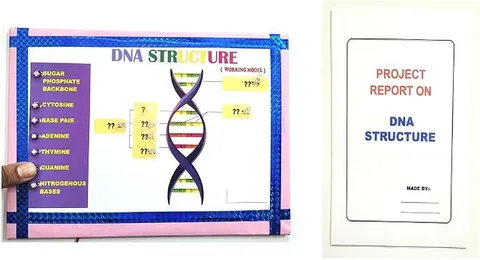
DNA Sequencing Structure Educational Biology Chemistry Science Working Project Model with Report
Code B0DK26M8NW
- Paid for and delivered by Amazon. The current price and the delivery date for your PIN code are shown there.
- Sold by Gurukul Technicals Institute, Delhi.
- Need a different topic, a custom version or a school order? Ask on WhatsApp.
In this project guide
Ready-made model
About this model
This model shows the double helix structure of DNA, the molecule that carries genetic information in almost every living thing. Students can use it to point out the two twisted strands, the sugar-phosphate backbone and the base pairs that hold the strands together. The listing says a project report is included, which helps when writing up the exhibit.
How it works
The science behind it
The idea the model demonstrates, in words you can use in your report and when you explain it.
DNA (deoxyribonucleic acid) is made of two long strands wound around each other in a double helix, a structure proposed by James Watson and Francis Crick in 1953 using X-ray images taken by Rosalind Franklin. Each strand has a backbone of alternating deoxyribose sugar and phosphate groups. Attached to each sugar is one of four nitrogenous bases: adenine (A), thymine (T), guanine (G) or cytosine (C). The bases pair in a fixed way, A with T through two hydrogen bonds and G with C through three, so the two strands are complementary and run in opposite directions. The order of bases along a strand is the genetic code, and DNA sequencing means reading that order. Because parts of this order differ from person to person, DNA fingerprinting can compare samples, a method forensic labs in India use in criminal and paternity cases.
Make it yourself
Make a rotating DNA double helix model yourself
Build your own version from scratch, or use the steps to understand how the ready-made model is put together before you present it.
What you need 9
Step by step 8 steps
Thread each backbone wire with beads, alternating sugar and phosphate, so each strand has 20 sugars. Bend the wire ends over so the beads cannot slip off.
- Prepare 20 rungs
Colour half of each straw for one base and the other half for its partner, always A with T and G with C. Mix the order along the ladder and write down your sequence.
Lay the two strands side by side and fix each rung between a sugar bead on one strand and the facing sugar bead on the other; in real DNA the bases join to the sugars, never to the phosphates.
Mark one end of each strand 5′ and the other end 3′, with the two strands pointing in opposite directions, because the strands of DNA are antiparallel.
When every rung is fixed, twist the ladder gently into a right-handed helix, with about ten rungs to each full turn as in real DNA.
Tie the helix to the central rod at several points so it keeps its shape.
Fix the rod to the motor shaft through the base so the model turns slowly, with the battery and switch on the base.
Add the colour key, showing that A–T pairs are held by two hydrogen bonds and G–C pairs by three, and label the backbone, a base pair and the major and minor grooves.
Read this first
Safety first
Go through these points before you build or switch anything on. Younger students should do this with an adult.
- Bend over or cover all wire ends so they cannot scratch anyone.
- Cut skewers with an adult and blunt their points.
- Use hot glue only with an adult, and let it cool before touching.
- Keep the beads away from young children, who might swallow them.
Troubleshooting
If something does not work
The usual problems with this model and how to fix them. Open a problem to see the fix.
The helix untwists or sags
The wire is too soft. Use thicker wire, and tie the helix to the central rod at more points.
The model wobbles as it turns
The rod is not centred on the motor shaft, or the helix is heavier on one side. Re-centre the rod and spread the rungs evenly.
The rungs keep falling off
Glue alone holds poorly on beads. Tie each rung to its sugar bead with thin wire as well as gluing it.
Visitors ask which way the helix should twist
Real DNA is right-handed: curl the fingers of your right hand along the strands and your thumb points along the axis the way the helix climbs.
Exhibition day
How to present it
A running order for the exhibition table or the practical, step by step.
Start by tracing one base pair from backbone to backbone and name the bonds that hold it.
Keep a small chart of the A-T and G-C pairing rule beside the model so judges can check any rung.
Explain the difference between a gene and the whole DNA molecule in one simple line.
Mention one real use of DNA sequencing, such as diagnosing genetic diseases or DNA fingerprinting.
Practice
Viva questions
Practice questions on this model, with short answers. Try each one aloud before you open the answer.
Who proposed the double helix model of DNA?
James Watson and Francis Crick proposed it in 1953, using X-ray diffraction data from Rosalind Franklin and Maurice Wilkins.
Which bases pair with each other in DNA?
Adenine pairs with thymine through two hydrogen bonds, and guanine pairs with cytosine through three hydrogen bonds.
What is the backbone of a DNA strand made of?
It is made of alternating deoxyribose sugar and phosphate groups, with a base attached to each sugar.
What does DNA sequencing tell us?
It tells us the exact order of the bases A, T, G and C in a DNA molecule, which is how genes are read and compared.
Project file
Project file outline
The headings of the project file, in order. Give each heading its own section and write it in your own words.
The listing includes a printed project report: use this outline to check that your own file covers every part.
Free ebook: Writing a Science Project FileContents
- Aim: to show the double helix structure of DNA and the rules of base pairing
- Introduction: DNA as the genetic material
- Discovery of the double helix: Watson, Crick, Franklin and Wilkins
- Structure of a nucleotide: deoxyribose sugar, phosphate group and nitrogenous base
- Base pairing (A–T and G–C), hydrogen bonds and antiparallel strands
- How complementary pairing lets DNA copy itself during replication
- DNA sequencing: reading the order of bases along a strand
- Uses of DNA knowledge: DNA fingerprinting, genetic testing and the Human Genome Project
- Construction of the rotating model and conclusion
Buying checklist
Before you buy
What to check before you order the model, and what to do when it arrives.
1Before you order
- Check that DNA structure suits your class syllabus and what your teacher has asked for.
- The listing mentions a project report; read it and check that it covers what your textbook expects.
- Check that the model has a colour key for the four bases, and make your own if it does not.
- Check the delivery date for your PIN code on the marketplace, and order well before the exhibition or practical.
- The project report is a learning aid. Read it, understand how the model works, and write your own observations; schools expect your own work.
- Practise explaining it. Judges ask what the model shows and why; knowing the science matters as much as the model. The viva questions above are a good place to start.
2When it arrives
- Look it over for loose parts when it arrives, and keep the box to carry it upright.
Next steps
Take it further
Ways to turn this model into a bigger investigation or a stronger exhibition entry.
Extract DNA from a banana or strawberry with salt, washing-up liquid and ice-cold rubbing alcohol, with an adult, and show it in a small jar beside the model.
Show replication by unzipping part of the model and adding new complementary rungs of a different colour.
Add a short single strand of RNA beside the model, using uracil in place of thymine, and explain the differences.
Audience
Who it suits
Suits Class 10 and Class 12 biology projects on heredity and the molecular basis of inheritance, and also works as a classroom teaching aid.
- SubjectBiology
- TypeReady-made model
- Project reportPrinted report included
Free to read
Free ebooks for this topic
Free PDF ebooks from Gurukul Technicals Institute on the science, the making and the presenting of projects like this one.
- Free PDF ebook
Safe Chemistry Projects for School
Experiments and models with kitchen materials and proper safety
- Free PDF ebook
Biology Models Guide
Make the heart, lungs, kidney, eye, cell and more, and explain them well
- Free PDF ebook
Your Science Exhibition Guide
Choose a project, build it, present it and answer the judges with confidence
- Free PDF ebook
Writing a Science Project File
How to write the report, from the cover page to the bibliography