- Physics
- Ready-made model
- Class 10 to 12
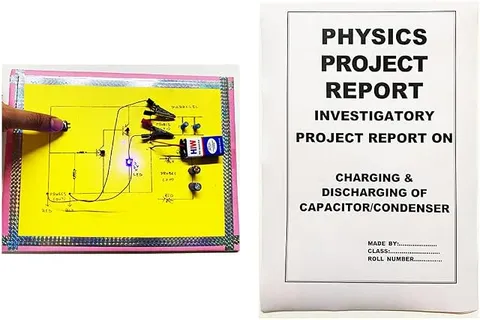
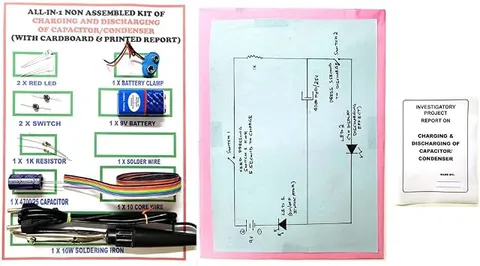
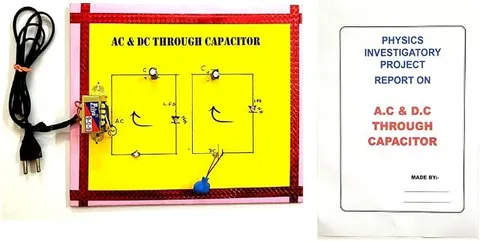
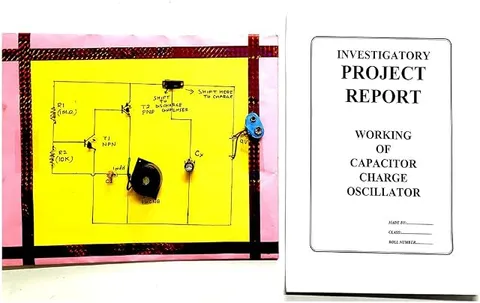
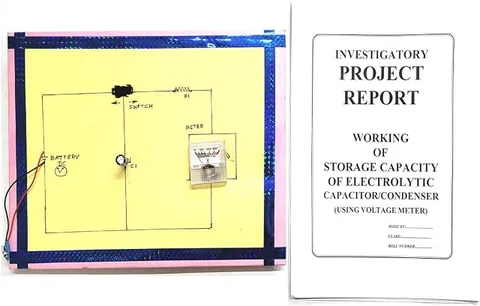
Storage Capacity of Electrolytic Capacitor Using Voltmeter Physics Working Model Educational Investigatory Project
Code B0C3H4SL81
- Paid for and delivered by Amazon. The current price and the delivery date for your PIN code are shown there.
- Sold by Gurukul Technicals Institute, Delhi.
- Need a different topic, a custom version or a school order? Ask on WhatsApp.
In this project guide
Ready-made model
About this model
This investigatory model studies how an electrolytic capacitor stores electric charge, using a voltmeter to watch the voltage across it as it charges and then holds or loses that charge. It is a good choice for a measurement-based project on capacitance and stored energy.
How it works
The science behind it
The idea the model demonstrates, in words you can use in your report and when you explain it.
A capacitor stores electric charge on two conducting plates separated by an insulator called a dielectric. The charge stored is Q = C × V, where C is the capacitance in farads and V is the voltage. An electrolytic capacitor gets its large capacitance from an extremely thin oxide layer used as the dielectric. Because that layer forms in one direction only, the capacitor is polarised: its positive lead must go to the higher voltage, or it can be damaged. The energy stored is E = ½ × C × V². For example, a 1000 µF capacitor charged to 9 V holds Q = 0.001 × 9 = 0.009 C and E = ½ × 0.001 × 81 ≈ 0.04 J. Once disconnected, a voltmeter across the capacitor shows the voltage slowly falling, because charge leaks away through the dielectric and through the voltmeter itself. A camera flash charges a capacitor and then releases its energy in one burst.
Make it yourself
Make a capacitor charge storage experiment with a voltmeter yourself
Build your own version from scratch, or use the steps to understand how the ready-made model is put together before you present it.
What you need 10
Step by step 9 steps
Mount the three capacitors on the board with their negative legs on a common negative strip, and label each with its capacitance.
Join each capacitor's positive leg to one position of the selector, and the selector's common terminal to the middle terminal of the SPDT switch.
Connect one end of the SPDT switch to the battery positive through the 1 kΩ resistor (charge), and the other end to the LED and its 470 Ω resistor going to negative (discharge).
Connect the voltmeter between the selector's common terminal and the negative strip, so it always shows the voltage on the capacitor in use.
Select 470 µF, switch to charge and watch the voltage climb to nearly the battery voltage. Write down the final reading.
Switch to discharge and time how long the LED stays clearly lit. Repeat for 1000 µF and 2200 µF.
Work out the stored charge Q = C × V and the energy E = ½ × C × V² for each capacitor, and compare them with the LED glow times.
Charge the 2200 µF capacitor, put the switch in its centre-off position and note the voltage every minute for ten minutes to see how well it holds its charge.
Repeat the charge and discharge test using the four AA cells (about 6 V) to see how the stored energy depends on voltage.
Read this first
Safety first
Go through these points before you build or switch anything on. Younger students should do this with an adult.
- Connect the long (positive) leg of each capacitor to the positive side, and use capacitors rated well above 9 V; a reversed or overloaded electrolytic can bulge or burst.
- Discharge each capacitor through the LED and resistor before handling it, and never short its leads with a screwdriver or wire, which causes sparks and damages it.
- Use only the 9 V battery or AA cells for this experiment.
- If a capacitor ever gets warm or bulges, disconnect it at once and replace it.
Troubleshooting
If something does not work
The usual problems with this model and how to fix them. Open a problem to see the fix.
The voltage never reaches 9 V
Measure the battery itself: a used 9 V battery often reads well under 9 V. Use the battery's actual voltage in your calculations, and fit a fresh battery for the final readings.
The LED only flashes briefly
The capacitor is small or the LED resistor lets the charge out quickly. That is part of the result; for a longer, dimmer glow that is easier to time, use a 1 kΩ resistor with the LED for all three capacitors.
The voltage falls even with the switch off
Electrolytic capacitors leak a little, and the voltmeter itself draws a tiny current. This is normal, so record it as self-discharge. A capacitor that has not been used for a long time leaks more until it has been charged for a few minutes.
The results do not match the marked capacitance
Electrolytic capacitors often differ from their marked value by 20% or more. Mention the tolerance as a source of error.
Exhibition day
How to present it
A running order for the exhibition table or the practical, step by step.
Charge the capacitor, disconnect the supply and note the voltmeter reading every ten seconds.
Plot voltage against time and explain why the curve falls quickly at first and then more slowly.
Point out the negative marking on the capacitor and explain why polarity matters.
Show a worked example of Q = CV and E = ½CV² on your chart.
Practice
Viva questions
Practice questions on this model, with short answers. Try each one aloud before you open the answer.
What is the relation between charge, capacitance and voltage?
Q = C × V.
Why must an electrolytic capacitor be connected the right way round?
It is polarised, and reversing it can break down the thin oxide dielectric, damaging the capacitor and sometimes making it swell or burst.
What is the SI unit of capacitance?
The farad (F); practical capacitors are usually rated in microfarads (µF).
How does the stored energy depend on voltage?
E = ½ × C × V², so doubling the voltage stores four times the energy.
Project file
Project file outline
The headings of the project file, in order. Give each heading its own section and write it in your own words.
Free ebook: Writing a Science Project FileContents
- Aim: to study how much charge and energy an electrolytic capacitor can store
- Introduction: capacitors, dielectrics and the unit farad
- Theory: Q = C × V and E = ½ × C × V², with a worked example
- Why electrolytic capacitors are polarised
- Circuit diagram of the charge, hold and discharge board
- Observations: final voltage, LED glow time and calculated Q and E for each capacitor
- Self-discharge: voltage against time with the switch off
- Applications: camera flashes, smoothing in power supplies and memory back-up
- Sources of error, precautions and conclusion
Buying checklist
Before you buy
What to check before you order the model, and what to do when it arrives.
1Before you order
- Check that capacitance is in your syllabus and that your teacher wants a measurement-based project.
- Read the listing to see which capacitor values and what meter are used, and what powers the board.
- Practise one calculation of Q and E with your own readings, since examiners often ask for one.
- Keep the box to protect the meter on the way to school.
- Check the delivery date for your PIN code on the marketplace, and order well before the exhibition or practical.
2When it arrives
- Charge and discharge it a few times as soon as it arrives and note the readings, so you know what normal looks like.
Next steps
Take it further
Ways to turn this model into a bigger investigation or a stronger exhibition entry.
Discharge each capacitor through a 10 kΩ resistor, time how long its voltage takes to fall to about 37% of the starting value, and use t = R × C to work out its capacitance.
Explain why the stored energy is ½CV² rather than CV² by finding the area under the Q–V graph.
Compare an electrolytic capacitor with a 5.5 V supercapacitor charged from three AA cells, and discuss why the supercapacitor stores far more energy.
Audience
Who it suits
Class 11 and 12 physics students who need an investigatory project with readings, a graph and calculations on capacitors.
- ClassClass 10 to 12
- SubjectPhysics
- TypeReady-made model
Free to read
Free ebooks for this topic
Free PDF ebooks from Gurukul Technicals Institute on the science, the making and the presenting of projects like this one.
- Free PDF ebook
Physics Working Models Explained
Twenty classic models, how each works and how to make it
- Free PDF ebook
Investigatory Projects for Class 11 and 12
Topics, method and report structure for physics, chemistry and biology
- Free PDF ebook
Your Science Exhibition Guide
Choose a project, build it, present it and answer the judges with confidence
- Free PDF ebook
Writing a Science Project File
How to write the report, from the cover page to the bibliography