- Physics
- Ready-made model
- Class 10 to 12
Bulbs in Series and Parallel Physics Working Model & Educational Investigatory Project
Code B0C3H63THY
- Paid for and delivered by Amazon. The current price and the delivery date for your PIN code are shown there.
- Sold by Gurukul Technicals Institute, Delhi.
- Need a different topic, a custom version or a school order? Ask on WhatsApp.
In this project guide
Ready-made model
About this model
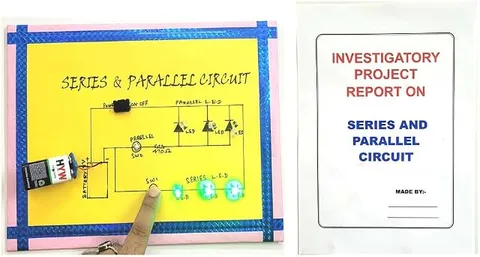
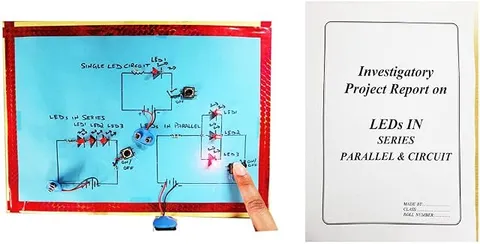
This physics working model compares bulbs connected in series with bulbs connected in parallel. It helps explain the difference in brightness, what happens when one bulb fails, and why houses are wired in parallel.
How it works
The science behind it
The idea the model demonstrates, in words you can use in your report and when you explain it.
In a series circuit, bulbs are connected one after another, so the same current flows through each and the battery voltage is shared between them. The total resistance is the sum: R = R₁ + R₂ + R₃. With more bulbs the resistance rises, the current falls and each bulb glows dimmer; if one bulb fuses, the path is broken and all of them go off. In a parallel circuit, each bulb is connected directly across the battery, so each gets the full voltage and the currents add up. The combined resistance is given by 1/R = 1/R₁ + 1/R₂ + 1/R₃, which is less than the smallest resistance, so the battery supplies more current in total. Each bulb works independently. Homes are wired in parallel so every fan and light gets 230 V and can be switched separately. Some older Diwali serial-light strings were wired in series, which is why one loose bulb could darken the whole string.
Make it yourself
Make a series and parallel bulbs board yourself
Build your own version from scratch, or use the steps to understand how the ready-made model is put together before you present it.
What you need 9
Step by step 8 steps
Fix three bulb holders in a row on the left side of the board for the series circuit, and three on the right side side by side like the rungs of a ladder for the parallel circuit.
- Wire the series circuit
Battery positive to the first switch, then through bulb 1, bulb 2 and bulb 3 one after another, and back to the battery negative.
- Wire the parallel circuit
From the second switch run two long wires (rails), and connect each of the three holders across both rails.
Screw in the bulbs, switch on each side in turn and compare the brightness.
Unscrew one bulb on each side. On the series side all the bulbs go out; on the parallel side the other two stay lit.
Measure the voltage across each bulb and across the battery in both circuits. In series the three bulb voltages add up to the battery voltage; in parallel each bulb gets almost the full battery voltage.
Measure the current from the battery in each circuit by putting the multimeter, on its current range, in series with the switch.
Record the brightness, voltages and currents in a table and add a chart explaining why houses are wired in parallel.
Read this first
Safety first
Go through these points before you build or switch anything on. Younger students should do this with an adult.
- Bulbs get hot after a few minutes, so do not touch them while lit and keep them away from paper.
- Use only cells and bulbs rated for them; never connect these holders or bulbs to a mains socket.
- The parallel circuit draws more current and drains the cells faster, so switch off when not demonstrating.
- Never connect the multimeter on its current range directly across the cells.
Troubleshooting
If something does not work
The usual problems with this model and how to fix them. Open a problem to see the fix.
The series bulbs hardly glow at all
With three in series, each bulb gets only about a third of the voltage and may glow faintly orange. This is the expected result; dim the room so viewers can see it, or show two bulbs in series as well.
One parallel bulb is brighter than the others
The bulbs may not be identical, or one holder may have a loose contact. Swap the bulbs round and tighten the holder screws.
The cells get warm
The two parallel rails are touching somewhere, making a short circuit. Switch off and check that the rails are well apart and insulated.
A bulb does not light in its holder
Screw it in fully, check that the centre contact in the holder is not bent down, and test the bulb in another holder.
Exhibition day
How to present it
A running order for the exhibition table or the practical, step by step.
If the bulbs are removable, take one out of each circuit in turn and let the judges see which side goes dark.
Compare the brightness of the series and parallel bulbs side by side and explain the reason.
Work out the total resistance of two equal bulbs in series and in parallel on a small chart.
Connect the parallel circuit to the wiring in your own house.
Practice
Viva questions
Practice questions on this model, with short answers. Try each one aloud before you open the answer.
Why are household circuits connected in parallel?
So that every appliance gets the full supply voltage and can be switched on or off without affecting the others.
What is the equivalent resistance of two 10 Ω resistors in series and in parallel?
20 Ω in series and 5 Ω in parallel.
Why do bulbs in series glow dimmer than the same bulbs in parallel?
In series the voltage is shared and the total resistance is higher, so less current flows through each bulb.
What happens in a series circuit if one bulb fuses?
The circuit is broken, so the current stops and all the bulbs go off.
Project file
Project file outline
The headings of the project file, in order. Give each heading its own section and write it in your own words.
Free ebook: Writing a Science Project FileContents
- Aim: to compare bulbs connected in series and in parallel
- Introduction: electric current, voltage and resistance
- Series combination: same current, shared voltage
- Parallel combination: same voltage, shared current
- Circuit diagrams and materials used
- Procedure
- Observations: brightness, voltage and current in each circuit
- Why household wiring is done in parallel
- Conclusion
Buying checklist
Before you buy
What to check before you order the model, and what to do when it arrives.
1Before you order
- Check that series and parallel circuits are in your syllabus and suit your class level.
- Read the listing to see what is mentioned with the model and whether cells or batteries are needed.
- Keep a spare bulb or two in case one fails on the day.
- Keep the box to protect the bulbs during transport.
- Check the delivery date for your PIN code on the marketplace, and order well before the exhibition or practical.
- Practise explaining it. Judges ask what the model shows and why; knowing the science matters as much as the model. The viva questions above are a good place to start.
2When it arrives
- Test both circuits as soon as it arrives and again a few days before the exhibition.
Next steps
Take it further
Ways to turn this model into a bigger investigation or a stronger exhibition entry.
Calculate each bulb's resistance from your voltage and current readings, and check the series and parallel formulas for total resistance.
Build a mixed circuit with one bulb in series with two in parallel and predict the brightness before switching on.
Replace the bulbs with LEDs and resistors, and compare the current drawn for similar brightness.
Audience
Who it suits
Suits Class 6 to 10 science exhibitions and practical work on electric circuits and combinations of resistors.
- ClassClass 10 to 12
- SubjectPhysics
- TypeReady-made model
Free to read
Free ebooks for this topic
Free PDF ebooks from Gurukul Technicals Institute on the science, the making and the presenting of projects like this one.
- Free PDF ebook
Electricity and Magnetism Experiments
Hands-on experiments with cells, wires, bulbs and magnets
- Free PDF ebook
Physics Working Models Explained
Twenty classic models, how each works and how to make it
- Free PDF ebook
Investigatory Projects for Class 11 and 12
Topics, method and report structure for physics, chemistry and biology
- Free PDF ebook
Your Science Exhibition Guide
Choose a project, build it, present it and answer the judges with confidence