- Physics
- Ready-made model
- Class 10 to 12
- Printed report included
Simple Electrical Circuit Readymade Science Working Project & Model in Physics for School & College (with Printed Report)
Code B099QZN7H3
- Paid for and delivered by Amazon. The current price and the delivery date for your PIN code are shown there.
- Sold by Gurukul Technicals Institute, Delhi.
- Need a different topic, a custom version or a school order? Ask on WhatsApp.
In this project guide
Ready-made model
About this model
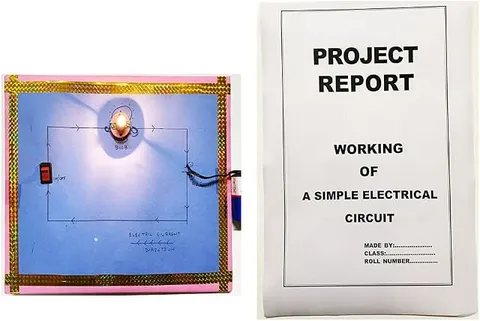
A readymade physics working model of a simple electrical circuit, the starting point of every chapter on electricity. It demonstrates that current flows only through a complete, closed path and lets students explain what a source, a switch and a load each do. The listing says a printed report is included.
How it works
The science behind it
The idea the model demonstrates, in words you can use in your report and when you explain it.
An electric circuit is a closed path through which electric current flows. It needs a source such as a cell or battery, conducting wires, a load such as a bulb, and usually a switch. When the switch is on, the circuit is closed and current flows; when it is off, there is a gap, the circuit is open and no current flows. By convention, current flows from the positive terminal of the cell through the circuit to the negative terminal, though electrons actually move the other way. The current depends on voltage and resistance, as Ohm's law states: V = IR, with V in volts, I in amperes and R in ohms. Metals such as copper are good conductors, while plastic and rubber are insulators, which is why wires are coated in plastic. The switchboard in every Indian home and an ordinary torch work on exactly this idea.
Make it yourself
Make a simple electric circuit board with Ohm's law readings yourself
Build your own version from scratch, or use the steps to understand how the ready-made model is put together before you present it.
What you need 9
Step by step 8 steps
Fix the 3 V cell holder, the switch and the bulb holder on the board in a loop, and join them: positive to the switch, the switch to the bulb, and the bulb back to negative.
- Close the switch
The circuit is complete and the bulb lights. Open it: the gap stops the current and the bulb goes out. Label the two positions 'closed circuit' and 'open circuit'.
Draw red arrows from the positive terminal round the loop for conventional current, and black arrows the other way for the direction electrons actually move.
Measure the voltage across the cells and across the bulb with the multimeter on the DC volts range, placing the probes on either side of each part.
- Measure the current
Open the loop at one point, connect the meter in series with its red lead towards positive, and close the switch. A torch bulb can draw more than the mA range allows, so use the 10 A socket and range for the bulb, and the mA range for the resistors.
Replace the bulb with the 100 Ω resistor and record the voltage and current; repeat with 220 Ω and 470 Ω, and again with the 6 V holder.
Divide the voltage by the current for each resistor (current in amperes) and show that the answer matches the resistor's value; this is Ohm's law, V = IR.
- Add a fault-finding corner
Loosen one wire or turn one cell round, and let visitors work out why the bulb will not light.
Read this first
Safety first
Go through these points before you build or switch anything on. Younger students should do this with an adult.
- Use only cells on this board; never connect it to a socket, an opened adapter or a vehicle battery.
- Never join the two battery terminals with a bare wire; the short circuit makes the wire and cells hot.
- Always connect the meter for current in series with a bulb or resistor, never straight across the cells, which can blow its fuse.
- If a resistor or wire gets hot, open the switch at once and check the connections.
Troubleshooting
If something does not work
The usual problems with this model and how to fix them. Open a problem to see the fix.
The bulb does not light when the switch is on
A cell may be reversed, the bulb may be loose or fused, or a clip may not be gripping. Check each cell's direction, screw the bulb in firmly, and test the bulb on its own across the cells.
The multimeter shows 0 mA
The red lead may be in the volts socket, or the meter's fuse has blown. Move the lead to the current socket for that range (10 A for the bulb, mA for the resistors), make sure the meter is in series, and replace the fuse if it has blown.
V ÷ I does not exactly match the resistor's value
Resistors have a tolerance, often 5%, and meter readings are rounded. Small differences are normal; list them as sources of error.
The bulb glows dimly
The cells are weak or a contact is dirty. Use fresh cells and clean the holder's springs.
Exhibition day
How to present it
A running order for the exhibition table or the practical, step by step.
Break and complete the circuit in front of the judges, and explain open and closed circuits in your own words.
Draw the circuit diagram beside the model, using the standard symbol for each part it uses, such as a cell, switch, bulb or wire.
Prepare a short demonstration of conductors and insulators, for example a steel spoon against a plastic scale.
Revise from the printed report the listing mentions, but answer questions in your own words.
Practice
Viva questions
Practice questions on this model, with short answers. Try each one aloud before you open the answer.
What is an electric circuit?
It is a closed conducting path through which electric current flows from one terminal of the source to the other.
What is the difference between an open and a closed circuit?
In a closed circuit the path is complete and current flows; in an open circuit there is a break, so no current flows.
State Ohm's law.
At constant temperature, the current through a conductor is directly proportional to the potential difference across it, so V = IR.
Why are electric wires covered with plastic?
Plastic is an insulator, so the coating prevents electric shocks and stops bare wires touching and causing a short circuit.
Project file
Project file outline
The headings of the project file, in order. Give each heading its own section and write it in your own words.
The listing includes a printed project report: use this outline to check that your own file covers every part.
Free ebook: Writing a Science Project FileContents
- Aim: to make a simple electric circuit and show that current flows only through a closed path
- Introduction: electric current, potential difference and resistance
- Parts of a circuit and their symbols
- Open and closed circuits
- Conventional current and electron flow
- Observation table: voltage and current for the bulb and three resistors
- Verification of Ohm's law, V = IR
- Electrical safety at home: fuses, switches and insulation
- Conclusion, precautions and bibliography
Buying checklist
Before you buy
What to check before you order the model, and what to do when it arrives.
1Before you order
- Match the project to your class: a simple circuit suits Class 6 to 8, while Class 10 students should add Ohm's law readings to score well.
- Practise drawing the circuit diagram with the correct symbols, which examiners often ask for.
- Keep the box to carry it.
- Check the delivery date for your PIN code on the marketplace, and order well before the exhibition or practical.
2When it arrives
- The listing says a printed report is included; read it when it arrives and add your own measurements and circuit diagram.
- Test the circuit on arrival, and keep spare cells for the exhibition day.
Next steps
Take it further
Ways to turn this model into a bigger investigation or a stronger exhibition entry.
Add a second bulb and compare series and parallel connections, measuring the current in each.
Plot a V–I graph for one resistor and find its resistance from the slope.
Measure the resistance of a bulb when cold and when lit, and explain why a filament does not obey Ohm's law.
Audience
Who it suits
Suits Class 6 to 10 science exhibitions and first practical projects on electricity.
- ClassClass 10 to 12
- SubjectPhysics
- TypeReady-made model
- Project reportPrinted report included
Free to read
Free ebooks for this topic
Free PDF ebooks from Gurukul Technicals Institute on the science, the making and the presenting of projects like this one.
- Free PDF ebook
Electricity and Magnetism Experiments
Hands-on experiments with cells, wires, bulbs and magnets
- Free PDF ebook
Physics Working Models Explained
Twenty classic models, how each works and how to make it
- Free PDF ebook
Your Science Exhibition Guide
Choose a project, build it, present it and answer the judges with confidence
- Free PDF ebook
Writing a Science Project File
How to write the report, from the cover page to the bibliography