- Physics
- Ready-made model
- Class 10 to 12
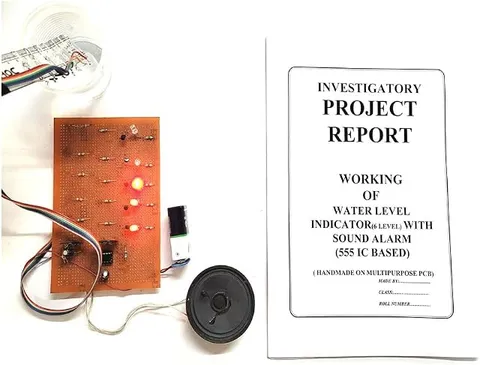
Water Level Indicator 4 Level Physics Working Model Educational Investigatory Project, Multi
Code B0BN2HHGNC
- Paid for and delivered by Amazon. The current price and the delivery date for your PIN code are shown there.
- Sold by Gurukul Technicals Institute, Delhi.
- Need a different topic, a custom version or a school order? Ask on WhatsApp.
In this project guide
Ready-made model
About this model
A physics working model of a four-level water level indicator that signals when water in a tank reaches each of four marked heights. It shows how ordinary water can complete an electric circuit, and it tackles a familiar problem in Indian homes, the overflowing rooftop tank.
How it works
The science behind it
The idea the model demonstrates, in words you can use in your report and when you explain it.
The model relies on the fact that ordinary tap water conducts electricity because it contains dissolved salts that form ions. A common probe sits at the bottom of the tank and four more probes are fixed at different heights. When rising water touches a probe, it completes a small circuit between that probe and the common one. The current through water is tiny, so circuits like this usually use a transistor as a switch: a small base current lets a much larger collector current flow and operate the indicator for that level. As the water rises, the indicators come on one after another; as it falls, they go off in reverse order. Pure distilled water conducts very poorly, so the model works properly only with tap water. Many Indian homes pump water to an overhead tank, and a level indicator tells you when to switch off the motor before the tank overflows.
Make it yourself
Make a four-level water level indicator yourself
Build your own version from scratch, or use the steps to understand how the ready-made model is put together before you present it.
What you need 10
Step by step 8 steps
Fix the long common probe so its tip reaches the bottom of the tank, and the four short probes so their tips sit at one quarter, half, three quarters and full height, keeping them a little apart.
Connect the common probe to the battery's positive through the on/off switch.
Check the transistor's pins in its datasheet; on most BC547s, with the flat face towards you and the legs down, they are collector, base and emitter from left to right.
For each level, connect its probe through a 1 kΩ resistor to the base of its own BC547, the emitter to negative, and the collector to the LED's short leg; the LED's long leg goes through its 470 Ω resistor to positive.
Connect the buzzer in parallel with the full-level LED and its resistor, with the buzzer's positive lead to positive and its negative lead to the fourth transistor's collector.
Mount the four LEDs in a column on the panel box, lowest level at the bottom, and label them 25%, 50%, 75% and Full.
- Fill the tank slowly
As the water reaches each probe it completes that transistor's base circuit through the common probe, and the LED for that level lights. At the top probe the buzzer sounds too.
Pour the water out and watch the LEDs go off one by one as the level falls below each probe.
Read this first
Safety first
Go through these points before you build or switch anything on. Younger students should do this with an adult.
- Use only the 9 V battery. Never fit this model to a real tank or connect it to a pump on the mains; that is a job for an electrician.
- Keep the battery and circuit board above and away from the water, and fill the tank over a tray.
- Use the soldering iron only with an adult, and let the board cool before handling it.
- Do not drink water from the model tank.
Troubleshooting
If something does not work
The usual problems with this model and how to fix them. Open a problem to see the fix.
An LED lights when the tank is empty
Two probe wires are touching, or drops of water are bridging them outside the tank. Dry the probes and separate the wires.
A level LED does not light when the water reaches it
The probe may be coated or corroded, or the water is very pure. Clean the probe with sandpaper and use ordinary tap water, which conducts because of its dissolved salts.
The buzzer is very faint
The battery is weak or the buzzer is not an active type. Use a fresh battery and an active buzzer, which beeps when connected straight to a battery.
The probes turn dark after a few days
Direct current through water slowly corrodes metal by electrolysis. Use stainless steel probes, switch off when the model is not in use, and clean them before the exhibition.
Exhibition day
How to present it
A running order for the exhibition table or the practical, step by step.
Pour water slowly so each level's indicator comes on in turn, and name the level as it does.
Compare a cup of distilled water with a cup of salty water to show that conduction depends on dissolved ions.
If your circuit uses a transistor, explain its job as a switch with a simple labelled diagram.
Talk about saving water and electricity: the pump is switched off in time and no water is wasted.
Practice
Viva questions
Practice questions on this model, with short answers. Try each one aloud before you open the answer.
Why does tap water conduct electricity?
Tap water contains dissolved salts that split into ions, and these moving ions carry the current.
Why do circuits like this usually need a transistor?
The current through water is very small, so a transistor acts as a switch, letting this small current control the larger current the indicator needs.
Would the model work with distilled water?
Hardly, because distilled water has almost no ions and is a very poor conductor.
Why are the probes placed at different heights?
Each probe completes its circuit only when the water reaches its height, so each one marks a separate level.
Project file
Project file outline
The headings of the project file, in order. Give each heading its own section and write it in your own words.
Free ebook: Writing a Science Project FileContents
- Aim: to make an indicator that shows four water levels in a tank and sounds an alarm when it is full
- Introduction: water wasted by overflowing tanks
- Why tap water conducts electricity
- The transistor as a switch
- Circuit diagram and list of components
- Construction of the probes and the indicator panel
- Observations: LEDs lit at each water level while filling and emptying
- Applications and improvements, such as automatic pump control
- Conclusion, precautions and bibliography
Buying checklist
Before you buy
What to check before you order the model, and what to do when it arrives.
1Before you order
- Check whether your teacher wants an investigatory project with a circuit explanation (Class 10 to 12) or a simpler working model.
- Read the listing to see what battery it needs and whether a tank is part of the model, so you can arrange one if not.
- Practise explaining how a transistor switches on when water touches a probe.
- Empty and dry it before packing it in its box.
- Check the delivery date for your PIN code on the marketplace, and order well before the exhibition or practical.
2When it arrives
- Test it with tap water on a tray as soon as it arrives, and dry the probes afterwards.
Next steps
Take it further
Ways to turn this model into a bigger investigation or a stronger exhibition entry.
Add a relay module and a small low-voltage pump that switches off by itself when the tank is full.
Use a microcontroller board to show the level as a percentage on a small display.
Compare tap water, salt water and distilled water with the probes, and explain the differences.
Audience
Who it suits
Suits Class 7 to 10 physics exhibitions and investigatory projects on electricity and conductors.
- ClassClass 10 to 12
- SubjectPhysics
- TypeReady-made model
Free to read
Free ebooks for this topic
Free PDF ebooks from Gurukul Technicals Institute on the science, the making and the presenting of projects like this one.
- Free PDF ebook
Physics Working Models Explained
Twenty classic models, how each works and how to make it
- Free PDF ebook
Investigatory Projects for Class 11 and 12
Topics, method and report structure for physics, chemistry and biology
- Free PDF ebook
Your Science Exhibition Guide
Choose a project, build it, present it and answer the judges with confidence
- Free PDF ebook
Writing a Science Project File
How to write the report, from the cover page to the bibliography