- Physics
- Ready-made model
- Class 10 to 12
Clap Switch Physics Working Model Educational Investigatory Project, Multi
Code B0BN2FQB5K
- Paid for and delivered by Amazon. The current price and the delivery date for your PIN code are shown there.
- Sold by Gurukul Technicals Institute, Delhi.
- Need a different topic, a custom version or a school order? Ask on WhatsApp.
In this project guide
Ready-made model
About this model
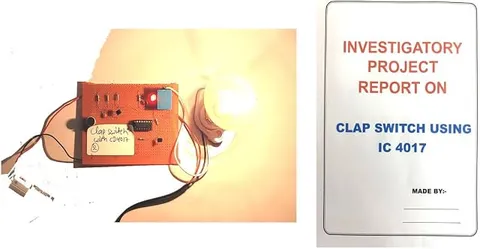
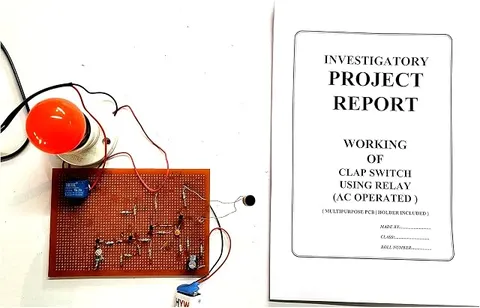
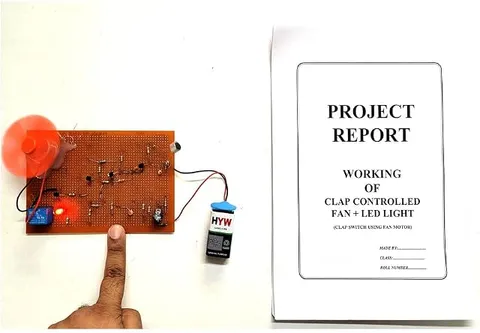
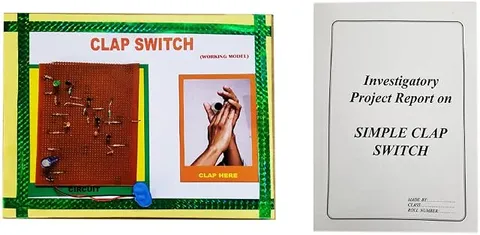
This working model is a clap switch: clap once and a light turns on, clap again and it turns off. It is a fun way to explore the physics of sound, and how a vibration in the air can be picked up and used to control an electric circuit. It suits middle and secondary school exhibitions.
How it works
The science behind it
The idea the model demonstrates, in words you can use in your report and when you explain it.
Sound is produced by vibrating objects. When you clap, your palms suddenly squeeze the air between them, sending out a sound wave made of compressions and rarefactions. Sound is a longitudinal wave: the air particles vibrate back and forth in the same direction in which the wave travels. In air at room temperature it travels at about 343 m/s, so a clap reaches a microphone 1 m away in about 3 milliseconds. The loudness of a sound depends on the amplitude of the wave and is measured in decibels, while its pitch depends on frequency. A clap is ideal for a switch because it is a short, loud burst, a sudden pressure pulse that stands out from steady background sound. At the microphone, the pressure changes make a diaphragm vibrate, turning sound energy into an electrical signal, which the circuit amplifies and uses to toggle the light.
Make it yourself
Make a clap switch yourself
Build your own version from scratch, or use the steps to understand how the ready-made model is put together before you present it.
What you need 9
Step by step 8 steps
Power the microphone through its 10 kΩ resistor from the positive rail, noting that the pad joined to its metal case is the negative one.
Couple the microphone through a 100 nF capacitor to the first transistor, and use two transistor stages so that a sharp clap gives a strong pulse while normal talking gives very little.
Wire one flip-flop of the CD4013 as a toggle: join its Q-bar output to its D input, feed the amplifier's pulse to its clock input, and tie its set and reset pins to the negative rail.
Tie all the inputs of the unused second flip-flop to the negative rail, because floating CMOS inputs make the chip behave unpredictably.
Connect the Q output through a 10 kΩ resistor to the base of the third transistor, which switches the LEDs.
- Power up and clap once
The light should come on; clap again and it should go off.
Stand 1 m away and measure the loudness of a clap, a finger snap, a whistle and a tap on the table with the phone app, and note which of them switch the circuit.
Move back 1 m at a time to find the greatest distance at which a clap still works, and record it in a table.
Read this first
Safety first
Go through these points before you build or switch anything on. Younger students should do this with an adult.
- Use only the 9 V battery; this model is not for switching any mains appliance.
- Do not clap or shout close to anyone's ears while testing.
- Touch a grounded metal object before handling the CD4013, as static can damage CMOS chips.
- Solder only with an adult and let the joints cool before touching them.
Troubleshooting
If something does not work
The usual problems with this model and how to fix them. Open a problem to see the fix.
It switches on and off by itself
The amplifier is picking up noise or an input is floating. Tie every unused CMOS input to a rail, keep the wires short, and lower the gain if it reacts to speech.
One clap switches it on and straight off again
The echo of the clap is giving a second clock pulse. Make the amplifier a little less sensitive, or add a small capacitor at the clock input to slow the pulse, so the echo does not reach the switching level.
Claps do nothing
Check the microphone's polarity and that the flip-flop's set and reset pins are tied to negative. Test the amplifier alone with an LED to see whether it reacts to a clap.
The light is dim
The driver transistor is not fully on or the battery is weak. Check its base resistor and fit a fresh battery.
Exhibition day
How to present it
A running order for the exhibition table or the practical, step by step.
Clap from different distances and show the range at which the switch still responds.
Explain compressions and rarefactions with a slinky or a simple drawing.
Ask a visitor to clap softly and then loudly to show how loudness affects the response.
Suggest real uses, such as switching a light for an elderly person or in a dark room.
Practice
Viva questions
Practice questions on this model, with short answers. Try each one aloud before you open the answer.
What type of wave is sound?
Sound is a longitudinal mechanical wave, made of compressions and rarefactions, that needs a medium to travel.
What is the speed of sound in air?
About 343 m/s at room temperature (around 20 °C), and it increases with temperature.
What decides the loudness of a sound?
The amplitude of the sound wave; a larger amplitude means a louder sound.
How does the microphone help the clap switch work?
It converts the pressure changes of the clap into an electrical signal that the circuit amplifies and uses to switch the light.
Project file
Project file outline
The headings of the project file, in order. Give each heading its own section and write it in your own words.
Free ebook: Writing a Science Project FileContents
- Aim: to make a clap switch and find out which sounds can control it
- Sound as a longitudinal wave: compressions, rarefactions and its speed in air
- Loudness, amplitude and decibels
- How the microphone and amplifier turn a clap into an electrical pulse
- The flip-flop as a memory that changes state on each clap
- Circuit diagram and construction
- Observation tables: different sounds, their loudness and whether they worked; distance tests
- Uses of sound-operated switches, and conclusion
Buying checklist
Before you buy
What to check before you order the model, and what to do when it arrives.
1Before you order
- Check with your teacher that a clap switch suits your class and the chapter on sound or electronics.
- Read the listing for the battery it needs and anything else it mentions; do not assume a battery is included.
- Practise explaining how the sound becomes an electrical signal, because examiners usually ask.
- Keep the box for safe transport.
- Check the delivery date for your PIN code on the marketplace, and order well before the exhibition or practical.
2When it arrives
- When it arrives, test it in a quiet room and in a noisy one, because an exhibition hall is loud.
Next steps
Take it further
Ways to turn this model into a bigger investigation or a stronger exhibition entry.
Plot the measured loudness of a clap against distance and link it to the distance at which the switch stops working.
Add a relay so the clap switch controls a separate low-voltage circuit.
Compare how the switch responds to sounds of different pitch, such as a high whistle and a low hum, and discuss why.
Audience
Who it suits
Class 8 to 10 science exhibitions on sound and simple electronics, and Class 11 physics projects on waves.
- ClassClass 10 to 12
- SubjectPhysics
- TypeReady-made model
Free to read
Free ebooks for this topic
Free PDF ebooks from Gurukul Technicals Institute on the science, the making and the presenting of projects like this one.
- Free PDF ebook
Electricity and Magnetism Experiments
Hands-on experiments with cells, wires, bulbs and magnets
- Free PDF ebook
Physics Working Models Explained
Twenty classic models, how each works and how to make it
- Free PDF ebook
Investigatory Projects for Class 11 and 12
Topics, method and report structure for physics, chemistry and biology
- Free PDF ebook
Your Science Exhibition Guide
Choose a project, build it, present it and answer the judges with confidence