- Physics
- Ready-made model
- Class 10 to 12
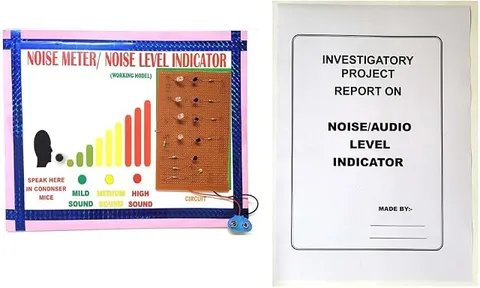
Traffic Noise Level Indicator for Noise Pollution Measurement Physics Educational Investigatory Project for School & Colleges
Code B0DK25M7W9
- Paid for and delivered by Amazon. The current price and the delivery date for your PIN code are shown there.
- Sold by Gurukul Technicals Institute, Delhi.
- Need a different topic, a custom version or a school order? Ask on WhatsApp.
In this project guide
Ready-made model
About this model
This physics investigatory project senses sound and indicates how loud the surroundings are, as a way to study noise pollution near roads, schools and hospitals. It helps students connect the decibel scale with the effects of traffic noise on health.
How it works
The science behind it
The idea the model demonstrates, in words you can use in your report and when you explain it.
Sound is a mechanical wave, and its loudness depends on its intensity, the energy it carries per second through each square metre. Because the ear handles a huge range of intensities, sound level is measured on a logarithmic decibel scale: L = 10 log₁₀(I/I₀) dB, where I₀ = 10⁻¹² W/m² is roughly the faintest sound a person can hear. An increase of 10 dB means ten times the intensity, and about 3 dB means double. A noise indicator uses a microphone to change sound into an electrical signal, and the circuit compares that signal with set levels to show the result. India's noise rules set a daytime limit of 55 dB(A) for residential areas and 50 dB(A) for silence zones around hospitals and schools, while honking at a busy Delhi junction can be much louder. Long exposure to sound of about 85 dB or more can damage hearing.
Make it yourself
Make a traffic noise level indicator yourself
Build your own version from scratch, or use the steps to understand how the ready-made model is put together before you present it.
What you need 10
Step by step 8 steps
On a breadboard, bias the microphone through a resistor from the supply (most electret microphones have one terminal joined to the metal case, which is negative), and couple its signal through a capacitor into an LM358 amplifier with a gain of about 100.
- Add the peak detector
The amplified signal passes through the diode to charge a capacitor, and a resistor across the capacitor lets the level fall again when it is quiet.
Feed the capacitor's voltage into the bar-graph driver's signal input, and set its reference and full-scale with the resistors given in the IC datasheet.
Connect the ten LEDs to the driver's outputs: green for the lowest positions, then yellow, then red at the top.
Test by speaking softly and then loudly near the microphone. Adjust the amplifier's gain resistor until normal speech lights the middle of the bar.
Beside the phone app, note the approximate decibel reading at which each LED lights, and write these marks next to the bar.
When it works, solder the circuit on a board with an adult and mount it behind a road-scene panel with the LED bar showing.
Add a small sign comparing the levels with quiet zones such as hospitals and schools.
Read this first
Safety first
Go through these points before you build or switch anything on. Younger students should do this with an adult.
- Solder only with an adult, keep the hot iron on its stand and work in a ventilated room.
- Insert the ICs the right way round, matching the notch to the socket.
- Do not test the indicator with very loud sounds close to anyone's ears.
- If you record readings near a road, stay on the footpath with an adult and never step into traffic.
Troubleshooting
If something does not work
The usual problems with this model and how to fix them. Open a problem to see the fix.
All the LEDs stay lit all the time
The amplifier gain is too high, or the peak-detector capacitor has no resistor to let it discharge. Lower the gain and check that the discharge resistor is in place.
No LEDs respond to sound
The microphone may be connected the wrong way round or have no bias resistor, or the coupling capacitor may be missing. Check the microphone wiring first.
The LEDs flicker rapidly instead of rising and falling smoothly
The peak-detector capacitor is too small. Try a larger value so the level changes more slowly.
The readings differ from the phone app
Phone apps are only approximate and so is this indicator. Write the marks as rough levels and say in your report that the model shows relative loudness.
Exhibition day
How to present it
A running order for the exhibition table or the practical, step by step.
Explain clearly that a school model indicates noise levels and is not a calibrated sound-level meter.
Demonstrate with a whisper, normal talking and a clap so judges can see the indicator respond step by step.
Show the decibel formula and the Indian daytime limits for different zones on a chart.
Suggest solutions such as no-honking zones, trees along roads and well-maintained silencers.
Practice
Viva questions
Practice questions on this model, with short answers. Try each one aloud before you open the answer.
What is a decibel?
It is a unit of sound level on a logarithmic scale; every rise of 10 dB means the intensity has become ten times larger.
Why is a logarithmic scale used for sound?
The ear can hear sounds whose intensities differ by about a million million times, and a log scale squeezes this range into easy numbers.
Which part of the circuit converts sound into an electrical signal?
The microphone, a transducer that changes variations in sound pressure into a varying voltage.
What is a silence zone?
An area of at least 100 metres around hospitals, educational institutions and courts, where the noise limit is lower than in other zones.
Project file
Project file outline
The headings of the project file, in order. Give each heading its own section and write it in your own words.
Free ebook: Writing a Science Project FileContents
- Aim: to build an indicator that shows the level of traffic noise
- Introduction: sound waves, loudness and intensity
- The decibel scale and typical sound levels
- Noise pollution: sources, effects on health and noise rules in India
- Circuit diagram: microphone, amplifier, peak detector and bar-graph driver
- Construction and calibration of the indicator
- Observations: readings at different places and times
- Ways to control traffic noise
- Conclusion
Buying checklist
Before you buy
What to check before you order the model, and what to do when it arrives.
1Before you order
- Check that noise pollution or sound is an approved investigatory topic for your class.
- Read the listing to see what is mentioned with the project and whether a battery is needed.
- Remember an exhibition hall is noisy, so practise showing the difference between a quiet voice and a clap rather than expecting a calm baseline.
- Keep the box to protect the microphone and circuit.
- Check the delivery date for your PIN code on the marketplace, and order well before the exhibition or practical.
2When it arrives
- Switch it on and test it with your voice soon after it arrives and again a few days before the exhibition.
Next steps
Take it further
Ways to turn this model into a bigger investigation or a stronger exhibition entry.
Survey readings near your home or school at different times, such as morning, rush hour and late evening, and plot them.
Test how much a wall, a row of plants or a closed window lowers the reading, with the same sound source.
Add a buzzer driven by a transistor that sounds when the top red LED lights, as a warning.
Log readings over time with a microcontroller board and draw a graph of a whole day.
Audience
Who it suits
Suits Class 9 to 12 physics and environmental science investigatory projects and college projects on noise pollution.
- ClassClass 10 to 12
- SubjectPhysics
- TypeReady-made model
Free to read
Free ebooks for this topic
Free PDF ebooks from Gurukul Technicals Institute on the science, the making and the presenting of projects like this one.
- Free PDF ebook
Physics Working Models Explained
Twenty classic models, how each works and how to make it
- Free PDF ebook
Investigatory Projects for Class 11 and 12
Topics, method and report structure for physics, chemistry and biology
- Free PDF ebook
Your Science Exhibition Guide
Choose a project, build it, present it and answer the judges with confidence
- Free PDF ebook
Writing a Science Project File
How to write the report, from the cover page to the bibliography