- Physics
- Ready-made model
- Class 10 to 12
- Printed report included
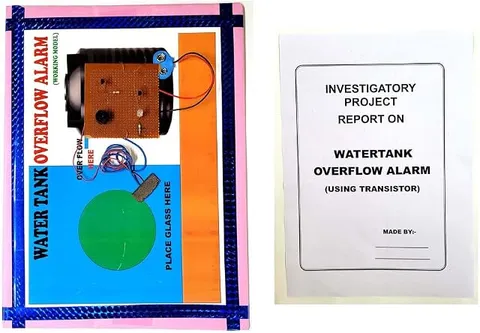
Water Tank Overflow Alarm Siren Indicator Physics Educational Investigatory Project with Report for School & Colleges
Code B0DK238C9N
- Paid for and delivered by Amazon. The current price and the delivery date for your PIN code are shown there.
- Sold by Gurukul Technicals Institute, Delhi.
- Need a different topic, a custom version or a school order? Ask on WhatsApp.
In this project guide
Ready-made model
About this model
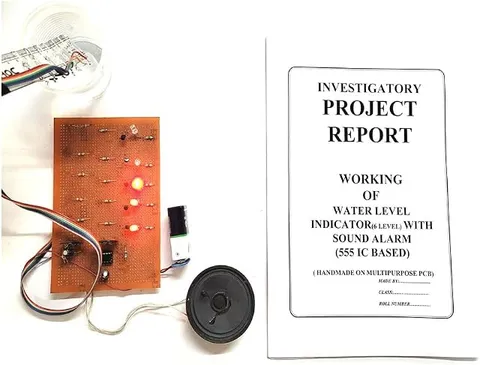
This investigatory project is an overflow alarm that sounds a siren when a water tank becomes full, and the listing says it includes a report. It solves a real household problem, the water and electricity wasted when an overhead tank overflows. That practical use makes it a convincing exhibition piece and a solid physics project.
How it works
The science behind it
The idea the model demonstrates, in words you can use in your report and when you explain it.
Pure distilled water is a poor conductor, but tap water contains dissolved salts that form ions, so it conducts a small current. The alarm uses this. Two metal probes are fixed near the top of the tank. While the water is below them, the gap between the probes is open. When water reaches them, it bridges the gap and a tiny current flows. This current is too small to run a siren directly, so it goes to the base of a transistor, which amplifies it: a small base current controls a much larger collector current, IC = β IB, enough to switch on the siren or buzzer. Using a low-voltage battery keeps the circuit safe. Probes slowly corrode because current through water causes electrolysis, so stainless steel probes are often used. On Indian rooftops, where electric pumps fill overhead tanks, such alarms prevent overflow and save both water and electricity.
Make it yourself
Make a water tank overflow alarm yourself
Build your own version from scratch, or use the steps to understand how the ready-made model is put together before you present it.
What you need 10
Step by step 8 steps
Fix the two probes side by side near the top of the tank, about 1 cm apart, at the level where the alarm should sound.
Connect one probe to the positive terminal of the battery through the switch.
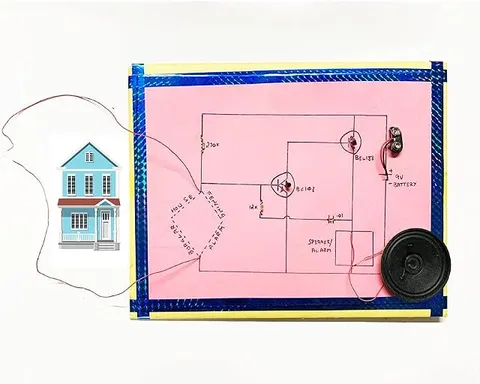
Connect the other probe through the 1 kΩ resistor to the transistor's base, and fit the 100 kΩ resistor from the base to the emitter.
Connect the emitter to the negative terminal, and the buzzer between the positive terminal and the collector, with the buzzer's positive lead towards the battery.
Check the transistor's pin order against its datasheet, because different types differ, then solder the joints with an adult.
Keep the board and the battery outside the tank, well above the water, and run only the probe wires down to the probes.
Switch on and pour tap water slowly into the tank: the siren should sound the moment the water touches both probes.
Repeat with distilled water and with salt water, and note how quickly and how loudly the alarm responds each time.
Read this first
Safety first
Go through these points before you build or switch anything on. Younger students should do this with an adult.
- Use only the 9 V battery; never connect the alarm to a real pump or to anything powered from the mains.
- Keep the board and battery dry and above the water, and dry your hands before touching the switch.
- Do not drink water from the model, as the probes slowly corrode in it.
- Solder only with an adult and let the joints cool before touching them.
Troubleshooting
If something does not work
The usual problems with this model and how to fix them. Open a problem to see the fix.
The siren does not sound when the water reaches the probes
Check the transistor's pin order and the buzzer's polarity, and clean the probes. Very pure water hardly conducts, so test with ordinary tap water.
The siren keeps sounding after the water is poured out
A drop or a wet film is bridging the probes or the board. Dry them, and check that the 100 kΩ resistor from base to emitter is in place.
The sound is weak or crackly
The battery is running down or a joint is loose. Fit a fresh battery and re-solder any dull, grainy joints.
The probes turn dark after a few days
A small current through water slowly corrodes the metal. Use stainless steel probes, clean them before the exhibition and switch off when not in use.
Exhibition day
How to present it
A running order for the exhibition table or the practical, step by step.
Pour water slowly into a glass or small tank and let the siren start as the level reaches the probes.
Compare tap water with distilled water, if available, and explain the difference in conduction.
Explain the role of the transistor with a simple current-amplification diagram.
Mention the water and electricity saved at home as the practical benefit.
Practice
Viva questions
Practice questions on this model, with short answers. Try each one aloud before you open the answer.
Why does tap water conduct electricity?
Because it contains dissolved salts that split into ions, which carry the current.
Why is a transistor needed in this circuit?
The current through the water is very small, so the transistor amplifies it enough to switch on the siren.
Why do the probes corrode over time?
Current passing through water causes electrolysis at the metal probes, which slowly corrodes them.
Can the probes be powered from the mains supply?
No. The probes touch water that people may also touch, so only a safe low-voltage battery supply should be used.
Project file
Project file outline
The headings of the project file, in order. Give each heading its own section and write it in your own words.
The listing includes a printed project report: use this outline to check that your own file covers every part.
Free ebook: Writing a Science Project FileContents
- Aim: to make an alarm that sounds a siren when a water tank is full
- The problem of tank overflow and the water and electricity it wastes
- Why tap water conducts electricity and distilled water hardly does
- The transistor as a switch and as an amplifier
- Circuit diagram and working of the alarm
- Construction and testing of the model
- Observations with tap water, distilled water and salt water
- Uses, limitations and possible improvements
- Conclusion and sources used
Buying checklist
Before you buy
What to check before you order the model, and what to do when it arrives.
1Before you order
- The listing says a report is included; check it against your school's project format and add your own observations.
- Read the listing for the battery the alarm needs and whether one is mentioned; do not assume it is in the box.
- Carry a small bottle of tap water and a cloth on the day, to demonstrate it and dry it afterwards.
- Keep the box for transport so the probe wires are not pulled off.
- Check the delivery date for your PIN code on the marketplace, and order well before the exhibition or practical.
- Practise explaining it. Judges ask what the model shows and why; knowing the science matters as much as the model. The viva questions above are a good place to start.
2When it arrives
- When it arrives, test it with a glass of tap water a few days before the exhibition.
Next steps
Take it further
Ways to turn this model into a bigger investigation or a stronger exhibition entry.
Add a second pair of probes near the bottom with its own transistor and an LED that stays lit while water covers them, so a dark LED warns that the tank is nearly empty.
Replace the buzzer with a 555 timer tone circuit to make a two-tone siren.
Measure the resistance of different water samples with a multimeter and link it to how quickly the alarm responds.
Audience
Who it suits
Class 8 to 12 physics investigatory projects and exhibitions on water conservation and simple electronics.
- ClassClass 10 to 12
- SubjectPhysics
- TypeReady-made model
- Project reportPrinted report included
Free to read
Free ebooks for this topic
Free PDF ebooks from Gurukul Technicals Institute on the science, the making and the presenting of projects like this one.
- Free PDF ebook
Physics Working Models Explained
Twenty classic models, how each works and how to make it
- Free PDF ebook
Investigatory Projects for Class 11 and 12
Topics, method and report structure for physics, chemistry and biology
- Free PDF ebook
Your Science Exhibition Guide
Choose a project, build it, present it and answer the judges with confidence
- Free PDF ebook
Writing a Science Project File
How to write the report, from the cover page to the bibliography