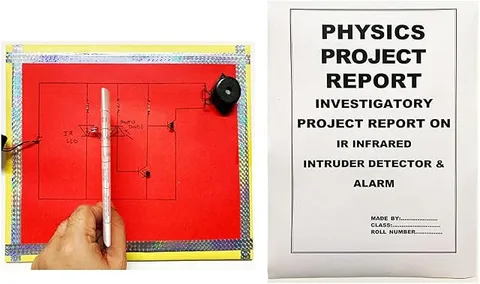
- Physics
- Ready-made model
- Class 10 to 12
- Printed report included
Fence Based Burglar Alarm Readymade Physics Working Investigatory Project & Model for School & College(with Printed Report)
Code B099QZXQ39
- Paid for and delivered by Amazon. The current price and the delivery date for your PIN code are shown there.
- Sold by Gurukul Technicals Institute, Delhi.
- Need a different topic, a custom version or a school order? Ask on WhatsApp.
In this project guide
Ready-made model
About this model
A readymade physics working model of a fence-based burglar alarm that sounds when the protective wire along a boundary is disturbed. It shows how a simple switching circuit can guard a home or farm, and the listing says a printed report is included.
How it works
The science behind it
The idea the model demonstrates, in words you can use in your report and when you explain it.
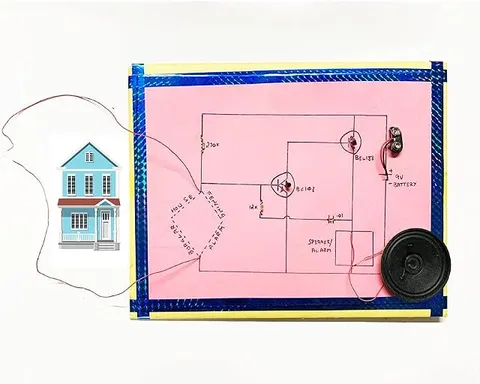
In the common break-wire design, a thin conducting wire runs along the fence and forms part of the circuit. While the wire is unbroken, it connects the base of a transistor to the negative side of the supply, so the base gets almost no current and the transistor stays off; the buzzer is silent. When an intruder cuts or breaks the wire, this short path is lost and current flows into the base through a resistor. A small base current switches the transistor on, letting a much larger collector current flow through the buzzer, which sounds the alarm. This arrangement is called a normally closed loop, and it has a built-in safety advantage: cutting the wire, the most likely way to defeat it, is exactly what triggers it. Here the transistor works purely as a switch. The same idea can protect a farm boundary, a godown or the gate of a house.
Make it yourself
Make a fence-wire burglar alarm yourself
Build your own version from scratch, or use the steps to understand how the ready-made model is put together before you present it.
What you need 10
Step by step 8 steps
Fix the fence posts round the house and cut a small notch at the top of each to hold the wire.
- Solder the circuit
The 22 kΩ resistor from positive to the transistor's base, the emitter to negative, the buzzer's positive lead to positive and its negative lead to the collector. Add the LED with its resistor beside the buzzer, from positive to the collector.
Connect one screw terminal to the base and the other to negative.
Run the thin wire round the fence posts, scrape the enamel off its ends, and clamp them in the two terminals.
- Switch on
The alarm stays silent. The multimeter should show nearly 0 V on the base, because the fence wire connects it to negative.
- Break the fence wire
The buzzer sounds and the LED lights, and they stay on while the wire is broken.
Restring the fence with spare wire before the next demonstration.
Label the house, the fence loop, the circuit board and the battery.
Read this first
Safety first
Go through these points before you build or switch anything on. Younger students should do this with an adult.
- Cut the wire with cutters only with an adult nearby, and keep the fine wire ends away from eyes.
- Solder only with an adult present, and keep the iron in its stand.
- Do not test the buzzer close to anyone's ears.
- Switch off when the model is not being demonstrated.
Troubleshooting
If something does not work
The usual problems with this model and how to fix them. Open a problem to see the fix.
The buzzer sounds even though the fence wire is whole
The enamel may still be on the wire's ends, a terminal may be loose, or the wire may be broken somewhere. Scrape the ends bright and check continuity with a multimeter.
Nothing happens when the wire is cut
Check the transistor's legs, the buzzer's polarity and the battery. With the wire cut, the base should read about 0.7 V.
The buzzer only clicks or is very faint
It may be a passive buzzer, which needs a changing signal, instead of an active one; or the battery is weak. Use an active buzzer and a fresh battery.
The battery runs down even when the alarm is silent
A small current always flows through the 22 kΩ resistor and the fence wire. Switch off between demonstrations.
Exhibition day
How to present it
A running order for the exhibition table or the practical, step by step.
Show the alarm triggering by opening the fence loop in whatever way your model allows, then restore it.
Explain why a normally closed loop is safer than a switch that has to be pressed.
On a chart, draw the transistor stage of the common design: wire intact, transistor off; wire broken, transistor on.
Prepare from the printed report the listing mentions, and add your own idea for an upgrade, such as a warning light.
Practice
Viva questions
Practice questions on this model, with short answers. Try each one aloud before you open the answer.
How does the alarm know the fence wire has been cut?
In the common design, the intact wire keeps the transistor's base at low voltage; when it breaks, current flows into the base and the transistor switches the buzzer on.
What is the role of the transistor in a break-wire alarm?
It acts as a switch, letting a tiny base current control the larger current the buzzer needs.
What is a normally closed circuit?
It is a circuit that is complete in its normal state and triggers an action when it is broken.
Why is the break-wire method hard to defeat?
Cutting or breaking the wire, which an intruder is most likely to do, is exactly what sets off the alarm.
Project file
Project file outline
The headings of the project file, in order. Give each heading its own section and write it in your own words.
The listing includes a printed project report: use this outline to check that your own file covers every part.
Free ebook: Writing a Science Project FileContents
- Aim: to make an alarm that sounds when a wire fence round a property is cut or broken
- Introduction: why homes and farms need boundary security
- Principle: the normally closed loop and the transistor as a switch
- Circuit diagram and its working with the wire whole and with the wire broken
- Construction of the fence, the break-wire and the circuit board
- Observations: base voltage and buzzer state with the wire whole and broken
- Limitations, such as replacing the wire after each alarm, and improvements such as a latching alarm
- Applications: shop shutters, window alarms and farm fences
- Conclusion and bibliography
Buying checklist
Before you buy
What to check before you order the model, and what to do when it arrives.
1Before you order
- Check that a transistor switching project suits your class level and your teacher's instructions.
- The listing mentions a printed report; read it and add your own readings and observations.
- Find out how the model's fence wire is replaced, and keep spare thin wire for repeated demonstrations.
- Check the delivery date for your PIN code on the marketplace, and order well before the exhibition or practical.
- Practise explaining it. Judges ask what the model shows and why; knowing the science matters as much as the model. The viva questions above are a good place to start.
2When it arrives
- Test it as soon as it arrives and keep the box for transport.
Next steps
Take it further
Ways to turn this model into a bigger investigation or a stronger exhibition entry.
Make the alarm latch with an SCR (thyristor), so it keeps sounding even if the wire is joined again, and add a reset switch.
Add a short delay so the owner can switch the alarm off after entering.
Compare a normally closed break-wire alarm with a normally open pressure-mat alarm, and explain which is harder to defeat.
Audience
Who it suits
Suits Class 8 to 12 physics exhibitions and investigatory projects on transistors and security circuits.
- ClassClass 10 to 12
- SubjectPhysics
- TypeReady-made model
- Project reportPrinted report included
Free to read
Free ebooks for this topic
Free PDF ebooks from Gurukul Technicals Institute on the science, the making and the presenting of projects like this one.
- Free PDF ebook
Physics Working Models Explained
Twenty classic models, how each works and how to make it
- Free PDF ebook
Investigatory Projects for Class 11 and 12
Topics, method and report structure for physics, chemistry and biology
- Free PDF ebook
Your Science Exhibition Guide
Choose a project, build it, present it and answer the judges with confidence
- Free PDF ebook
Writing a Science Project File
How to write the report, from the cover page to the bibliography