- Physics
- Ready-made model
- Class 10 to 12
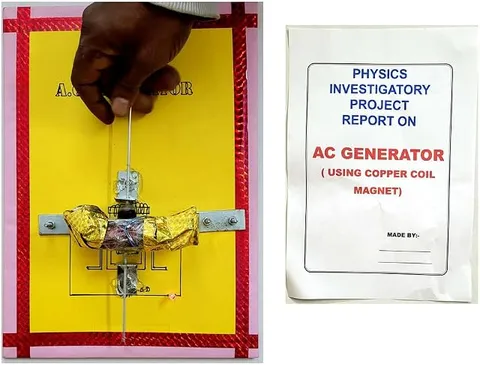
Ontex Electronics AC Generator & Magnetic Generator Physics Investigatory Project Model Engineering College & Science Teaching Aid
Code B0DML1C38F
- Paid for and delivered by Amazon. The current price and the delivery date for your PIN code are shown there.
- Sold by Gurukul Technicals Institute, Delhi.
- Need a different topic, a custom version or a school order? Ask on WhatsApp.
In this project guide
Ready-made model
About this model
This physics model of an AC generator shows how rotating a coil in a magnetic field, or moving a magnet near a coil, produces electricity. It demonstrates electromagnetic induction, the same principle used in the power stations that supply our homes.
How it works
The science behind it
The idea the model demonstrates, in words you can use in your report and when you explain it.
An AC generator works on electromagnetic induction. When a coil of N turns and area A rotates with angular speed ω in a uniform magnetic field B, the magnetic flux through it keeps changing, and by Faraday's law an emf is induced: e = NBAω sin ωt. The emf rises to a peak, falls to zero, reverses and repeats every rotation, so the current is alternating. Slip rings and carbon brushes take this current out without twisting the wires, while a DC dynamo uses a split-ring commutator. Fleming's right-hand rule gives the direction of the induced current, and Lenz's law explains why the coil becomes harder to turn when current is drawn. Moving a magnet in and out of a coil induces a current in the same way. Hydro, thermal and nuclear power stations all use huge generators of this kind, and India's mains supply is 230 V at 50 Hz, meaning 50 cycles every second.
Make it yourself
Make a hand-cranked AC generator yourself
Build your own version from scratch, or use the steps to understand how the ready-made model is put together before you present it.
What you need 9
Step by step 8 steps
Make a hole in the centre of two opposite faces of the box so the axle can pass straight through and turn freely.
Wind several hundred turns of enamelled wire neatly around the box, keeping clear of the axle holes, and tape the coil in place.
Scrape the enamel off the last 2 cm of both wire ends with sandpaper.
Push the axle through the holes and fix the magnets on it inside the box, so their poles sweep past the coil as the axle turns.
Fix the crank wheel on one end of the axle outside the box and mount the box on the base.
Connect the two LEDs side by side facing opposite ways (the long leg of each to the short leg of the other) across the coil ends.
- Turn the crank quickly
The red and green LEDs flash in turn, showing that the current keeps reversing. Turn it slowly with the galvanometer connected and watch the needle swing left and right.
For the moving-magnet demonstration, push the bar magnet into the hollow coil and pull it out again with the galvanometer connected: the needle swings one way, then the other, and further when you move faster.
Read this first
Safety first
Go through these points before you build or switch anything on. Younger students should do this with an adult.
- Neodymium magnets snap together hard and can pinch; handle them one at a time and keep them away from phones and cards.
- Keep fingers clear of the crank and spinning axle.
- The output of this generator is small and safe, but never connect it to a wall socket, a battery or any mains appliance.
- Keep magnets away from young children.
Troubleshooting
If something does not work
The usual problems with this model and how to fix them. Open a problem to see the fix.
The LEDs do not light
The crank may be turning too slowly, the coil may have too few turns, the enamel may still be on the wire ends, or the magnets may be weak or too far from the coil. An LED needs about 2 V, so spin faster and check each point.
Only one LED ever flashes
Both LEDs are facing the same way. Turn one round so each long leg joins the other's short leg.
The axle wobbles and the magnets hit the box
The holes are too large. Fit a short piece of straw in each hole as a bush so the axle runs straight.
The galvanometer moves only one way
You may be moving the magnet in one direction only. Show both pushing in and pulling out, or turn the crank slowly through a full turn.
Exhibition day
How to present it
A running order for the exhibition table or the practical, step by step.
Show that the output grows when the coil turns or the magnet moves faster.
Connect two LEDs facing opposite ways, or a galvanometer, to show the current changing direction.
Draw the sine curve of emf against time and mark one full rotation on it.
Explain the difference between the slip rings of an AC generator and the commutator of a DC machine.
Practice
Viva questions
Practice questions on this model, with short answers. Try each one aloud before you open the answer.
On what principle does an AC generator work?
Electromagnetic induction: a changing magnetic flux through a coil induces an emf in it.
How can the emf of a generator be increased?
By increasing the number of turns, the area of the coil, the strength of the magnetic field or the speed of rotation, since the peak emf is NBAω.
What is the frequency of AC mains in India?
50 Hz, which means the current completes 50 cycles every second.
What is the function of slip rings?
They keep the rotating coil connected to the outer circuit through brushes, so the alternating current can be taken out without the wires twisting.
Project file
Project file outline
The headings of the project file, in order. Give each heading its own section and write it in your own words.
Free ebook: Writing a Science Project FileContents
- Aim: to show how an AC generator produces alternating current by electromagnetic induction
- Introduction: Faraday's law of electromagnetic induction
- Principle and parts of an AC generator: armature, field magnets, slip rings and brushes
- Fleming's right-hand rule and Lenz's law
- Construction of the hand-cranked model
- Observations: effect of speed, number of turns and magnet strength
- Difference between an AC generator and a DC dynamo
- Uses: power stations, bicycle dynamos and wind turbines
- Conclusion
Buying checklist
Before you buy
What to check before you order the model, and what to do when it arrives.
1Before you order
- Check that electromagnetic induction is in your syllabus or approved by your teacher as a project topic.
- Read the listing to see what is mentioned with the model, such as a report or an output indicator.
- Practise turning at a steady speed while you explain, since the light depends on how fast you turn.
- Keep the box and keep the magnets away from phones in transit.
- Check the delivery date for your PIN code on the marketplace, and order well before the exhibition or practical.
2When it arrives
- Try it as soon as it arrives by turning it and watching for the light or meter movement.
Next steps
Take it further
Ways to turn this model into a bigger investigation or a stronger exhibition entry.
Build a version where the coil turns between fixed magnets, with slip rings and brushes made from copper strips.
With your teacher, view the output on the school oscilloscope to see the alternating wave.
Add four diodes as a bridge rectifier and a capacitor to turn the output into DC.
Fit cardboard blades and drive the generator with a table fan to model a wind turbine.
Audience
Who it suits
Suits Class 12 physics investigatory projects on electromagnetic induction, Class 10 science fairs, and polytechnic or engineering teaching labs.
- ClassClass 10 to 12
- SubjectPhysics
- TypeReady-made model
Free to read
Free ebooks for this topic
Free PDF ebooks from Gurukul Technicals Institute on the science, the making and the presenting of projects like this one.
- Free PDF ebook
Electricity and Magnetism Experiments
Hands-on experiments with cells, wires, bulbs and magnets
- Free PDF ebook
Physics Working Models Explained
Twenty classic models, how each works and how to make it
- Free PDF ebook
Investigatory Projects for Class 11 and 12
Topics, method and report structure for physics, chemistry and biology
- Free PDF ebook
Your Science Exhibition Guide
Choose a project, build it, present it and answer the judges with confidence