- Physics
- Ready-made model
- Class 10 to 12
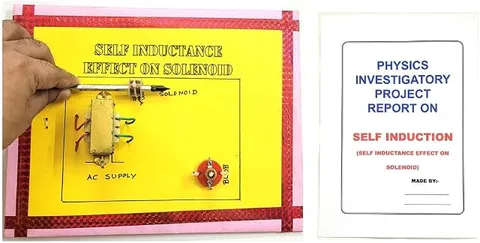
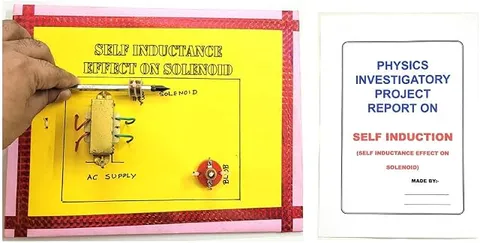
Ontex Electronics Self Induction Inductance Effect on Solenoid Physics Investigatory Project Model Engineering College & Science Teaching Aid
Code B0DML22J2J
- Paid for and delivered by Amazon. The current price and the delivery date for your PIN code are shown there.
- Sold by Gurukul Technicals Institute, Delhi.
- Need a different topic, a custom version or a school order? Ask on WhatsApp.
In this project guide
Ready-made model
About this model
This working model demonstrates self-induction, where a coil opposes any change in the current flowing through it. It makes an abstract Class 12 idea visible, showing how a solenoid's inductance affects a circuit and why an iron core makes the effect stronger.
How it works
The science behind it
The idea the model demonstrates, in words you can use in your report and when you explain it.
When the current in a coil changes, the magnetic flux linked with the coil itself changes, and an EMF is induced in the same coil. By Lenz's law this EMF opposes the change, so it is called a back EMF. Its size is e = −L (dI/dt), where L is the self-inductance, measured in henry. For a long air-cored solenoid, L = μ₀N²A/l, so more turns, a larger area and a shorter length increase L, and a soft iron core multiplies it by the core's relative permeability. In an AC circuit, a coil's opposition to current is its inductive reactance, XL = 2πfL. A common demonstration puts a bulb in series with the solenoid on AC: sliding an iron rod into the coil raises L, and the bulb dims. Older tube lights in Indian homes used a choke, a coil whose self-induced voltage, when the starter broke the circuit, helped strike the tube.
Make it yourself
Make a self-induction solenoid model yourself
Build your own version from scratch, or use the steps to understand how the ready-made model is put together before you present it.
What you need 8
Step by step 8 steps
Wind the enamelled wire in neat, close layers along the tube in one direction until most of the wire is used, counting the turns as you go.
Scrape the enamel off both ends and fix them to two screw terminals on the base.
Connect the coil, the bulb and the switch in series, with two terminals for the supply.
Connect the 9 V battery first and note the bulb's brightness with the core out and then in; on steady DC it hardly changes.
Disconnect the battery. Ask an adult to connect the low-voltage AC adapter to the supply terminals and plug it in.
Note the brightness with no core, then slide the iron core in slowly: the bulb dims as the coil's inductance and its opposition to AC rise.
Pull the core out again and watch the bulb brighten, recording the current with the multimeter at each core position.
Unplug the adapter and measure the coil's DC resistance, to show that the dimming on AC is not caused by resistance alone.
Read this first
Safety first
Go through these points before you build or switch anything on. Younger students should do this with an adult.
- Only a ready-made low-voltage AC adapter is used, plugged in and switched on by an adult; students never wire anything to mains.
- Unplug the adapter before changing any connection or moving the coil.
- The coil and bulb can get warm after a few minutes; switch off between sets of readings.
- Scrape the wire ends away from your eyes and wash your hands afterwards.
Troubleshooting
If something does not work
The usual problems with this model and how to fix them. Open a problem to see the fix.
The bulb does not dim when the core goes in
The supply may be DC; many adapters give DC, so check the label says AC output. Too few turns or a thin core also weakens the effect, so add turns or more iron rods.
The bulb does not light at all on AC
Check the coil for continuity with the multimeter and that both ends are scraped bare. A coil with very many turns may allow the bulb to glow only with the core out, so start there.
The bulb flickers
A loose terminal or a poorly scraped wire end is the usual cause; tighten and re-scrape it.
The coil gets hot quickly
The wire may be too thin for the current, or turns are shorted where the enamel is scratched. Switch off, let it cool, and rewind if needed.
Exhibition day
How to present it
A running order for the exhibition table or the practical, step by step.
If your model has a movable core, show the effect of inserting and removing it, and explain why the output changes.
Write e = −L dI/dt on your chart and explain what the minus sign means.
Explain the tube light choke as a real example of self-induction.
Keep any mains-powered setup enclosed, and let only a teacher switch it on.
Practice
Viva questions
Practice questions on this model, with short answers. Try each one aloud before you open the answer.
What is self-induction?
It is the production of an induced EMF in a coil due to a change in the current flowing through the same coil.
What is the SI unit of self-inductance?
The henry (H); a coil has an inductance of 1 H if a current changing at 1 A per second induces 1 V in it.
Why does inserting an iron core increase inductance?
Iron has a high relative permeability, so it greatly increases the magnetic flux linked with the coil for the same current.
What is the inductive reactance of a coil?
It is the opposition offered by an inductor to AC, given by XL = 2πfL.
Project file
Project file outline
The headings of the project file, in order. Give each heading its own section and write it in your own words.
Free ebook: Writing a Science Project FileContents
- Aim: to study how the self-inductance of a solenoid affects a bulb in an AC circuit
- Self-induction, back emf and Lenz's law
- What decides inductance: number of turns, area, length and core material
- Construction of the solenoid and circuit diagram
- Observation table: core position, bulb brightness and current
- The same circuit on DC and on AC compared
- Uses: chokes, filters and the inductance of motor windings
- Precautions, and errors in judging bulb brightness by eye
- Conclusion: how an iron core changes a coil's opposition to AC
Buying checklist
Before you buy
What to check before you order the model.
1Check these first
- Check in the listing what power source the model uses; if it needs AC, an adult must provide and connect a low-voltage AC adapter.
- Confirm with your teacher that it suits the Class 12 chapter on electromagnetic induction.
- Test it at home well before the exhibition, with an adult present, and note the brightness change for your file.
- Keep the iron core and loose parts in a bag, and keep the box for transport.
- Check the delivery date for your PIN code on the marketplace, and order well before the exhibition or practical.
- Practise explaining it. Judges ask what the model shows and why; knowing the science matters as much as the model. The viva questions above are a good place to start.
Next steps
Take it further
Ways to turn this model into a bigger investigation or a stronger exhibition entry.
Work out the coil's impedance from your AC voltage and current readings, allow for the bulb's resistance, and estimate its inductance.
Compare cores of iron, brass and aluminium and explain why only iron raises the inductance a lot.
Wind a second coil with half the turns and compare the dimming, linking it to inductance rising with the square of the number of turns.
Audience
Who it suits
Suits Class 12 physics investigatory projects on electromagnetic induction and engineering college electrical labs.
- ClassClass 10 to 12
- SubjectPhysics
- TypeReady-made model
Free to read
Free ebooks for this topic
Free PDF ebooks from Gurukul Technicals Institute on the science, the making and the presenting of projects like this one.
- Free PDF ebook
Electricity and Magnetism Experiments
Hands-on experiments with cells, wires, bulbs and magnets
- Free PDF ebook
Physics Working Models Explained
Twenty classic models, how each works and how to make it
- Free PDF ebook
Investigatory Projects for Class 11 and 12
Topics, method and report structure for physics, chemistry and biology
- Free PDF ebook
Your Science Exhibition Guide
Choose a project, build it, present it and answer the judges with confidence