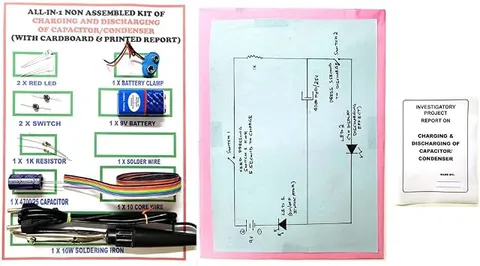
- Physics
- Ready-made model
- Class 10 to 12
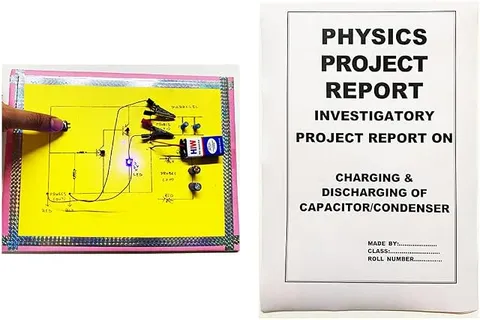
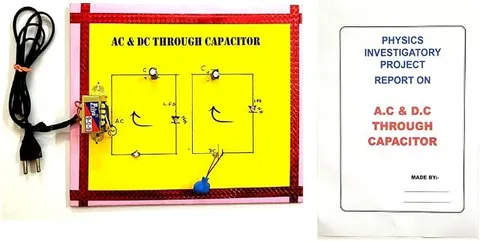
Ontex Electronics AC & DC Through Capacitor Physics Investigatory Project Model Engineering College & Science Teaching Aid
Code B0DMKZJTFW
- Paid for and delivered by Amazon. The current price and the delivery date for your PIN code are shown there.
- Sold by Gurukul Technicals Institute, Delhi.
- Need a different topic, a custom version or a school order? Ask on WhatsApp.
In this project guide
Ready-made model
About this model
This investigatory project model shows how differently a capacitor behaves with DC and with AC: it blocks steady DC but allows AC to pass. It turns a surprising textbook statement into something a student can demonstrate and explain. It suits Class 12 physics projects on alternating current and engineering teaching labs.
How it works
The science behind it
The idea the model demonstrates, in words you can use in your report and when you explain it.
A capacitor is two conducting plates separated by an insulator, so no charge actually crosses between them. With a DC source, current flows only for the short time the capacitor takes to charge; once its voltage equals the supply, the current stops, and in steady DC the capacitor behaves like an open circuit. With AC, the supply keeps reversing, so the capacitor charges, discharges and charges the other way again and again, and a current keeps flowing in the circuit. The opposition it offers is called capacitive reactance, Xc = 1/(2πfC), measured in ohm. A higher frequency or a larger capacitance means lower reactance; at f = 0 (DC) the reactance is infinite. For example, a 10 µF capacitor on 50 Hz mains has Xc ≈ 318 Ω. In a purely capacitive circuit the current leads the voltage by 90°. The capacitor fitted in a ceiling fan works only because AC can pass through it.
Make it yourself
Make an AC and DC through a capacitor model yourself
Build your own version from scratch, or use the steps to understand how the ready-made model is put together before you present it.
What you need 8
Step by step 8 steps
Connect bulb A directly across the supply terminals as the reference bulb.
Connect bulb B in series with the larger capacitor, also across the supply terminals.
Wire the two-way switch so the supply terminals take either the battery or the AC adapter, never both at once.
- Select the battery
Bulb A glows while bulb B stays dark, because the capacitor charges in a moment and then blocks steady DC.
Set the switch to the AC side and ask an adult to plug in the adapter.
- Now both bulbs glow
The capacitor charges and discharges each time the AC reverses, so current keeps flowing round its branch.
Measure the current in bulb B's branch on DC and on AC with the multimeter.
Unplug, fit the smaller capacitor in place of the first, and repeat: bulb B is dimmer because the smaller capacitor opposes AC more.
Read this first
Safety first
Go through these points before you build or switch anything on. Younger students should do this with an adult.
- Only a ready-made low-voltage AC adapter is used, plugged in by an adult; students never connect anything to mains.
- Use non-polar capacitors for AC; an ordinary electrolytic capacitor on AC can overheat and burst.
- Discharge each capacitor through a bulb or resistor before touching its leads.
- Bulbs get hot, so let them cool before changing them.
Troubleshooting
If something does not work
The usual problems with this model and how to fix them. Open a problem to see the fix.
Bulb B glows on DC as well
The capacitor may be shorted, or a wire is bypassing it. Test it and check the wiring.
Bulb B does not glow on AC
The adapter may give DC; check its label. The capacitor may also be too small for a filament bulb, so try the larger one.
Bulb A is dim on the battery
A 12 V bulb on a 9 V battery is expected to glow less brightly. Compare the two bulbs with each other, not with full brightness.
Bulb B flashes once when the battery is switched in
That is the capacitor charging, and it is a good extra observation for your file.
Exhibition day
How to present it
A running order for the exhibition table or the practical, step by step.
Connect the same lamp or LED circuit first to DC and then to AC, and let the judges see the difference.
Write Xc = 1/(2πfC) on the chart and show why it becomes infinite for DC.
If more than one capacitor is available, show that a larger capacitor lets more AC current through.
Keep any mains-connected part covered and explain the safety precautions you have taken.
Practice
Viva questions
Practice questions on this model, with short answers. Try each one aloud before you open the answer.
Why does a capacitor block DC?
Once charged to the supply voltage, no further charge flows, so steady DC current stops. Its reactance at zero frequency is infinite.
How does AC pass through a capacitor?
The capacitor repeatedly charges and discharges as the AC reverses, so current keeps flowing in the external circuit, though no charge crosses the dielectric.
What is the formula for capacitive reactance?
Xc = 1/(2πfC), where f is the frequency and C is the capacitance.
What is the phase relation between current and voltage in a pure capacitive circuit?
The current leads the voltage by 90° (π/2).
Project file
Project file outline
The headings of the project file, in order. Give each heading its own section and write it in your own words.
Free ebook: Writing a Science Project FileContents
- Aim: to show that a capacitor blocks steady DC but lets AC flow
- Structure of a capacitor and how it charges
- A capacitor in a DC circuit
- A capacitor in an AC circuit, and capacitive reactance
- Circuit diagram of the model
- Observation table: brightness and current of both bulbs on DC and AC, for two capacitor values
- Uses: coupling and blocking capacitors, filters and ceiling fan capacitors
- Precautions with non-polar capacitors, and conclusion
Buying checklist
Before you buy
What to check before you order the model.
1Check these first
- Check what supply the model needs; if it uses AC, an adult must provide and connect a low-voltage AC adapter.
- Confirm the chapter (alternating current, Class 12) and class level with your teacher.
- Test it with an adult before the exhibition and note what each bulb does on each supply.
- Keep the box, as bulbs and their holders break easily in transport.
- Check the delivery date for your PIN code on the marketplace, and order well before the exhibition or practical.
- Practise explaining it. Judges ask what the model shows and why; knowing the science matters as much as the model. The viva questions above are a good place to start.
Next steps
Take it further
Ways to turn this model into a bigger investigation or a stronger exhibition entry.
Measure the AC current for three capacitor values and show that it rises with capacitance.
Calculate the capacitive reactance at 50 Hz for each capacitor and compare it with V/I from your readings.
Add a coil in series and explain how an inductor and a capacitor behave in opposite ways on AC.
Audience
Who it suits
Class 12 physics investigatory projects on alternating current, and first-year engineering electrical labs.
- ClassClass 10 to 12
- SubjectPhysics
- TypeReady-made model
Free to read
Free ebooks for this topic
Free PDF ebooks from Gurukul Technicals Institute on the science, the making and the presenting of projects like this one.
- Free PDF ebook
Physics Working Models Explained
Twenty classic models, how each works and how to make it
- Free PDF ebook
Investigatory Projects for Class 11 and 12
Topics, method and report structure for physics, chemistry and biology
- Free PDF ebook
Your Science Exhibition Guide
Choose a project, build it, present it and answer the judges with confidence
- Free PDF ebook
Writing a Science Project File
How to write the report, from the cover page to the bibliography