- Physics
- Ready-made model
- Class 10 to 12
- Printed report included
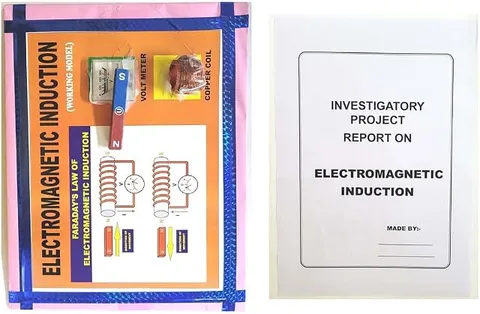
Electromagnetic Induction Experiment Working Project Model with Report Physics Educational Investigatory Project for School & Colleges
Code B0DK22D713
- Paid for and delivered by Amazon. The current price and the delivery date for your PIN code are shown there.
- Sold by Gurukul Technicals Institute, Delhi.
- Need a different topic, a custom version or a school order? Ask on WhatsApp.
In this project guide
Ready-made model
About this model
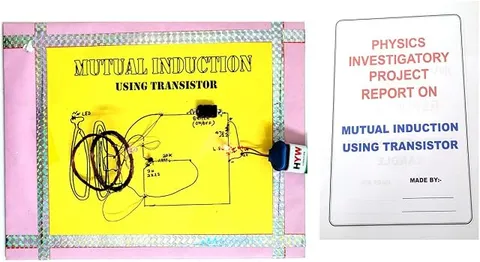
This working project model demonstrates electromagnetic induction, Michael Faraday's discovery that a changing magnetic field can produce electricity in a coil. The listing says it includes a report, which helps with the written part of an investigatory project. It suits Class 12 physics students and anyone who wants to show how generators and dynamos make electricity.
How it works
The science behind it
The idea the model demonstrates, in words you can use in your report and when you explain it.
Whenever the magnetic flux linked with a coil changes, an emf is induced in it. Faraday's law gives its size: e = −N (dΦ/dt), where N is the number of turns and Φ is the magnetic flux in weber. So the faster a magnet moves into or out of a coil, or the more turns the coil has, the larger the induced emf. Lenz's law gives the direction: the induced current flows so as to oppose the change that produced it, which is the law of conservation of energy in action. When the north pole of a magnet is pushed in, the near end of the coil becomes a north pole and repels it; when it is pulled out, that end becomes a south pole and attracts it. A magnet held still inside the coil gives no current at all. The dynamo on a bicycle lights its lamp on this principle: the faster you pedal, the brighter the lamp glows.
Make it yourself
Make an electromagnetic induction model yourself
Build your own version from scratch, or use the steps to understand how the ready-made model is put together before you present it.
What you need 8
Step by step 9 steps
Wind the thin wire neatly around the middle of the tube, several hundred turns in the same direction, counting as you go.
Tape the coil, scrape the enamel off both ends and fix them to the screw terminals.
Connect the galvanometer to the terminals.
Push the magnet's north pole quickly into the coil and note which way the needle swings; hold the magnet still and watch the needle return to zero.
Pull the magnet out quickly and note that the needle swings the other way.
Repeat with the south pole, and then with slow and fast movements, recording the size of each swing.
Hold the magnet still and move the coil instead, to show that only relative motion matters.
Swap the galvanometer for the LED pair and move a strong magnet quickly through the coil to make the LEDs flash.
Drop a magnet through the copper or aluminium pipe and compare its fall with a non-magnetic object of similar size, to show Lenz's law slowing it down.
Read this first
Safety first
Go through these points before you build or switch anything on. Younger students should do this with an adult.
- Strong magnets can snap together and pinch skin; keep them apart, and away from phones, cards and watches.
- Keep small round magnets away from young children, who may swallow them.
- Sand the wire ends gently, away from your eyes, and wash your hands afterwards.
- Catch the magnet at the bottom of the pipe so it does not hit the floor or your feet.
Troubleshooting
If something does not work
The usual problems with this model and how to fix them. Open a problem to see the fix.
The needle hardly moves
Use more turns, a stronger magnet and quicker movements, and check that both wire ends are scraped bare.
The LEDs do not flash
LEDs need much more voltage than a galvanometer does. Move the magnet faster through the whole coil, add turns, or use the galvanometer instead.
The needle swings the same way going in and coming out
Check that you pull the magnet back out of the same end without turning it round. The needle may also overshoot and swing back past zero, so watch only its first movement each time.
The magnet sticks to the pipe
The pipe is steel, not copper or aluminium. Use a pipe of a non-magnetic metal.
Exhibition day
How to present it
A running order for the exhibition table or the practical, step by step.
Show that a stationary magnet gives no response on the meter or indicator and a moving one does; this single contrast proves the law.
Move the magnet slowly and then quickly so judges can see the response grow with speed.
Reverse the magnet or its direction of motion and point out that the direction of the current reverses too.
Before the demonstration, tell the story of Faraday's experiment in one or two lines.
Practice
Viva questions
Practice questions on this model, with short answers. Try each one aloud before you open the answer.
State Faraday's law of electromagnetic induction.
The induced emf in a coil equals the rate of change of magnetic flux linked with it, e = −N dΦ/dt.
What does Lenz's law state?
The direction of the induced current is such that it opposes the change in magnetic flux that produces it.
Why is there no current when the magnet is held still inside the coil?
Because the flux is not changing, and only a changing flux induces an emf.
Name two devices that work on electromagnetic induction.
An electric generator and a transformer. A bicycle dynamo and an induction cooktop also use it.
Project file
Project file outline
The headings of the project file, in order. Give each heading its own section and write it in your own words.
The listing includes a printed project report: use this outline to check that your own file covers every part.
Free ebook: Writing a Science Project FileContents
- Aim: to show that a changing magnetic field induces a current in a coil
- Faraday's experiments and his laws of electromagnetic induction
- Lenz's law and the conservation of energy
- Construction of the coil, with a labelled diagram
- Observation table: magnet movement, speed and galvanometer deflection
- The magnet falling through a metal pipe, and eddy currents
- Applications: generators, induction cooktops and metal detectors
- Precautions with strong magnets, and conclusion
Buying checklist
Before you buy
What to check before you order the model, and what to do when it arrives.
1Before you order
- The listing says a report is included; read it, and add your own observations and photos so the file is your own work.
- Check whether the model uses a galvanometer, LEDs or a meter, so you can explain what is actually on your board.
- Store the magnet in its own pouch away from phones, and keep the box for transport.
- Check the delivery date for your PIN code on the marketplace, and order well before the exhibition or practical.
2When it arrives
- Test it as soon as it arrives by moving the magnet in and out of the coil.
Next steps
Take it further
Ways to turn this model into a bigger investigation or a stronger exhibition entry.
Wind coils with different numbers of turns, measure the peak induced voltage for each, and plot a graph.
Film the falling magnet in slow motion and work out its speed inside the pipe.
Make a shake torch: a magnet sliding inside a coil, a bridge rectifier and a capacitor that powers an LED.
Audience
Who it suits
Class 12 physics investigatory projects on electromagnetic induction, and Class 10 exhibitions on the magnetic effects of current.
- ClassClass 10 to 12
- SubjectPhysics
- TypeReady-made model
- Project reportPrinted report included
Free to read
Free ebooks for this topic
Free PDF ebooks from Gurukul Technicals Institute on the science, the making and the presenting of projects like this one.
- Free PDF ebook
Electricity and Magnetism Experiments
Hands-on experiments with cells, wires, bulbs and magnets
- Free PDF ebook
Physics Working Models Explained
Twenty classic models, how each works and how to make it
- Free PDF ebook
Investigatory Projects for Class 11 and 12
Topics, method and report structure for physics, chemistry and biology
- Free PDF ebook
Your Science Exhibition Guide
Choose a project, build it, present it and answer the judges with confidence