- Physics
- Ready-made model
- Class 10 to 12
Electromagnetic Magnetic Crane Physics Investigatory Working Model Project
Code B0G2TH13P3
- Paid for and delivered by Amazon. The current price and the delivery date for your PIN code are shown there.
- Sold by Gurukul Technicals Institute, Delhi.
- Need a different topic, a custom version or a school order? Ask on WhatsApp.
In this project guide
Ready-made model
About this model
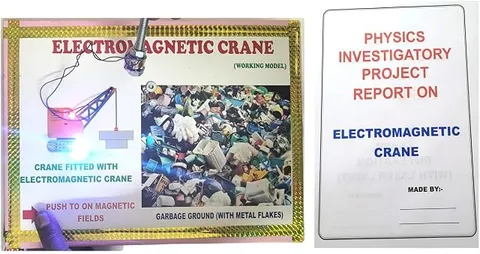
This working model shows how a crane can pick up iron objects with an electromagnet and drop them again when the current is switched off. It is a lively way to explain temporary magnets and why industries prefer electromagnets to permanent magnets for lifting scrap.
How it works
The science behind it
The idea the model demonstrates, in words you can use in your report and when you explain it.
An electromagnet is a coil of insulated wire wound on a soft iron core. When current flows through the coil it produces a magnetic field, and the iron core becomes strongly magnetised, so it attracts iron and steel. When the current stops, soft iron loses almost all its magnetism and the load drops. This ability to switch magnetism on and off is the whole point of a lifting magnet. The strength of an electromagnet increases with the current, with the number of turns in the coil, and with a soft iron core in place of air. Steel is avoided for the core because it keeps its magnetism after the current stops. Aluminium, copper and plastic are not attracted in any useful way, which is why the electromagnet cranes in Indian steel plants and scrap yards can pick iron and steel out of mixed scrap.
Make it yourself
Make an electromagnetic crane model yourself
Build your own version from scratch, or use the steps to understand how the ready-made model is put together before you present it.
What you need 9
Step by step 8 steps
Wrap a layer of paper or tape round the bolt, then wind the wire tightly along it in neat turns, all in the same direction, in two or three layers. Leave about 20 cm free at each end.
Tape the coil so it cannot unwind and scrape the enamel off the two free ends with sandpaper.
- Test the electromagnet
Connect it through the push button to the cells, press and pick up some clips, then release and watch them drop.
- Build the crane
A tower of sticks or cardboard on a heavy base, an arm fixed at the top at an angle, and the reel with its crank at the back.
Run the thread from the reel over the tip of the arm and tie the electromagnet to its end. Let the coil's wires run loosely along the thread to the button on the base.
Turn the crank to lower the magnet onto the clips, press the button to pick them up, raise and swing the arm, then release the button to drop them in a tray.
Show that the magnet picks up iron objects but not aluminium foil, a brass key or plastic.
Count how many clips it lifts with fewer and more turns, or with one and two cells, and add a card explaining each part.
Read this first
Safety first
Go through these points before you build or switch anything on. Younger students should do this with an adult.
- Press the button only while lifting; the coil draws a large current, so the wire and cells get warm if it is held on.
- Use cells only (3 V to 6 V); never a charger or mains supply.
- Hot glue and cutting sticks need an adult, and the base must be heavy enough that the crane cannot tip over.
- Keep the magnet away from phones, watches and bank cards.
Troubleshooting
If something does not work
The usual problems with this model and how to fix them. Open a problem to see the fix.
The magnet lifts nothing
The enamel may still be on the wire ends, or the cells may be flat. Test the coil for continuity with a multimeter, then try fresh cells.
The clips stay stuck after switching off
The core keeps some magnetism. Use a soft iron bolt rather than a hardened steel screw, and tap the core lightly.
The coil gets hot
Too much current for too long. Press the button only while lifting, add more turns of wire, and never leave the cells connected.
The crane tips forward when it lifts
Add weight, such as a stone, at the back of the base, or shorten the arm.
Exhibition day
How to present it
A running order for the exhibition table or the practical, step by step.
Pick up a few paper clips or iron nails, then switch off and let them drop, so the on-off control is clear.
Try a piece of aluminium foil or a plastic item to show that only magnetic materials are lifted.
Explain the three ways to make the magnet stronger, and show one if your model allows it.
Mention the real cranes in scrap yards and steel plants that work on the same principle.
Practice
Viva questions
Practice questions on this model, with short answers. Try each one aloud before you open the answer.
Why is soft iron used as the core of an electromagnet?
Soft iron becomes strongly magnetised when current flows and loses its magnetism almost completely when the current stops.
How can the strength of an electromagnet be increased?
By increasing the current, increasing the number of turns in the coil, or using a soft iron core.
Why do cranes use electromagnets instead of permanent magnets?
An electromagnet can be switched off, so the crane can release its load exactly where it is needed.
Will this crane pick up an aluminium can? Why?
No. Aluminium is not attracted by a magnet in any useful way; only magnetic materials such as iron, steel, nickel and cobalt are lifted.
Project file
Project file outline
The headings of the project file, in order. Give each heading its own section and write it in your own words.
Free ebook: Writing a Science Project FileContents
- Aim: to show how an electromagnetic crane lifts and releases iron objects
- Introduction: temporary and permanent magnets, and cranes in scrap yards
- Materials and a labelled diagram of the crane and coil
- Theory: the magnetic effect of current and why soft iron is used for the core
- Factors affecting strength: current, number of turns and core material
- Procedure for winding the coil and building the crane
- Observations: clips lifted with different numbers of turns and cells (table)
- Uses of electromagnets: cranes, electric bells, relays and MRI machines
- Conclusion and precautions
Buying checklist
Before you buy
What to check before you order the model, and what to do when it arrives.
1Before you order
- Check that it fits your chapter on magnetic effects of current, and whether your teacher wants an investigatory project with readings.
- Read the listing to see whether batteries and a report are included.
- Carry some paper clips or pins for the demonstration.
- Keep the box and pack the arm carefully so it does not snap.
- Check the delivery date for your PIN code on the marketplace, and order well before the exhibition or practical.
- Practise explaining it. Judges ask what the model shows and why; knowing the science matters as much as the model. The viva questions above are a good place to start.
2When it arrives
- Test the lifting as soon as it arrives and again a few days before the exhibition, and keep fresh cells.
Next steps
Take it further
Ways to turn this model into a bigger investigation or a stronger exhibition entry.
Plot the number of clips lifted against the number of turns or the number of cells.
Find the electromagnet's north and south poles with a compass and check them with the right-hand thumb rule.
Add a small geared motor to wind the reel or turn the crane, controlled by switches.
Audience
Who it suits
Suits Class 6 to 10 science exhibitions on magnetism and the magnetic effect of electric current.
- ClassClass 10 to 12
- SubjectPhysics
- TypeReady-made model
Free to read
Free ebooks for this topic
Free PDF ebooks from Gurukul Technicals Institute on the science, the making and the presenting of projects like this one.
- Free PDF ebook
Electricity and Magnetism Experiments
Hands-on experiments with cells, wires, bulbs and magnets
- Free PDF ebook
Physics Working Models Explained
Twenty classic models, how each works and how to make it
- Free PDF ebook
Investigatory Projects for Class 11 and 12
Topics, method and report structure for physics, chemistry and biology
- Free PDF ebook
Your Science Exhibition Guide
Choose a project, build it, present it and answer the judges with confidence