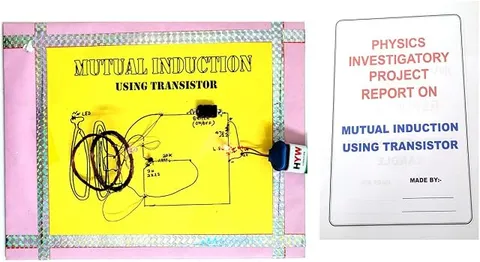
- Physics
- Ready-made model
- Class 10 to 12
Mutual Induction & Electromagnetic Induction Physics Investigatory Model Project
Code B0G2T8GL44
- Paid for and delivered by Amazon. The current price and the delivery date for your PIN code are shown there.
- Sold by Gurukul Technicals Institute, Delhi.
- Need a different topic, a custom version or a school order? Ask on WhatsApp.
In this project guide
Ready-made model
About this model
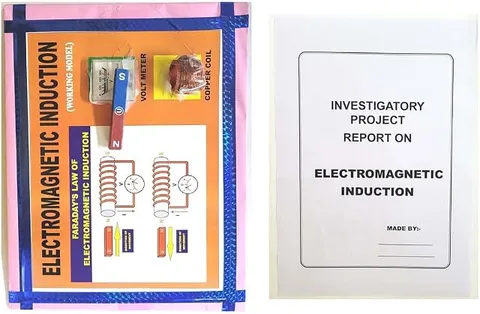
This investigatory model demonstrates electromagnetic induction, where a changing magnetic field produces a voltage in a coil, together with mutual induction between two coils. It brings the spirit of Michael Faraday's famous experiments into a form suited to a school project.
How it works
The science behind it
The idea the model demonstrates, in words you can use in your report and when you explain it.
In 1831 Michael Faraday found that a voltage is induced in a coil whenever the flux linked with it changes. Pushing a magnet into a coil joined to a galvanometer deflects the needle, pulling it out deflects it the other way, and a magnet held still gives no deflection; faster motion gives more. Faraday's law states that the induced emf is ε = −N × (ΔΦ / Δt), where N is the number of turns and ΔΦ / Δt the rate of change of flux. The minus sign expresses Lenz's law: the induced current opposes the change that causes it. Mutual induction is the same effect between two nearby coils. A changing current in the first coil changes the flux through the second, inducing an emf ε₂ = −M × (ΔI₁ / Δt), where M is the mutual inductance. So a meter on the second coil kicks only when the first is switched on or off.
Make it yourself
Make a Faraday induction and mutual induction model yourself
Build your own version from scratch, or use the steps to understand how the ready-made model is put together before you present it.
What you need 9
Step by step 8 steps
- Wind the secondary
500 turns of the thin wire on the main tube, all in one direction, taping after every hundred turns, and sand the two ends clean.
- Wind the primary
100 turns of the thicker wire on the narrower tube, and sand its ends.
Connect the secondary to the galvanometer, or the multimeter on millivolts, through screw terminals on the base.
- Faraday's test
Push the magnet's north pole quickly into the secondary and watch the needle swing. Hold the magnet still and the needle returns to zero; pull it out and the needle swings the other way.
Repeat slowly and quickly, and with the south pole first, and record the direction and size of each swing.
- Mutual induction
Connect the primary to the cells through the push button and the 10 Ω resistor, and slide it inside the secondary.
- Press the button
The needle kicks one way and returns to zero. Release it and the needle kicks the other way. A steady current gives no reading; only a changing one does.
Push the iron rod inside the primary and repeat: the kick is much bigger because the iron strengthens the changing flux. Then pull the primary partly out and watch the kick shrink.
Read this first
Safety first
Go through these points before you build or switch anything on. Younger students should do this with an adult.
- Press the primary's button only briefly; even with the resistor the coil warms up and the cells drain if it is held down.
- Use only the two AA cells; a larger battery could overheat the primary coil.
- Keep strong magnets away from the galvanometer, phones and bank cards, and out of reach of small children.
- Sand the wire ends gently and wash your hands afterwards.
Troubleshooting
If something does not work
The usual problems with this model and how to fix them. Open a problem to see the fix.
The needle hardly moves when the magnet goes in
The meter may not be sensitive enough, the magnet may be weak, or the enamel was not fully removed. Use the lowest millivolt range, move the magnet faster, and sand the coil ends again.
The digital meter's numbers flash by too quickly to read
Digital meters update only a few times a second. Watch for the + or − sign and the largest number, or use a centre-zero galvanometer, which shows the kick clearly.
Pressing the button gives no kick
The primary circuit may be open because of enamel left on the wire ends or flat cells, or the primary is too far from the secondary. Check that current flows in the primary, and slide it fully inside.
The needle stays deflected while the button is held
There should be no wire connection between the two coils. Scratched enamel may be letting the coils touch; check with the multimeter's continuity range and insulate them.
Exhibition day
How to present it
A running order for the exhibition table or the practical, step by step.
Show that a voltage appears only while the magnetic field is changing, not while it is steady.
If the model allows it, show that a faster change gives a bigger effect.
Explain Lenz's law using the direction of the deflection or current.
Write Faraday's law on a chart with the meaning of each symbol.
Practice
Viva questions
Practice questions on this model, with short answers. Try each one aloud before you open the answer.
What is electromagnetic induction?
The production of an emf in a conductor when the magnetic flux linked with it changes.
State Lenz's law.
The direction of the induced current is such that it opposes the change in magnetic flux that produces it.
What is mutual induction?
The production of an emf in one coil because of a changing current in a nearby coil.
Why is no current induced when the magnet is held still inside the coil?
The flux through the coil is not changing, so no emf is induced.
Project file
Project file outline
The headings of the project file, in order. Give each heading its own section and write it in your own words.
Free ebook: Writing a Science Project FileContents
- Aim: to demonstrate electromagnetic induction and mutual induction
- Introduction: Faraday's experiments of 1831
- Faraday's law, ε = −N × (ΔΦ / Δt), and Lenz's law
- Construction of the secondary and primary coils
- Observations: deflections as the magnet moves in and out, fast and slow
- Observations: deflections on pressing and releasing the primary switch, with and without the iron core
- Factors that affect the induced emf: speed, number of turns, core and distance
- Applications: generators, transformers, induction cooktops and wireless chargers
- Conclusion and bibliography
Buying checklist
Before you buy
What to check before you order the model, and what to do when it arrives.
1Before you order
- Check that electromagnetic induction is in your syllabus, and whether your teacher wants both Faraday's magnet experiment and mutual induction shown.
- Read the listing to see what kind of meter or indicator it uses and what powers it.
- Practise explaining why a steady current induces nothing, as this is a common viva question.
- Keep the box, and wrap any magnet so it does not chip or stick to steel in transport.
- Check the delivery date for your PIN code on the marketplace, and order well before the exhibition or practical.
2When it arrives
- Try both experiments as soon as it arrives, so there is time to sort out a weak reading.
Next steps
Take it further
Ways to turn this model into a bigger investigation or a stronger exhibition entry.
Add a tap halfway through the secondary and compare the deflection from 250 and 500 turns.
Drop the magnet through the coil from different heights and relate the deflection to its speed.
Spin a magnet beside the coil to make a simple AC generator, and show the needle swinging both ways.
Audience
Who it suits
Class 10 to 12 physics students preparing an investigatory project on electromagnetic induction.
- ClassClass 10 to 12
- SubjectPhysics
- TypeReady-made model
Free to read
Free ebooks for this topic
Free PDF ebooks from Gurukul Technicals Institute on the science, the making and the presenting of projects like this one.
- Free PDF ebook
Electricity and Magnetism Experiments
Hands-on experiments with cells, wires, bulbs and magnets
- Free PDF ebook
Physics Working Models Explained
Twenty classic models, how each works and how to make it
- Free PDF ebook
Investigatory Projects for Class 11 and 12
Topics, method and report structure for physics, chemistry and biology
- Free PDF ebook
Your Science Exhibition Guide
Choose a project, build it, present it and answer the judges with confidence