- Physics
- Ready-made model
- Class 10 to 12
- Printed report included
Electromagnet with Magnetic Compass Readymade Physics Working Project & Model for School & College(with Printed Report)
Code B099R1HL9T
- Paid for and delivered by Amazon. The current price and the delivery date for your PIN code are shown there.
- Sold by Gurukul Technicals Institute, Delhi.
- Need a different topic, a custom version or a school order? Ask on WhatsApp.
In this project guide
Ready-made model
About this model
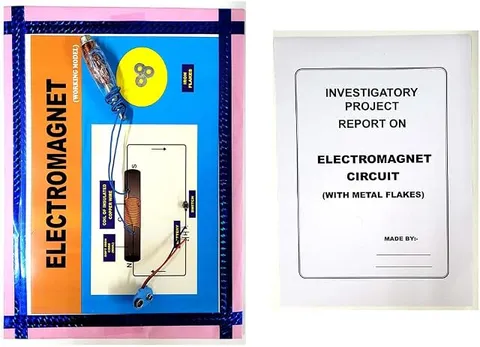
This model shows that electricity can make magnetism, using an electromagnet and a magnetic compass to detect it, as the title describes. The listing says a printed report is included, which helps with the project file.
How it works
The science behind it
The idea the model demonstrates, in words you can use in your report and when you explain it.
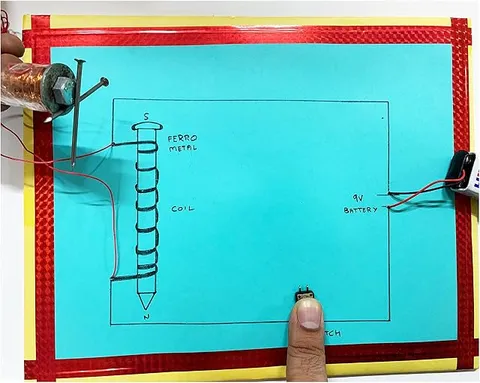
The link between electricity and magnetism was found in 1820, when Hans Christian Oersted saw a compass needle swing as current flowed in a nearby wire: every electric current sets up a magnetic field around it. Winding the wire into a coil concentrates the field, and placing a soft iron core inside makes it much stronger, because the iron itself becomes magnetised. This is an electromagnet: it acts like a bar magnet, with a north and a south pole, while current flows, and loses most of its magnetism when the current stops. Its strength increases with the current and with the number of turns in the coil. A compass needle, itself a small magnet, lines up with the field, showing that the field exists and which end of the coil is north. Reversing the current reverses the poles, and the right-hand thumb rule gives the direction of the field. Scrap-lifting cranes and electric bells both use electromagnets.
Make it yourself
Make an electromagnet with a compass detector yourself
Build your own version from scratch, or use the steps to understand how the ready-made model is put together before you present it.
What you need 10
Step by step 8 steps
Wrap the bolt with one layer of paper or tape, then wind 50 turns of enamelled wire tightly in one direction. Twist out a small loop (a tap), wind 50 more, make a second tap, and finish with another 50 turns.
Sand the enamel off the two ends and the taps, and fix them to terminals labelled 0, 50, 100 and 150 turns.
Wire the cells through the push button and the reversing DPDT switch to the 0 and 150-turn terminals.
- Oersted's test
Connect the straight wire through the 4.7 Ω resistor to the cells instead of the coil, lay it north-south directly over the compass, and press the button. The needle swings away from north.
Reconnect the coil, place the compass about 5 cm from the head of the bolt and press the button: the needle lines up with the coil. Mark that end N or S from the way the needle points.
Flip the DPDT switch and press again: the needle swings round, showing that reversing the current reverses the poles. Check this with the right-hand thumb rule.
- Measure strength
Count the paper clips the bolt lifts using 50, 100 and 150 turns, and then using two and three cells.
Release the button and see how many clips stay on, which shows the small amount of magnetism the bolt keeps.
Read this first
Safety first
Go through these points before you build or switch anything on. Younger students should do this with an adult.
- Press the button only for a few seconds at a time; the coil has low resistance, so it warms up and drains the cells if left on.
- Use only AA cells; a larger battery could heat the wire dangerously.
- Keep strong magnets, phones and bank cards away from the compass, as they can disturb or remagnetise its needle.
- Sand the wire gently and wash your hands afterwards.
Troubleshooting
If something does not work
The usual problems with this model and how to fix them. Open a problem to see the fix.
The compass needle does not move
The enamel may not be fully removed, a terminal may be loose, or the cells may be flat. Check the coil with the multimeter's continuity range, and move the compass closer.
The coil picks up very few clips
There may be too few turns or weak cells, or the bolt may be stainless steel, which is only weakly magnetic. Use a plain iron bolt, add turns and fit fresh cells.
The compass points the wrong way even with no current
The needle may have been remagnetised by a strong magnet, or there is steel nearby, such as a table frame. Test it away from metal and use a fresh compass if needed.
The bolt keeps holding clips after the current stops
Harder steel keeps some magnetism, called residual magnetism. Use a softer iron bolt, or record it as an observation.
Exhibition day
How to present it
A running order for the exhibition table or the practical, step by step.
Switch the current on and off and show the compass needle moving each time.
If possible, reverse the current and show the needle turning the other way.
Explain how the number of turns and the iron core affect the strength.
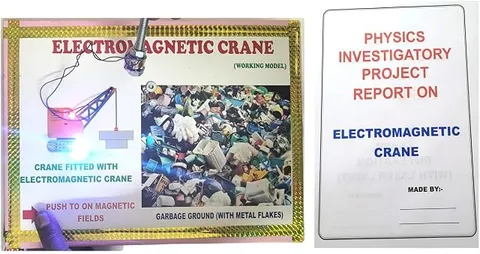
Mention everyday uses such as electric bells, relays and scrap-lifting cranes.
Practice
Viva questions
Practice questions on this model, with short answers. Try each one aloud before you open the answer.
What is an electromagnet?
A coil of wire, usually wound on a soft iron core, that behaves like a magnet only while current flows through it.
Why does the compass needle deflect?
The current produces a magnetic field, and the needle, being a small magnet, turns to line up with it.
How can you increase the strength of an electromagnet?
Increase the current, increase the number of turns, or use a soft iron core.
Who discovered the magnetic effect of electric current?
Hans Christian Oersted, in 1820.
Project file
Project file outline
The headings of the project file, in order. Give each heading its own section and write it in your own words.
The listing includes a printed project report: use this outline to check that your own file covers every part.
Free ebook: Writing a Science Project FileContents
- Aim: to show that an electric current produces a magnetic field, and to make an electromagnet
- Introduction: Oersted's discovery of 1820
- Magnetic field around a straight wire and a coil, and the right-hand thumb rule
- Construction of the electromagnet with taps at 50, 100 and 150 turns
- Observations: compass deflection with the current in each direction
- Observations: paper clips lifted for each number of turns and cells
- Uses of electromagnets: electric bells, cranes, relays and MRI scanners
- Precautions and conclusion
Buying checklist
Before you buy
What to check before you order the model, and what to do when it arrives.
1Before you order
- Check that magnetic effects of current are in your syllabus at your class level.
- Read the listing to see what powers the model, and keep spare cells ready.
- Pack it away from magnets and speakers, which can disturb the compass needle.
- Check the delivery date for your PIN code on the marketplace, and order well before the exhibition or practical.
- Practise explaining it. Judges ask what the model shows and why; knowing the science matters as much as the model. The viva questions above are a good place to start.
2When it arrives
- The listing says a printed report is included; check it when the parcel arrives and add your own readings.
- Test the compass deflection as soon as it arrives, and keep the model away from magnets and steel table frames when demonstrating.
Next steps
Take it further
Ways to turn this model into a bigger investigation or a stronger exhibition entry.
Measure the current with a multimeter and plot the number of clips against the current and against the number of turns.
Compare cores of soft iron, steel, aluminium and wood inside the same coil.
Turn the electromagnet into a simple relay or an electric bell model.
Audience
Who it suits
Class 6 to 10 students preparing a model on the magnetic effects of electric current.
- ClassClass 10 to 12
- SubjectPhysics
- TypeReady-made model
- Project reportPrinted report included
Free to read
Free ebooks for this topic
Free PDF ebooks from Gurukul Technicals Institute on the science, the making and the presenting of projects like this one.
- Free PDF ebook
Electricity and Magnetism Experiments
Hands-on experiments with cells, wires, bulbs and magnets
- Free PDF ebook
Physics Working Models Explained
Twenty classic models, how each works and how to make it
- Free PDF ebook
Your Science Exhibition Guide
Choose a project, build it, present it and answer the judges with confidence
- Free PDF ebook
Writing a Science Project File
How to write the report, from the cover page to the bibliography