- Physics
- Ready-made model
- Class 10 to 12
- Printed report included
Electromagnet Science Project with Report & Metal Scrap Physics Educational Investigatory Project for School & Colleges
Code B0DK23RGDH
- Paid for and delivered by Amazon. The current price and the delivery date for your PIN code are shown there.
- Sold by Gurukul Technicals Institute, Delhi.
- Need a different topic, a custom version or a school order? Ask on WhatsApp.
In this project guide
Ready-made model
About this model
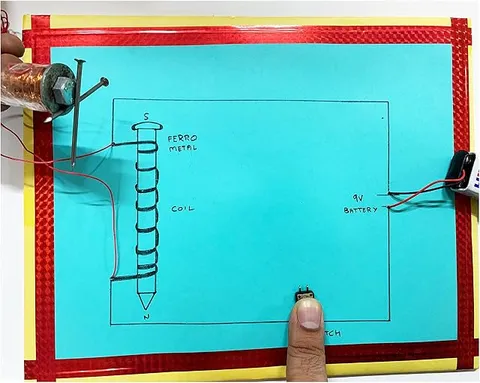
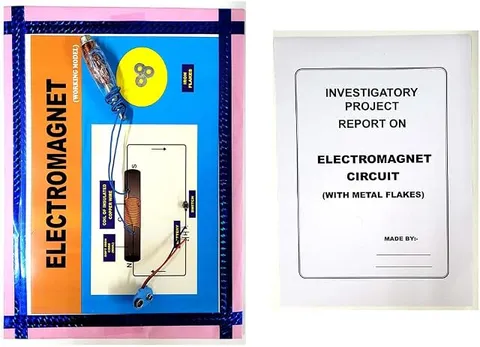
This science project demonstrates an electromagnet, a magnet that can be switched on and off with an electric current. The listing says it includes a report and metal scrap, which can be used to show the magnet picking up and dropping pieces of metal. It suits school exhibitions and projects on the magnetic effect of current.
How it works
The science behind it
The idea the model demonstrates, in words you can use in your report and when you explain it.
When current flows through a wire it produces a magnetic field around it, as Oersted discovered. Winding the wire into a coil adds up the fields of all the turns, and inside a long coil (a solenoid) the field is nearly uniform: B = μ0 n I, where n is the number of turns per metre and I is the current. Placing a soft iron core inside makes the field many times stronger, because iron has a very high relative permeability and becomes magnetised itself. So the strength of an electromagnet increases with more turns, more current and an iron core. Soft iron is chosen because it loses its magnetism almost as soon as the current stops, whereas hard steel would keep some magnetism and become a permanent magnet. Iron and steel pieces are attracted, while aluminium, copper and brass are not. Cranes in scrap yards and steel plants lift and drop heavy iron scrap with large electromagnets.
Make it yourself
Make an electromagnet that lifts scrap yourself
Build your own version from scratch, or use the steps to understand how the ready-made model is put together before you present it.
What you need 10
Step by step 8 steps
Slide the nail into the tube, leave about 20 cm of wire free, and wind tightly round the tube in neat side-by-side turns, all in one direction, counting as you go; stop at 50 turns and keep the rest of the wire for adding turns later.
Tape the winding so it does not unwind, and sand about 2 cm of enamel off each free end of the wire.
Connect one wire end to the cell holder and the other through the push button, using crocodile clips so you can change things easily.
Press the button and dip the nail into the paper clips; count how many it lifts, then release the button and watch them drop.
Add turns to make 100 and then 150, and then try two, three and four cells, recording the number of clips each time.
With the button pressed, hold the compass near one end of the nail to find its north pole, then swap the wires at the cells and show that the poles swap.
Slide the nail out and put the aluminium, wood and plastic rods into the coil in turn, and compare how many clips each lifts.
Fix the magnet to the stand and use it as a mini crane to pick up and drop the iron scraps over the tray.
Read this first
Safety first
Go through these points before you build or switch anything on. Younger students should do this with an adult.
- Press the button for only a few seconds at a time: the coil is almost a short circuit, so it and the cells get hot quickly.
- Never connect the coil to an adapter, a power bank, a car battery or the mains.
- If a cell or the coil feels hot, stop and let it cool before carrying on.
- Sand the wire carefully, as the sharp ends can prick fingers, and wash your hands afterwards.
Troubleshooting
If something does not work
The usual problems with this model and how to fix them. Open a problem to see the fix.
The nail lifts nothing
The enamel is probably still on the wire ends, or the cells are weak. Sand the ends until they shine copper-coloured, make sure the clips grip bare metal, and try fresh cells.
The coil and cells get hot very quickly
The wire is too short or too thick, so too much current flows. Use thinner wire with more turns, and press the button only briefly.
Clips stay stuck after the button is released
The nail is steel, which keeps some magnetism. Use a soft iron core, or tap the nail to drop the clips; this is why real electromagnets use soft iron.
More turns did not lift more clips
Extra turns also add resistance, which lowers the current, and tired cells give less. Wind neatly, use fresh cells for each trial and count carefully.
Exhibition day
How to present it
A running order for the exhibition table or the practical, step by step.
Pick up the metal scrap with the switch on and drop it by switching off, to show the magnet is temporary.
Show that aluminium or copper pieces are not attracted, while iron pieces are.
Explain the three ways to make the electromagnet stronger, and demonstrate one if you can.
Use a compass near the coil to find its north and south poles, then reverse the current to show they swap.
Practice
Viva questions
Practice questions on this model, with short answers. Try each one aloud before you open the answer.
What is an electromagnet?
A temporary magnet made by passing current through a coil wound around a soft iron core.
How can the strength of an electromagnet be increased?
By increasing the number of turns, increasing the current, or using a soft iron core.
Why is soft iron used as the core?
It is easily magnetised and loses its magnetism quickly when the current stops, so the magnet can be switched off.
Give two uses of electromagnets.
Electric bells and cranes that lift iron scrap; they are also used in relays, loudspeakers and MRI machines.
Project file
Project file outline
The headings of the project file, in order. Give each heading its own section and write it in your own words.
The listing includes a printed project report: use this outline to check that your own file covers every part.
Free ebook: Writing a Science Project FileContents
- Aim: to make an electromagnet and study how its strength depends on the number of turns, the current and the core
- Magnetic effect of electric current and Oersted's experiment
- Magnetic field of a solenoid and the right-hand thumb rule
- Why a soft iron core is used
- Construction of the electromagnet, with a diagram
- Observation tables: turns, number of cells and type of core against clips lifted
- Finding and reversing the poles with a compass
- Uses: scrapyard cranes, electric bells, relays and loudspeakers
- Conclusion and precautions
Buying checklist
Before you buy
What to check before you order the model, and what to do when it arrives.
1Before you order
- Check that the project matches your chapter on the magnetic effects of current and your class level.
- The listing mentions a report and metal scrap; read it for anything else, and do not assume cells are in the box.
- Take spare cells on the day, because an electromagnet drains them quickly.
- Keep the scrap pieces in a small box so they are not lost in transport.
- Check the delivery date for your PIN code on the marketplace, and order well before the exhibition or practical.
- The project report is a learning aid. Read it, understand how the model works, and write your own observations; schools expect your own work.
- Practise explaining it. Judges ask what the model shows and why; knowing the science matters as much as the model. The viva questions above are a good place to start.
2When it arrives
- When it arrives, test how much it lifts with fresh cells a few days before the exhibition.
Next steps
Take it further
Ways to turn this model into a bigger investigation or a stronger exhibition entry.
Plot graphs of clips lifted against number of turns and against number of cells, and describe the pattern.
Build a simple electric bell or a relay from the same coil and explain how each one uses the electromagnet.
Place a compass at different distances from the coil to show how the field weakens further away.
Audience
Who it suits
Class 6 to 10 science exhibitions and projects on magnetism and the magnetic effect of electric current.
- ClassClass 10 to 12
- SubjectPhysics
- TypeReady-made model
- Project reportPrinted report included
Free to read
Free ebooks for this topic
Free PDF ebooks from Gurukul Technicals Institute on the science, the making and the presenting of projects like this one.
- Free PDF ebook
Electricity and Magnetism Experiments
Hands-on experiments with cells, wires, bulbs and magnets
- Free PDF ebook
Physics Working Models Explained
Twenty classic models, how each works and how to make it
- Free PDF ebook
Investigatory Projects for Class 11 and 12
Topics, method and report structure for physics, chemistry and biology
- Free PDF ebook
Your Science Exhibition Guide
Choose a project, build it, present it and answer the judges with confidence