- Physics
- Ready-made model
- Class 10 to 12
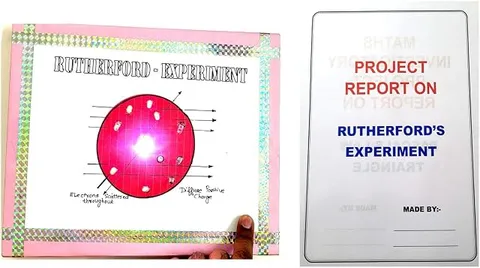
Rutherford’s Experiment Working Model
Code B0G2T6T38S
- Paid for and delivered by Amazon. The current price and the delivery date for your PIN code are shown there.
- Sold by Gurukul Technicals Institute, Delhi.
- Need a different topic, a custom version or a school order? Ask on WhatsApp.
In this project guide
Ready-made model
About this model
This investigatory model is based on Rutherford's gold foil experiment, which showed that an atom has a tiny, dense, positively charged nucleus. It helps students explain how the scattering of alpha particles changed our picture of the atom.
What the listing says
- Gold Foil Atomic Structure Investigatory Project
How it works
The science behind it
The idea the model demonstrates, in words you can use in your report and when you explain it.
In Rutherford's experiment, fast alpha particles, which are helium nuclei with a charge of +2, were aimed at a very thin gold foil. Most passed straight through, showing that an atom is mostly empty space. Some were turned through small angles, and a very small fraction bounced almost straight back. Rutherford concluded that all the positive charge and nearly all the mass of an atom are packed into a tiny central nucleus, which repels alpha particles that come very close to it, while electrons move around the nucleus. The nucleus is roughly 10⁵ times smaller than the atom: if an atom were as big as a cricket ground, the nucleus would be about the size of a mustard seed at its centre. The model had a weakness: by classical physics, a revolving electron should lose energy and fall into the nucleus, which led to Bohr's model. Gold was chosen because it can be beaten into extremely thin sheets.
Make it yourself
Make a Rutherford scattering model yourself
Build your own version from scratch, or use the steps to understand how the ready-made model is put together before you present it.
What you need 8
Step by step 8 steps
Fix the dome firmly at the centre of the board. Keep it small compared with the board, since a real nucleus is tiny compared with the atom.
Mark angles around the edge of the board measured from the dome: 0° straight ahead, then 30°, 60°, 90°, 120°, 150° and 180° straight back.
Set the ramp at one edge, aimed straight across, and mark a release point on it so every marble starts from the same height.
Launch marbles one at a time from different sideways positions spread evenly across the width, and note where each one leaves the board.
Adjust the ramp height so that a marble aimed straight at the dome climbs part of the way up and rolls back, like the few alpha particles that bounced back.
Tally how many marbles go straight, how many are slightly deflected and how many come back, and compare with what Rutherford saw.
Make the panel showing the real set-up: a radioactive source in a lead box, a thin gold foil and a circular zinc sulphide screen.
Draw Rutherford's model of the atom beside the board and use the threads to show a few typical paths.
Read this first
Safety first
Go through these points before you build or switch anything on. Younger students should do this with an adult.
- Marbles are a choking hazard for small children, so keep them in a closed box when not in use.
- Pick up any dropped marbles at once so nobody slips on them.
- Use a cutter only with an adult when making the ramp and panel.
- If you use clay that needs baking to harden, an adult must do the baking.
Troubleshooting
If something does not work
The usual problems with this model and how to fix them. Open a problem to see the fix.
The marbles roll straight over the dome
They are going too fast for the dome's height. Lower the ramp or make the dome taller and steeper.
The marbles curve even when they are far from the dome
The board is not level. Rest a marble in the middle to see which way it rolls and pack card under the low side.
Too many marbles hit the dome
The dome is large compared with the board. Use the smallest dome you can and explain that a real nucleus is about 10⁵ times smaller than its atom, which no tabletop model can show to scale.
The results change every time
Release each marble from the same mark without pushing, and take many trials so the overall pattern shows clearly.
Exhibition day
How to present it
A running order for the exhibition table or the practical, step by step.
Draw three paths on a chart, straight through, slightly deflected and bounced back, and explain what each one tells us.
Compare Thomson's plum-pudding model with Rutherford's nuclear model side by side.
Use the cricket-ground and mustard-seed comparison to help visitors picture how small the nucleus is.
End with the drawback of the model, since examiners often ask why Bohr's model was needed.
Practice
Viva questions
Practice questions on this model, with short answers. Try each one aloud before you open the answer.
Why did most alpha particles pass straight through the gold foil?
Because most of the space inside an atom is empty.
What did the few rebounding alpha particles show?
They showed that the positive charge and almost all the mass of the atom are concentrated in a very small nucleus.
Why was gold used for the foil?
Gold is extremely malleable, so it can be beaten into a very thin foil.
What was the main drawback of Rutherford's model?
It could not explain why the atom is stable, because a revolving electron should radiate energy and spiral into the nucleus.
Project file
Project file outline
The headings of the project file, in order. Give each heading its own section and write it in your own words.
Free ebook: Writing a Science Project FileContents
- Aim: to model Rutherford's alpha particle scattering experiment
- Background: Thomson's plum pudding model of the atom
- The gold foil experiment and its set-up
- Rutherford's observations and conclusions
- How the marble model represents the experiment
- Observations: tally of deflection angles
- Rutherford's nuclear model of the atom
- Limitations of the model and Bohr's improvement
- Conclusion and bibliography
Buying checklist
Before you buy
What to check before you order the model, and what to do when it arrives.
1Before you order
- Check that atomic structure is in your syllabus and that your teacher accepts this experiment as your topic.
- Read the listing to see what is mentioned with the model, such as a report or batteries, and plan for anything extra.
- Practise explaining what the gold foil, the alpha particles and the screen each stand for on the model.
- Keep the box to protect the model on the way to school.
- Check the delivery date for your PIN code on the marketplace, and order well before the exhibition or practical.
2When it arrives
- Look the model over when it arrives and try any lights or moving parts.
Next steps
Take it further
Ways to turn this model into a bigger investigation or a stronger exhibition entry.
Use domes of different heights to stand for nuclei of different charge, and compare the scattering patterns.
Plot the number of marbles against deflection angle as a bar graph and compare its shape with Rutherford's results.
Build a second board with many small low bumps spread evenly to stand for Thomson's model, and show that it gives only small deflections.
Audience
Who it suits
Suits Class 9 chemistry and Class 12 physics investigatory projects on the structure of the atom.
- ClassClass 10 to 12
- SubjectPhysics
- TypeReady-made model
Free to read
Free ebooks for this topic
Free PDF ebooks from Gurukul Technicals Institute on the science, the making and the presenting of projects like this one.
- Free PDF ebook
Physics Working Models Explained
Twenty classic models, how each works and how to make it
- Free PDF ebook
Investigatory Projects for Class 11 and 12
Topics, method and report structure for physics, chemistry and biology
- Free PDF ebook
Your Science Exhibition Guide
Choose a project, build it, present it and answer the judges with confidence
- Free PDF ebook
Writing a Science Project File
How to write the report, from the cover page to the bibliography