- Physics
- Ready-made model
- Class 10 to 12
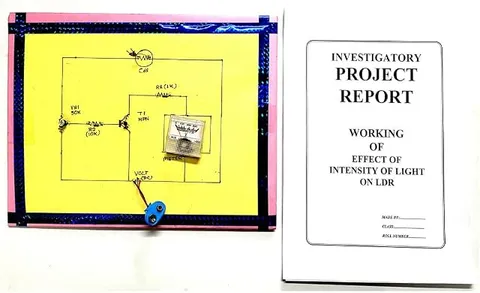
Effect Of Intensity Light On LDR Physics Working Model Educational Investigatory Project-15 Months And Up, Multicolor For Baby
Code B0C3H4XRXZ
- Paid for and delivered by Amazon. The current price and the delivery date for your PIN code are shown there.
- Sold by Gurukul Technicals Institute, Delhi.
- Need a different topic, a custom version or a school order? Ask on WhatsApp.
In this project guide
Ready-made model
About this model
This investigatory model studies how the resistance of a light dependent resistor (LDR) changes as the intensity of light falling on it changes. Because the result can be measured, tabulated and plotted as a graph, it is a popular choice for a physics investigatory project.
How it works
The science behind it
The idea the model demonstrates, in words you can use in your report and when you explain it.
An LDR, or photoresistor, is made from a semiconductor such as cadmium sulphide. In darkness very few charge carriers are free to move, so its resistance is high. When light falls on it, photons with enough energy free electrons from their bonds, creating electron-hole pairs. More charge carriers mean the material conducts better, so resistance falls as light intensity rises. This effect is called photoconductivity. The change is not a straight line: resistance drops steeply in dim light and more slowly in bright light. Light from a small source spreads out as it travels, so its intensity falls with the square of the distance (I ∝ 1/d²); moving a lamp to twice the distance cuts the intensity to one quarter. Automatic street lights that switch on by themselves at dusk use this same idea.
Make it yourself
Make an LDR light intensity experiment yourself
Build your own version from scratch, or use the steps to understand how the ready-made model is put together before you present it.
What you need 8
Step by step 8 steps
Fix the LDR upright at the zero end of the board, facing along the scale, inside the black paper tube.
Mount the bulb on the sliding block at the same height as the LDR, facing it directly.
Connect the multimeter, set to resistance, across the two LDR leads.
Darken the room, keep the bulb off, and note the dark resistance.
Switch on the bulb and place it 10 cm from the LDR. Wait a few seconds for the reading to settle and note it.
Move the bulb back in steps of 5 cm to about 50 cm, taking a reading at each distance. Repeat the set twice and take averages.
Work out 1/d² for each distance as a measure of relative intensity, and plot resistance against distance and against 1/d².
Switch the bulb off between sets so the cells do not run down.
Read this first
Safety first
Go through these points before you build or switch anything on. Younger students should do this with an adult.
- Use a small torch bulb on cells; do not use a hot halogen lamp or any mains lamp.
- Let the bulb cool before touching it.
- Keep the floor clear of wires when working in a darkened room.
Troubleshooting
If something does not work
The usual problems with this model and how to fix them. Open a problem to see the fix.
The multimeter shows OL or 1 in the dark
The resistance is above the selected range. Switch to a higher range, such as megohms.
The readings jump about
Stray light is reaching the LDR. Close the curtains, lengthen the paper tube and keep people from walking past the lamp.
The reading keeps creeping after I move the bulb
LDRs respond slowly, especially after being in the dark. Wait the same time, for example 10 seconds, before every reading.
Later readings do not match the earlier ones
The cells are running down and the bulb is dimming. Fit fresh cells and take your readings quickly.
Exhibition day
How to present it
A running order for the exhibition table or the practical, step by step.
Take resistance readings with a multimeter at several distances from a lamp, record them in a table and plot resistance against distance.
Work in a dim corner or shield the LDR with a paper tube so room light does not upset your readings.
Plot a second graph of resistance against 1/d² to connect your results with the inverse square law.
Finish with a real use, such as street lights or a night lamp that switches on in the dark.
Practice
Viva questions
Practice questions on this model, with short answers. Try each one aloud before you open the answer.
What does LDR stand for, and how does it behave?
LDR stands for light dependent resistor; its resistance decreases as the intensity of light falling on it increases.
Name a semiconductor commonly used in LDRs.
Cadmium sulphide (CdS), a semiconductor, is the most common material.
Why does the resistance of an LDR fall in bright light?
Light energy frees more electrons and holes in the semiconductor, and more charge carriers let current flow more easily.
How does light intensity change with distance from a small source?
It varies inversely as the square of the distance, so doubling the distance makes the intensity one quarter.
Project file
Project file outline
The headings of the project file, in order. Give each heading its own section and write it in your own words.
Free ebook: Writing a Science Project FileContents
- Aim: to study how the resistance of an LDR changes with the intensity of light falling on it
- Apparatus
- Theory: photoconductivity in an LDR
- Diagram of the set-up
- Procedure
- Observation table: distance, 1/d² and resistance
- Graphs of resistance against distance and against 1/d²
- Result
- Precautions, sources of error and uses of LDRs
Buying checklist
Before you buy
What to check before you order the model.
1Check these first
- Ignore the age line in the title: this is a senior secondary physics investigatory project with small parts, not a toy for young children.
- Check in the listing what the model needs to run, such as cells or a meter, and whether these are included.
- Check in the listing whether a report is included; the readings and graphs in your file should be your own.
- Test it in a dark room a few days before the practical, because results in a bright hall can look very different.
- Keep the box to protect the LDR and wires on the way to school.
- Check the delivery date for your PIN code on the marketplace, and order well before the exhibition or practical.
- Practise explaining it. Judges ask what the model shows and why; knowing the science matters as much as the model. The viva questions above are a good place to start.
Next steps
Take it further
Ways to turn this model into a bigger investigation or a stronger exhibition entry.
Put red, green and blue filters in front of the bulb and compare the resistance at the same distance.
Build an automatic night lamp from the LDR and a transistor.
Measure the actual intensity with a light meter app on a phone and plot resistance against it.
Audience
Who it suits
Suits Class 12 physics investigatory projects and Class 10 to 12 exhibitions on sensors and semiconductors.
- ClassClass 10 to 12
- SubjectPhysics
- TypeReady-made model
Free to read
Free ebooks for this topic
Free PDF ebooks from Gurukul Technicals Institute on the science, the making and the presenting of projects like this one.
- Free PDF ebook
Physics Working Models Explained
Twenty classic models, how each works and how to make it
- Free PDF ebook
Investigatory Projects for Class 11 and 12
Topics, method and report structure for physics, chemistry and biology
- Free PDF ebook
Your Science Exhibition Guide
Choose a project, build it, present it and answer the judges with confidence
- Free PDF ebook
Writing a Science Project File
How to write the report, from the cover page to the bibliography