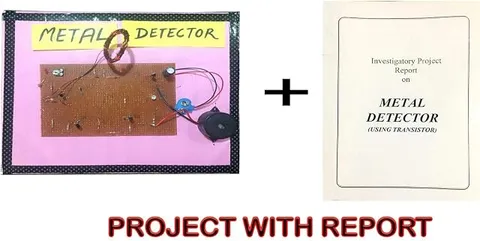
Metal Detector Educational Circuit Board
Code B07H5QP5TP
- Paid for and delivered by Amazon. The current price and the delivery date for your PIN code are shown there.
- Sold by Gurukul Technicals Institute, Delhi.
- Need a different topic, a custom version or a school order? Ask on WhatsApp.
In this project guide
Physics
About this model
An educational circuit board that works as a simple metal detector, sensing metal objects brought near it without touching them. It is a practical way to demonstrate electromagnetic induction and eddy currents, the same ideas used in the security gates at airports and metro stations.
How it works
The science behind it
The idea the model demonstrates, in words you can use in your report and when you explain it.
A metal detector uses electromagnetic induction. An oscillator circuit sends alternating current through a coil, which produces a changing magnetic field around it. When a piece of metal enters this field, the changing field induces small circulating currents inside the metal called eddy currents. By Lenz's law, these eddy currents set up their own magnetic field that opposes the change that caused them. This opposing field alters the effective inductance of the coil, which shifts the frequency or strength of the oscillation. The rest of the circuit senses this shift and sounds a buzzer or lights an indicator. Bigger objects and those closer to the coil produce a larger change, so the range depends on size and distance. Wood, plastic and paper have no free electrons to carry eddy currents, so they are ignored. The door-frame detectors at Delhi Metro stations work on the same principle.
Make it yourself
Make a simple metal detector circuit yourself
Build your own version from scratch, or use the steps to understand how the ready-made model is put together before you present it.
What you need 10
Step by step 8 steps
Wind 30 to 50 turns of enamelled wire neatly on the former, hold the turns with tape, and sand the enamel off the last 1 cm of each end.
Build the oscillator and detector on the zero PCB exactly as your circuit diagram shows, with the coil and its capacitor forming the tuned circuit.
Add the output stage, so that the detector's output switches the BC547, which drives the buzzer and the LED when metal is sensed.
Connect the coil with a short pair of twisted wires and fix it at the end of the handle, keeping the battery and any metal screws at least 15 cm away from it.
Switch on with no metal nearby and turn the preset slowly until the buzzer just stops; this is the point where the detector is most sensitive.
Bring a coin towards the coil: eddy currents induced in the coin take energy from the coil's field and change the oscillation, and the buzzer sounds.
Test each object, recording the greatest distance at which it is detected, and show that the non-metals are not detected at all.
Put the board and battery in the box, label the coil, oscillator, detector and buzzer, and keep a coin taped to the stand for demonstrations.
Read this first
Safety first
Go through these points before you build or switch anything on. Younger students should do this with an adult.
- Use the soldering iron only with an adult, rest it in its stand, and let joints cool before touching.
- Run the detector only on the 9 V battery; never connect it to the mains or an opened adapter.
- Do not use the model to look for wiring inside walls or for buried objects; real searches need proper equipment and adults.
- Keep sharp test objects such as keys and foil in a small box at the stall.
Troubleshooting
If something does not work
The usual problems with this model and how to fix them. Open a problem to see the fix.
The buzzer sounds all the time
The preset is set past the switching point, or metal is near the coil, such as a steel table or the battery. Move to a wooden table and turn the preset back until the buzzer just stops.
It does not detect anything
The coil may not be oscillating. Check that the enamel is cleaned off its ends and the joints are soldered, then set the preset again slowly from the point where the buzzer sounds.
It detects metal only a centimetre or two away
That is normal for a small single-coil detector. A slightly larger coil, a preset set right at the switching point, and bigger metal objects all help.
The setting drifts after a few minutes
The battery voltage and temperature change as it runs. Let the circuit run for a minute before setting it, use a fresh battery, and adjust again just before demonstrating.
Exhibition day
How to present it
A running order for the exhibition table or the practical, step by step.
Bring a coin, a key, a plastic pen and a wooden scale near the detector one by one to show it reacts only to metals.
Show how the response changes with distance, and mark the furthest distance at which a coin is detected.
Explain eddy currents with a simple diagram of a changing field passing through a metal coin.
Demonstrate away from metal tables and almirahs, which can disturb the detector all the time.
Practice
Viva questions
Practice questions on this model, with short answers. Try each one aloud before you open the answer.
On what principle does a metal detector work?
It works on electromagnetic induction: a changing magnetic field from a coil induces eddy currents in nearby metal, which changes the behaviour of the coil.
What are eddy currents?
Eddy currents are loops of current induced inside a solid piece of metal when it is placed in a changing magnetic field.
Why does the detector not respond to a plastic object?
Plastic is an insulator, so no eddy currents are induced in it and the coil's field is not disturbed.
State Lenz's law.
The direction of the induced current is such that it opposes the change in magnetic flux that produced it.
Project file
Project file outline
The headings of the project file, in order. Give each heading its own section and write it in your own words.
Free ebook: Writing a Science Project FileContents
- Aim: to make a simple metal detector and study how it senses metal without touching it
- Introduction: electromagnetic induction and eddy currents
- Lenz's law, and how eddy currents affect the search coil
- Working of the oscillator, detector and buzzer stages
- Circuit diagram and list of components
- Construction: winding the coil and building the board
- Observations: detection distance for different metals
- Uses: security gates at airports and metro stations, and finding lost objects
- Conclusion and bibliography
Buying checklist
Before you buy
What to check before you order the model, and what to do when it arrives.
1Before you order
- Check that electromagnetic induction or eddy currents fit your syllabus, and decide how much circuit detail you need to explain for your class.
- Read the listing to see what power source the board needs and whether a coil is shown, so you can arrange the rest.
- Keep a spare battery, since the setting changes as the battery runs down.
- Keep the box and carry the board without bending the coil.
- Check the delivery date for your PIN code on the marketplace, and order well before the exhibition or practical.
2When it arrives
- Test it on arrival on a wooden table with a coin, and practise setting the sensitivity.
Next steps
Take it further
Ways to turn this model into a bigger investigation or a stronger exhibition entry.
Compare detection distances for iron, copper, aluminium and steel objects of similar size, and explain the differences.
Wind a larger coil on a handle and test how coil size affects detection distance.
Explain how a security gate uses the same idea on a larger scale, and how pulse induction detectors work differently.
Audience
Who it suits
Suits Class 10 to 12 physics exhibitions and investigatory projects on electromagnetic induction.
- SubjectPhysics
Free to read
Free ebooks for this topic
Free PDF ebooks from Gurukul Technicals Institute on the science, the making and the presenting of projects like this one.
- Free PDF ebook
Electricity and Magnetism Experiments
Hands-on experiments with cells, wires, bulbs and magnets
- Free PDF ebook
Physics Working Models Explained
Twenty classic models, how each works and how to make it
- Free PDF ebook
Your Science Exhibition Guide
Choose a project, build it, present it and answer the judges with confidence
- Free PDF ebook
Writing a Science Project File
How to write the report, from the cover page to the bibliography