- Physics
- Class 1 to 9
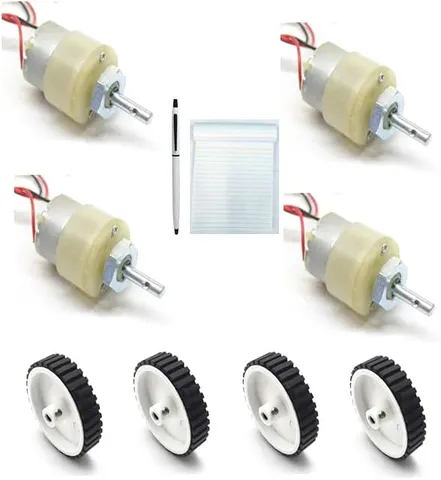
Value for Money 10IN1 12V 5KGCM 200 RPM High Torq Heavy Duty DC Metal Gear Motor
Code B0FGV1B8YF
- Paid for and delivered by Amazon. The current price and the delivery date for your PIN code are shown there.
- Sold by Gurukul Technicals Institute, Delhi.
- Need a different topic, a custom version or a school order? Ask on WhatsApp.
Physics
About this part
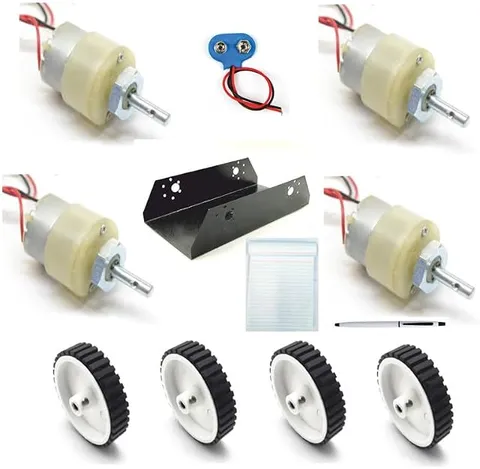
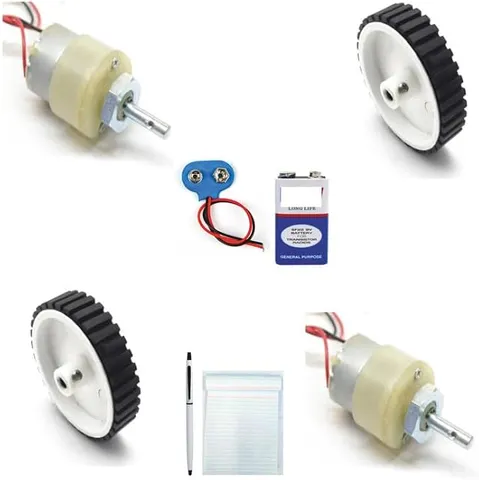
This is a 12 V DC motor with metal gears, and its title rates it at 200 RPM with 5 kg-cm of torque. It is a component rather than a finished model, used to power wheels, lifts, conveyors and arms in robotics and engineering projects. The title also says '10IN1', so check the listing for exactly what that covers.
How it works
The science behind it
The idea the part demonstrates, in words you can use in your report and when you explain it.
A DC motor turns electrical energy into mechanical work: a current-carrying coil in a magnetic field feels a force and turns. As the coil spins, it also behaves like a generator and produces a back emf that opposes the supply voltage. The faster it turns, the larger the back emf and the smaller the current. So a free-running motor draws little current, while a stalled motor, with no back emf, draws the most current and heats up. Speed rises roughly in proportion to the supply voltage, which is why a 12 V motor runs slower on 6 V. Its metal gearbox slows the fast motor shaft to the rated speed and multiplies the torque by almost the same ratio. Torque is force times radius, so lifting a 1 kg load on a drum of 2 cm radius needs about 2 kg-cm, or roughly 0.2 N·m. Under load the speed falls below the listed figure, so leave a safety margin.
Using it in your projects
Using a 12 V 200 RPM metal gear motor in your projects
What this part is good for, what else you need with it and how to connect it.
Projects you can build with it 8
- A two-wheel or four-wheel robot car
- A conveyor belt model for a factory or waste-sorting project
- A crane or lift model that raises a load on a rope drum
- A rotating turntable to display an exhibition model
- An automatic gate or sliding door model with limit switches
- A line follower robot with IR sensors and a motor driver
- A seed-sowing or ploughing farm robot model
- A hand-crank generator that lights an LED when the shaft is turned
What else you need 10
How to connect it 9 steps
Check the shaft's diameter and shape (round or D-shaped) and fit a matching wheel or coupler, tightening its grub screw onto the flat side.
With an adult, solder the 0.1 µF capacitor across the two motor terminals to cut electrical noise, then solder on red and black leads and insulate the joints.
Fix the motor firmly with a clamp or bracket so its body cannot twist when the wheel is loaded.
Test it first on 6 V (four AA cells) and then on 12 V (eight AA cells), and notice that the speed roughly doubles.
Wire the DPDT switch as a reversing switch: battery to one pair of end terminals, those cross-wired to the other pair, and the motor to the middle terminals. Check that the shaft reverses.
Put the multimeter in series on its 10 A range and measure the current running free and then with a light load. Do not hold the shaft stopped while measuring, as the stall current is large.
- Measure the speed
Stick a tape flag on the wheel, count turns in 30 seconds and multiply by 2 to get RPM, then compare with the rated 200 RPM at 12 V.
- Work out the pull
On a drum of 1.5 cm radius, the title's 5 kg-cm torque gives at most about 5 ÷ 1.5 ≈ 3.3 kg of pull, so design for well under half of that.
For a robot, connect the motor to an H-bridge driver module so a microcontroller board can control its direction and speed, powering the module from the 12 V supply and joining all the negative lines.
Read this first
Safety first
Go through these points before you build or switch anything on. Younger students should do this with an adult.
- Fit the fuse in the battery's positive lead and never let bare wires touch; a 12 V pack can push enough current to melt thin wire and burn fingers.
- Do not stall the motor for more than a moment; with no back emf it draws its largest current and the windings heat up quickly.
- Keep fingers, hair and loose sleeves away from the shaft, gears and wheels; a geared motor has enough torque to pinch hard.
- Charge rechargeable packs only with their own charger and with an adult, and never use a swollen or damaged battery.
- Fix the motor and its load firmly before switching on, so nothing can swing loose or fly off.
- Solder only with an adult, and rest the hot iron in its stand.
Troubleshooting
If something does not work
The usual problems with this part and how to fix them. Open a problem to see the fix.
The motor hums but does not turn
It is stalled: the load is too heavy, the battery is sagging, or the wheel is rubbing on something. Switch off at once, lighten the load, free the wheel and measure the battery voltage while the motor runs.
It runs much slower than 200 RPM
The supply is below 12 V (eight rechargeable AA cells give only about 9.6 V), the wires are too thin, or the load is heavy. Measure the voltage at the motor terminals while it runs.
The wheel slips on the shaft
The grub screw is not on the flat side of the shaft, or the wheel's bore is the wrong size. Tighten the screw onto the flat, and use a wheel or coupler made for this shaft size.
The microcontroller board resets when the motor starts
The motor's starting current pulls the supply down and makes electrical noise. Power the board from a separate battery with the negatives joined, and keep the 0.1 µF capacitor on the motor.
Exhibition day
How to present it
A running order for the exhibition table or the practical, step by step.
Fix a small drum or pulley to the shaft and lift a light weight on a string to show torque at work.
If you have a variable supply, run the motor at a lower voltage and show the speed falling.
Load the shaft gently by hand and explain why the motor slows and draws more current.
For a robot, plan a motor driver and a power supply that can handle the extra current at start-up and under load.
Practice
Viva questions
Practice questions on this part, with short answers. Try each one aloud before you open the answer.
What is back emf in a DC motor?
It is the voltage induced in the spinning coil that opposes the supply voltage; it rises with speed and limits the current.
Why does a motor heat up if its shaft is stalled?
With the shaft stopped there is no back emf, so a large current flows through the coil and heats it.
How much torque is needed to lift a 1 kg load on a drum of 2 cm radius?
About 2 kg-cm, or roughly 0.2 N·m, because torque equals the force multiplied by the radius.
What does the gearbox of a gear motor do?
It reduces the shaft speed and increases the torque by nearly the same ratio, so the output turns slowly but strongly.
Buying checklist
Before you buy
What to check before you order the part, and what to do when it arrives.
1Before you order
- Check that 200 RPM suits your project: it gives a moderate speed for robot car wheels, but a crane or conveyor may need a slower motor.
- Read the listing for the shaft diameter, mounting holes, rated current and what '10IN1' covers, so you can buy matching wheels, clamps and a driver.
- Make sure your battery can supply the motor's current at 12 V; a single small 9 V battery is not enough.
- Keep the box and any small screws or keys safely until your project is finished.
- Check the delivery date for your PIN code on the marketplace, and order well before the exhibition or practical.
- Practise explaining it. Judges ask what the part shows and why; knowing the science matters as much as the part. The viva questions above are a good place to start.
2When it arrives
- When it arrives, test it at a low voltage first and check it runs smoothly in both directions with no grinding.
Next steps
Take it further
Ways to turn this part into a bigger investigation or a stronger exhibition entry.
Use a PWM motor speed controller module and plot the speed against the controller setting.
Add a slotted disc and an IR sensor to count revolutions and display the RPM on a microcontroller board.
Measure the input power (V × I) and the output power when lifting a known mass at a measured speed, and work out the efficiency.
Audience
Who it suits
Class 9 to 12 students, diploma and engineering students, and hobbyists building robots, lifts and other projects that need a slow, strong motor.
- ClassClass 1 to 9
- SubjectPhysics
Free to read
Free ebooks for this topic
Free PDF ebooks from Gurukul Technicals Institute on the science, the making and the presenting of projects like this one.
- Free PDF ebook
Electronic Components Handbook
Resistors, capacitors, LEDs, diodes, transistors and more, with how to use each
- Free PDF ebook
Electricity and Magnetism Experiments
Hands-on experiments with cells, wires, bulbs and magnets
- Free PDF ebook
Motors, Gears and Motor Drivers
Make things move: DC motors, servos, steppers and how to drive them