 45% off
- Physics
- Ready-made model
- Class 10 to 12
- Printed report included
Self Inductance Induction Science Class 12 Physics Investigatory Project Model
Code B0HLY7PJFF
- Paid for and delivered by Amazon. The current price and the delivery date for your PIN code are shown there.
- Sold by Gurukul Technicals Institute, Delhi.
- Need a different topic, a custom version or a school order? Ask on WhatsApp.
In this project guide
Ready-made model
About this model
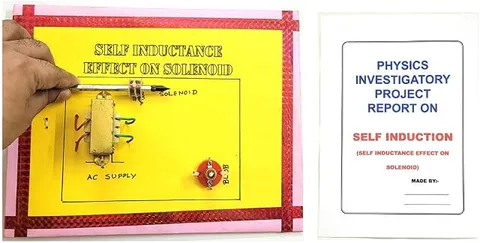
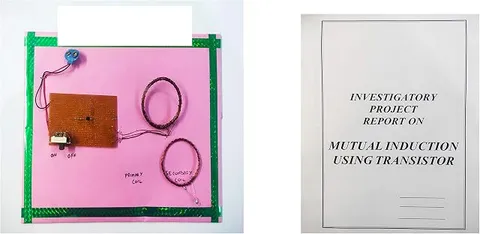
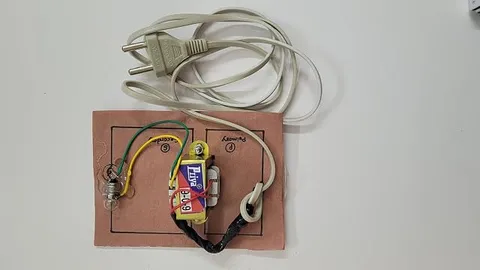
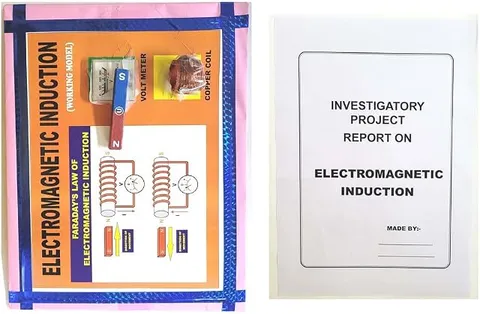
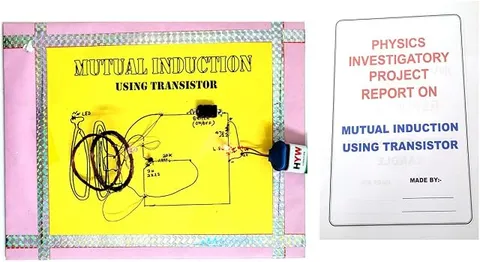
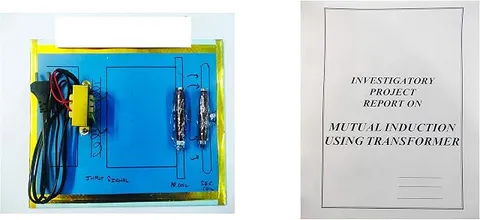
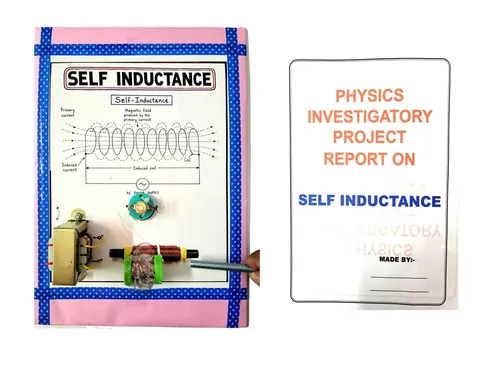
This Class 12 physics investigatory model shows self-induction, the property by which a coil opposes any change in the current through it. As shown in the photo, a white chart framed in blue star-print tape on a pink board carries a labelled drawing of a coil and its magnetic field, marked AC power supply. Below it are a small transformer, a bulb in a green holder, and copper coils on a black tube into which a threaded metal rod is pushed as a core. A printed report cover is also shown.
How it works
The science behind it
The idea the model demonstrates, in words you can use in your report and when you explain it.
When the current in a coil changes, the magnetic flux linked with that same coil changes, and by Faraday's law an emf is induced in it. This is self-induction. By Lenz's law the induced emf opposes the change in current that produces it, so it is often called a back emf. Its size is e = −L dI/dt, where L is the self-inductance, measured in henry (H). For a long solenoid, L = μ0μrN²A/l, so L grows with the square of the number of turns, with the area of the coil and with the relative permeability of the core; a soft iron core raises it many times. On steady DC a coil acts only as a resistance, because the current is not changing. On AC it opposes the current with an inductive reactance XL = 2πfL, so pushing an iron core into a coil in series with a bulb makes the bulb dimmer. A coil stores energy ½LI² in its magnetic field. The choke in an old tube-light fitting works on self-induction.
Make it yourself
Make a self-inductance coil and bulb model yourself
Build your own version from scratch, or use the steps to understand how the ready-made model is put together before you present it.
What you need 10
Step by step 8 steps
Wrap one layer of tape over the pipe so its edges cannot scratch the wire. Wind around 1000 turns of enamelled wire tightly in one direction, layer by layer, taping each layer, and leave about 15 cm free at each end.
Rub about 1 cm of enamel off each wire end with sandpaper until the copper shines, and fix the ends to two screw terminals on the base.
Fix the bulb holder and the switch on the base and wire them in series with the coil, leaving two input terminals for the power supply.
With the adapter unplugged, connect its output leads to the input terminals. Then ask an adult to plug it in and switch it on: the bulb should glow.
Slowly push the iron core into the coil. The bulb grows dimmer as more iron goes in, and brightens again as you pull it out.
Measure the AC voltage across the bulb with the core out and with the core fully in, and write both readings in a table.
Ask the adult to switch off and unplug the adapter. Connect the AA cell pack in its place, switch on and push the core in again: once the current is steady, the brightness does not change.
Draw the coil, its field lines and the circuit on the chart, and write e = −L dI/dt and XL = 2πfL beside the model.
Read this first
Safety first
Go through these points before you build or switch anything on. Younger students should do this with an adult.
- Only an adult should plug in, switch on, switch off and unplug the AC adapter. Never connect the coil or any wire to a wall socket, and never open the adapter.
- The coil and the bulb can get warm, so switch off between demonstrations and never leave the model running unattended.
- When a DC circuit through a large coil is broken, the induced emf can be much higher than the battery voltage, so do not hold the bare coil ends while switching off.
- Ask an adult to cut nails or iron strips for the core, cover sharp ends with tape, and wash your hands after sanding the enamel.
Troubleshooting
If something does not work
The usual problems with this model and how to fix them. Open a problem to see the fix.
The bulb does not glow at all
Check that the enamel is fully cleaned off both wire ends, that the bulb is tight in its holder, and that the coil has no break, using the multimeter's continuity setting.
The bulb glows but does not dim when the core goes in
The adapter may give DC, not AC, so read its label. If it is AC, the coil needs more turns or more iron: add turns, use a thicker bundle of nails, and let the core stick out beyond both ends of the coil.
The bulb is dim even with the core out
The coil's resistance is taking too much of the voltage. Rewind it with thicker enamelled wire, and check with the multimeter that the adapter gives the voltage on its label.
The core hums or is pulled into the coil
The coil acts as an electromagnet and pulls on the iron. On AC this pull rises and falls twice in every cycle, which causes the hum. Hold the core firmly and keep the coil taped tightly.
Exhibition day
How to present it
A running order for the exhibition table or the practical, step by step.
Slide the metal rod into the coil and out again while the bulb is lit, and explain why more iron inside the coil makes a bulb dimmer on AC.
Write e = −L dI/dt and XL = 2πfL on a card and explain each symbol in your own words.
Explain that on a steady battery current the iron core would make no difference to the steady brightness, because only a changing current induces a back emf.
Relate the model to the choke in an old tube-light fitting, which uses self-induction to start the tube and limit its current.
Practice
Viva questions
Practice questions on this model, with short answers. Try each one aloud before you open the answer.
What is self-induction?
It is the production of an emf in a coil when the current through that same coil changes; the induced emf opposes the change.
What is the SI unit of self-inductance?
The henry (H). A coil has an inductance of one henry if a current changing at one ampere per second induces an emf of one volt in it.
Why does a soft iron core increase the inductance of a coil?
Iron has a high relative permeability, so it greatly increases the magnetic flux linked with the coil for the same current.
Why does a coil oppose AC but not a steady DC?
AC keeps changing, so it induces a back emf all the time, giving a reactance XL = 2πfL; a steady current induces no emf.
Project file
Project file outline
The headings of the project file, in order. Give each heading its own section and write it in your own words.
The listing includes a printed project report: use this outline to check that your own file covers every part.
Free ebook: Writing a Science Project FileContents
- Aim: to study self-induction and the effect of an iron core on a coil carrying AC
- Introduction: electromagnetic induction, Faraday's law and Lenz's law
- Self-inductance, its unit the henry, and the factors it depends on
- Inductive reactance: why a coil opposes AC but not steady DC
- Materials, circuit diagram and construction of the coil
- Observations: bulb brightness and voltage with the core out and in, on AC and on DC
- Applications: the choke of a tube-light fitting, filter coils in power supplies and tuning coils in radios
- Precautions and sources of error
- Conclusion and bibliography
Buying checklist
Before you buy
What to check before you order the model, and what to do when it arrives.
1Before you order
- Check that your teacher accepts self-inductance as your topic; it belongs to the electromagnetic induction chapter of Class 12.
- Read the listing to see how the model is powered and what is mentioned with it, such as a report, and arrange anything else you need.
- If the model plugs into a wall socket, let only an adult plug it in and switch it off, and do not touch the board's wiring while it is on.
- Keep the box and carry the board flat, so the coils and their wire ends are not pulled loose.
- Check the delivery date for your PIN code on the marketplace, and order well before the exhibition or practical.
- The project report is a learning aid. Read it, understand how the model works, and write your own observations; schools expect your own work.
- Practise explaining it. Judges ask what the model shows and why; knowing the science matters as much as the model. The viva questions above are a good place to start.
2When it arrives
- Try the model with an adult soon after it arrives: switch on, slide the rod into the coil and watch the bulb.
Next steps
Take it further
Ways to turn this model into a bigger investigation or a stronger exhibition entry.
Bend soft iron strips into a closed loop through the coil, so the iron path is complete, and compare how much the bulb dims with a straight core.
With your teacher, connect a neon lamp across the coil and a battery through a switch; the lamp flashes when the circuit is broken, because the induced emf is much higher than the battery voltage.
Measure the AC voltage across the coil and across the bulb separately, and show that they do not simply add up to the supply voltage, because of the phase difference in an LR circuit.
Audience
Who it suits
Suits Class 12 physics investigatory projects on electromagnetic induction and alternating current, and science exhibitions on electromagnetism.
- ClassClass 10 to 12
- SubjectPhysics
- TypeReady-made model
- Project reportPrinted report included
Free to read
Free ebooks for this topic
Free PDF ebooks from Gurukul Technicals Institute on the science, the making and the presenting of projects like this one.
- Free PDF ebook
Electricity and Magnetism Experiments
Hands-on experiments with cells, wires, bulbs and magnets
- Free PDF ebook
Physics Working Models Explained
Twenty classic models, how each works and how to make it
- Free PDF ebook
Investigatory Projects for Class 11 and 12
Topics, method and report structure for physics, chemistry and biology
- Free PDF ebook
Your Science Exhibition Guide
Choose a project, build it, present it and answer the judges with confidence