- Physics
- Ready-made model
- Class 1 to 9
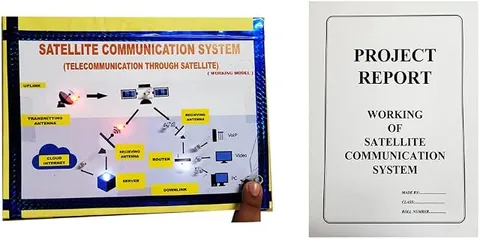
Satellite Communication System Physics Working Model Educational Science Project, Multicolor
Code B0BN2HFXC3
- Paid for and delivered by Amazon. The current price and the delivery date for your PIN code are shown there.
- Sold by Gurukul Technicals Institute, Delhi.
- Need a different topic, a custom version or a school order? Ask on WhatsApp.
In this project guide
Ready-made model
About this model
A working model of a satellite communication system that shows how signals travel from a ground station up to a satellite and back down to receivers far away. It helps students explain how DTH television, weather updates and long-distance links reach places that cables cannot.
How it works
The science behind it
The idea the model demonstrates, in words you can use in your report and when you explain it.
Most communication satellites are placed in geostationary orbit, about 36,000 km above the equator. At this height a satellite takes 24 hours to go round the Earth, the same time the Earth takes to rotate, so it appears fixed in the sky and a dish antenna can stay pointed at it. A ground station sends a signal up to the satellite, called the uplink. The satellite's transponder receives it, amplifies it, shifts it to a different frequency and beams it back down, called the downlink, over a very large area. Different frequencies are used for up and down so that the strong outgoing signal does not drown the weak incoming one. Microwaves are used because they pass through the ionosphere, while lower-frequency radio waves are reflected by it. Three evenly spaced geostationary satellites can cover almost the whole Earth. ISRO's INSAT and GSAT satellites carry many of India's television and weather services.
Make it yourself
Make a satellite communication model with signal lights yourself
Build your own version from scratch, or use the steps to understand how the ready-made model is put together before you present it.
What you need 10
Step by step 9 steps
Paint the hemisphere as the Earth, with the equator marked, and fix it near one end of the base.
Fix the satellite on its stand high above the Earth, and label it 'geostationary orbit, about 36,000 km above the equator'.
Place the ground station dish on one side of the Earth pointing at the satellite, and two receiving dishes on small houses on the other side.
Fix five red LEDs in a line from the ground station up to the satellite (the uplink) and five green LEDs from the satellite down to the houses (the downlink), on card strips or stiff wires.
- Build the chaser
555 pins 8 and 4 to positive, pin 1 to negative, 1 kΩ from positive to pin 7, 47 kΩ from pin 7 to pins 6 and 2 joined, the 10 µF capacitor from pin 2 to negative (long leg to pin 2), and pin 3 to the CD4017's clock, pin 14; the counter's pin 16 goes to positive and pins 8, 13 and 15 to negative.
Wire outputs Q0 to Q4 (pins 3, 2, 4, 7 and 10) to the uplink LEDs from the ground upwards, and Q5 to Q9 (pins 1, 5, 6, 9 and 11) to the downlink LEDs from the satellite downwards. Join all the LEDs' short legs and take them to negative through the one 470 Ω resistor.
Hide the circuit under the base, with the battery and switch at the front edge.
- Switch on
A light climbs up to the satellite and then comes down to the homes, showing the path of the signal.
Add labels for uplink, transponder, downlink and footprint, and a card explaining that the uplink and downlink use different frequencies.
Read this first
Safety first
Go through these points before you build or switch anything on. Younger students should do this with an adult.
- Solder only with an adult present, and keep the hot iron in its stand.
- Blunt the points of skewers and toothpicks, and bend over any sharp wire ends.
- Use the cutter and hot glue only with an adult nearby.
- Switch off and unclip the battery when the model is not on show.
Troubleshooting
If something does not work
The usual problems with this model and how to fix them. Open a problem to see the fix.
The light runs the wrong way along one beam
Those LEDs are connected to the outputs in reverse order. Rewire them so the lowest output is nearest the start of the path.
Two neighbouring LEDs light together
There is probably a solder bridge between two output pins of the counter. Look closely at the back of the board and remove it.
The lights do not move at all
The 555 is not sending pulses. Check its capacitor, that pin 4 goes to positive, and that the counter's pins 13 and 15 go to negative.
The satellite stand leans or falls over
The base is too light or the wire too thin. Fix the stand deeper into the base, use a thicker rod, and keep the satellite light.
Exhibition day
How to present it
A running order for the exhibition table or the practical, step by step.
Trace the signal path on the model: ground station, uplink, satellite transponder, downlink, receivers.
Explain why the satellite appears fixed in the sky and why that matters for a rooftop dish antenna.
Show on a globe or chart how three geostationary satellites can cover nearly the whole Earth.
Name real uses such as DTH television, weather forecasting and disaster warnings.
Practice
Viva questions
Practice questions on this model, with short answers. Try each one aloud before you open the answer.
What is a geostationary satellite?
It is a satellite orbiting above the equator at about 36,000 km with a period of 24 hours, so it appears to stay fixed above one point on Earth.
What are uplink and downlink?
Uplink is the signal sent from a ground station to the satellite, and downlink is the signal sent from the satellite back to Earth.
Why are microwaves used for satellite communication?
Microwaves pass through the ionosphere instead of being reflected by it, so they can reach the satellite and come back.
What does a transponder do?
It receives the uplink signal, amplifies it, changes its frequency and retransmits it as the downlink.
Project file
Project file outline
The headings of the project file, in order. Give each heading its own section and write it in your own words.
Free ebook: Writing a Science Project FileContents
- Aim: to show how a communication satellite relays signals from a ground station to distant receivers
- Introduction: why satellites are needed where cables cannot reach
- Geostationary orbit: its height, its 24-hour period and why the satellite seems fixed in the sky
- Uplink, transponder and downlink, and why different frequencies are used
- Uses: DTH television, weather pictures, telephone links and disaster warnings
- India's communication satellites, such as the INSAT and GSAT series
- Construction of the model and the LED signal circuit
- Limitations: signal delay and the effect of heavy rain
- Conclusion and bibliography
Buying checklist
Before you buy
What to check before you order the model, and what to do when it arrives.
1Before you order
- Check that the topic suits your class level and your teacher's instructions.
- Read the listing to see how the lights are powered and whether batteries are mentioned.
- Test the lights a few days before the exhibition and practise explaining uplink and downlink.
- Keep the box for carrying it to school.
- Check the delivery date for your PIN code on the marketplace, and order well before the exhibition or practical.
2When it arrives
- The satellite and its stand are the parts most likely to bend in transport, so check them on arrival and pack them carefully.
Next steps
Take it further
Ways to turn this model into a bigger investigation or a stronger exhibition entry.
Calculate the delay for a signal going up to a geostationary satellite and back down, about 72,000 km at the speed of light, which is roughly a quarter of a second.
Show the satellite's height to scale: if your Earth is 10 cm across, a geostationary satellite would sit about 28 cm above its surface.
Explain how three geostationary satellites spaced 120 degrees apart can cover almost the whole Earth except the polar regions.
Audience
Who it suits
Suits Class 8 to 12 physics exhibitions on communication and space technology.
- ClassClass 1 to 9
- SubjectPhysics
- TypeReady-made model
Free to read
Free ebooks for this topic
Free PDF ebooks from Gurukul Technicals Institute on the science, the making and the presenting of projects like this one.
- Free PDF ebook
Physics Working Models Explained
Twenty classic models, how each works and how to make it
- Free PDF ebook
Your Science Exhibition Guide
Choose a project, build it, present it and answer the judges with confidence
- Free PDF ebook
Writing a Science Project File
How to write the report, from the cover page to the bibliography
- Free PDF ebook
Viva Questions for Science Projects
How to answer examiner questions, with sample questions for popular projects