- Science
- Ready-made model
- Class 10 to 12
Rain Alarm Using 555 Ic Physics Investigatory Minor Project And Model-15 Months Up, Multicolor For Baby
Code B0C3H7TNXG
- Paid for and delivered by Amazon. The current price and the delivery date for your PIN code are shown there.
- Sold by Gurukul Technicals Institute, Delhi.
- Need a different topic, a custom version or a school order? Ask on WhatsApp.
In this project guide
Ready-made model
About this model
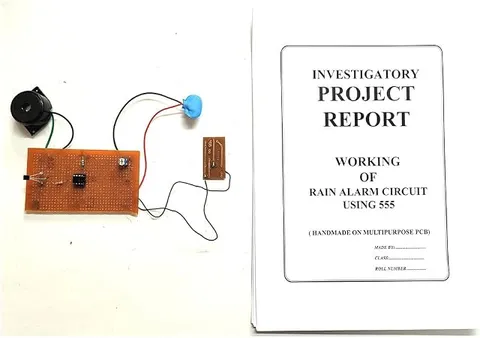
This rain alarm uses a 555 timer IC to sound an alert as soon as raindrops fall on its sensor. It is a useful investigatory project that shows how water can complete a circuit and how a 555 oscillator produces a warning tone.
How it works
The science behind it
The idea the model demonstrates, in words you can use in your report and when you explain it.
The rain sensor is usually a board with two sets of interleaved metal tracks that sit close together without touching, so when it is dry no current flows between them. Rainwater is not pure: it contains dissolved salts and gases that form ions, so it conducts electricity. A raindrop bridging the tracks lets a small current flow, which in many designs switches on a transistor that then powers or enables a 555 timer working in astable mode, in which it oscillates continuously at a frequency f ≈ 1.44 / ((R1 + 2R2) × C). This oscillating output drives a buzzer or speaker to give a tone. Pure distilled water is a very poor conductor, which shows that it is the dissolved impurities that carry the current. In the monsoon, an alarm like this can warn a family to bring in clothes drying on the terrace, and similar water sensors are used to detect leaks and to control irrigation.
Make it yourself
Make a 555 rain alarm yourself
Build your own version from scratch, or use the steps to understand how the ready-made model is put together before you present it.
What you need 10
Step by step 8 steps
- Make the sensor
Lay two copper tracks in a comb pattern so their fingers interleave about 2 mm apart without touching, and solder a wire to each track.
Build the 555 as a tone oscillator: pin 1 to negative, pin 8 to positive, 1 kΩ from pin 8 to pin 7, 6.8 kΩ from pin 7 to pins 2 and 6 (joined), 0.1 µF from pins 2 and 6 to negative, and 0.01 µF from pin 5 to negative. This gives a tone of about 1 kHz.
Connect pin 3 through the 100 Ω resistor and the 10 µF capacitor (long leg towards pin 3) to the speaker, and the speaker's other lead to negative.
Keep the 555 silent when dry: connect pin 4 to negative through the 10 kΩ resistor and also to the emitter of the BC547, and connect the collector to positive.
Connect one sensor wire to positive, and the other to the transistor's base through the second 1 kΩ resistor, with the 100 kΩ resistor from the base to negative.
- Switch on
The speaker should stay silent while the sensor is dry. Put a drop of tap water across the tracks and the tone should start.
Test a drop of distilled water, tap water and salt water in turn, drying the sensor in between, and note which ones start the alarm.
Fit the circuit in the closed box indoors and place only the sensor outside, tilted slightly so water runs off and it dries when the rain stops.
Read this first
Safety first
Go through these points before you build or switch anything on. Younger students should do this with an adult.
- Keep the circuit and battery in a closed box away from water; only the sensor plate should ever get wet.
- Use only the 9 V battery; never put any mains-powered circuit outdoors or near water.
- Use the soldering iron only with an adult and rest it in its stand.
- Although the title mentions babies, this is an electronics project for school students: keep the small parts and battery away from young children.
Troubleshooting
If something does not work
The usual problems with this model and how to fix them. Open a problem to see the fix.
The alarm sounds when the sensor is dry
The tracks are touching somewhere, there is a solder bridge, or damp dust is lying between them. Clean the plate, check it with the multimeter's continuity range, and make sure the 100 kΩ resistor is in place.
Raindrops do not set it off
The tracks may be too far apart, or the emitter is not connected to pin 4. Test with a drop of salt water; if that works, bring the tracks closer together.
The alarm keeps sounding after the rain stops
Water is trapped between the tracks. Tilt the sensor more steeply so water runs off, and wipe it dry.
The copper tracks turn green or black
Current through wet tracks slowly corrodes them by electrolysis. Clean them with fine sandpaper or an eraser, and switch off when the alarm is not needed.
Exhibition day
How to present it
A running order for the exhibition table or the practical, step by step.
Sprinkle a few drops of water on the sensor to trigger the alarm, then dry it to stop.
Explain why tap water or rainwater conducts but distilled water hardly does.
Show the 555 astable formula on a chart and explain what sets the tone.
Keep the circuit board itself dry; only the sensor should get wet.
Practice
Viva questions
Practice questions on this model, with short answers. Try each one aloud before you open the answer.
Why does rainwater conduct electricity?
It contains dissolved salts and gases that form ions, and these ions carry the current.
In which mode is the 555 timer used in a rain alarm?
Astable mode, so that it oscillates and produces a continuous tone.
In many rain alarm designs, what does the transistor do?
It acts as a switch, turning on the alarm stage when the small current through the wet sensor reaches its base.
Does distilled water conduct electricity?
Only very poorly, because it has almost no dissolved ions.
Project file
Project file outline
The headings of the project file, in order. Give each heading its own section and write it in your own words.
Free ebook: Writing a Science Project FileContents
- Aim: to make an alarm that sounds when rain falls on a sensor
- Introduction: uses of a rain alarm at home and on farms
- Why rainwater conducts electricity: dissolved salts and ions
- The sensor plate and the transistor switch
- The 555 timer in astable mode, f ≈ 1.44 / ((R1 + 2R2) × C)
- Circuit diagram and construction
- Observations: response to distilled, tap and salt water
- Applications: rain-sensing car wipers, irrigation control and water level alarms
- Precautions and conclusion
Buying checklist
Before you buy
What to check before you order the model, and what to do when it arrives.
1Before you order
- Ignore the age wording in the title and check with your teacher that a 555 timer project suits your class.
- Read the listing to see what powers it and how the sensor connects, and keep a fresh battery ready.
- Carry a small dropper bottle of tap water to demonstrate it at the exhibition.
- Keep the box so the sensor plate is not bent or scratched.
- Check the delivery date for your PIN code on the marketplace, and order well before the exhibition or practical.
- Practise explaining it. Judges ask what the model shows and why; knowing the science matters as much as the model. The viva questions above are a good place to start.
2When it arrives
- Test it with a few drops of tap water as soon as it arrives, then dry the sensor fully.
Next steps
Take it further
Ways to turn this model into a bigger investigation or a stronger exhibition entry.
Test drops of water with different amounts of salt dissolved in them and relate how quickly the alarm responds to the concentration.
Turn it into a water level indicator with several probes at different heights in a model tank.
Change the logic so the alarm sounds when a soil probe dries out, and show it as a plant-watering reminder.
Audience
Who it suits
Class 8 to 12 students making a sensor or weather-related project; it is an electronics project for older children working with adult supervision, not a toy for babies.
- ClassClass 10 to 12
- SubjectScience
- TypeReady-made model
Free to read
Free ebooks for this topic
Free PDF ebooks from Gurukul Technicals Institute on the science, the making and the presenting of projects like this one.
- Free PDF ebook
Earth, Space and Geography Models
Solar system, seasons, eclipses, volcanoes and the water cycle explained
- Free PDF ebook
Physics Working Models Explained
Twenty classic models, how each works and how to make it
- Free PDF ebook
Investigatory Projects for Class 11 and 12
Topics, method and report structure for physics, chemistry and biology