- Science
- Ready-made model
- Class 10 to 12
- Printed report included
Solar LED Lights Readymade Science Working Project & Model in Physics for School & College (Printed Report Included)
Code B099QZWKD7
- Paid for and delivered by Amazon. The current price and the delivery date for your PIN code are shown there.
- Sold by Gurukul Technicals Institute, Delhi.
- Need a different topic, a custom version or a school order? Ask on WhatsApp.
In this project guide
Ready-made model
About this model
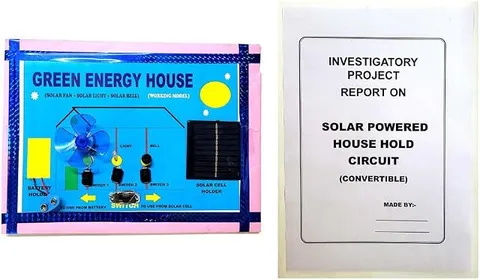
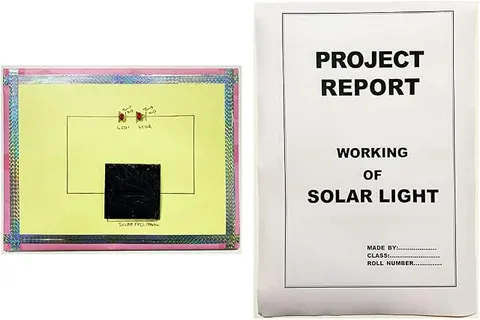
This readymade model shows how sunlight can be turned into electricity to light LEDs, which is the idea behind solar lamps and solar street lights. The listing says a printed report is included, which helps with the written part of an exhibition or project file.
How it works
The science behind it
The idea the model demonstrates, in words you can use in your report and when you explain it.
A solar cell is a wide, thin silicon p-n junction. Each photon of sunlight that carries enough energy can free an electron, leaving a hole behind. The built-in field at the junction separates these charges, sending electrons one way and holes the other, so a voltage appears across the cell and current flows through a connected circuit. This is the photovoltaic effect. One silicon cell gives only about 0.5 to 0.6 V, so cells are joined in series in a panel to reach a useful voltage. An LED (light emitting diode) does the opposite job: when current flows through it in the forward direction, electrons and holes recombine and release energy as light. LEDs waste far less energy as heat than filament bulbs, so they suit a small panel. The energy chain is light to electrical energy to light. Solar street lights and solar lanterns use this idea, usually with a battery that stores the day's energy for the night.
Make it yourself
Make a solar LED light model yourself
Build your own version from scratch, or use the steps to understand how the ready-made model is put together before you present it.
What you need 9
Step by step 8 steps
Measure the panel's voltage with the multimeter in sunlight and in shade, and note the difference.
Connect the panel's positive wire to the diode's plain end and the diode's banded end to the positive terminal of the cell holder, and the panel's negative wire to the holder's negative.
Connect the four LEDs, each with its 47 Ω resistor, in parallel, and wire them to the cell holder through the on/off switch.
Put the panel in sunlight with the switch off, and measure the charging current by placing the multimeter in series between the diode and the cells.
Tilt the panel at different angles to the Sun and note which angle gives the most current.
After charging, take the model into a dark room, switch on the LEDs and time how long they stay bright.
Cover the panel and show that the cells keep their voltage, because the diode stops them discharging back through the panel.
Mount the panel on the roof of the model house or the top of the lamp post with the LEDs below it, and label the panel, diode, storage cells and lamps.
Read this first
Safety first
Go through these points before you build or switch anything on. Younger students should do this with an adult.
- Use only rechargeable NiMH cells with this simple circuit; never charge lithium cells or ordinary non-rechargeable cells from a panel without a proper charger.
- Use a small panel so the charging current stays low, and do not leave the cells charging in strong sun for days on end.
- Never look at the Sun while aiming the panel, and handle glass-covered panels by their edges.
- Do not short the cell holder's terminals, and solder only with an adult.
Troubleshooting
If something does not work
The usual problems with this model and how to fix them. Open a problem to see the fix.
The LEDs do not light after charging
The diode may be reversed, so the cells never charged, or an LED is the wrong way round. Check that the diode's band points towards the cells' positive terminal.
The charging current is very small
The panel is shaded, tilted away from the Sun or behind window glass. Take it outdoors and face it towards the Sun in clear daylight.
The lights go dim quickly
The cells were not charged for long enough, or they are old. Charge them in full sun for longer, or try a fresh set of NiMH cells.
The cells get warm while charging
The panel is too large for the cells. Use a smaller panel or charge for a shorter time.
Exhibition day
How to present it
A running order for the exhibition table or the practical, step by step.
Shade the solar panel with a card and explain what the model shows when the light is cut off.
Write the energy chain, light to electrical energy to light, on a chart.
Explain why LEDs are better than filament bulbs for solar lighting.
Give real examples such as solar street lights on highways and solar lanterns in villages.
Practice
Viva questions
Practice questions on this model, with short answers. Try each one aloud before you open the answer.
What is the photovoltaic effect?
The production of a voltage and current in a material, such as a silicon solar cell, when light falls on it.
Why are many solar cells connected in series in a panel?
Each silicon cell gives only about half a volt, so connecting them in series adds up their voltages.
How does an LED produce light?
When it is forward biased, electrons and holes recombine at its junction and give out energy as light.
Why do solar street lights need a battery?
To store the electricity produced during the day so that the lights can work at night.
Project file
Project file outline
The headings of the project file, in order. Give each heading its own section and write it in your own words.
The listing includes a printed project report: use this outline to check that your own file covers every part.
Free ebook: Writing a Science Project FileContents
- Aim: to show how sunlight can be turned into electricity, stored and used to light LEDs
- The solar cell and the photovoltaic effect
- Cells joined in series in a panel, and the panel's voltage and current
- Why a diode and storage cells are needed for lighting at night
- LEDs and why they save energy
- Circuit diagram and construction of the model
- Observation tables: panel output at different angles, charging time and lighting time
- Uses of solar lighting in villages and on streets, and conclusion
Buying checklist
Before you buy
What to check before you order the model.
1Check these first
- Check that the project suits your class and the chapter on sources of energy or semiconductor devices.
- The listing says a printed report is included; read it alongside your textbook and add your own readings.
- Read the listing to see whether the model stores energy and whether batteries are needed; do not assume anything it does not mention.
- Exhibition halls are indoors, so charge any storage cells in the sun the day before and bring photographs of the panel working outdoors.
- Keep the box so the panel's surface is not scratched in transport.
- Check the delivery date for your PIN code on the marketplace, and order well before the exhibition or practical.
- Practise explaining it. Judges ask what the model shows and why; knowing the science matters as much as the model. The viva questions above are a good place to start.
Next steps
Take it further
Ways to turn this model into a bigger investigation or a stronger exhibition entry.
Add an LDR switch so the lights come on by themselves at dusk, like a real solar street light.
Measure the panel's voltage and current with several loads and plot power against voltage to find its best working point.
Compare the panel's output on a clear day, a hazy day and through a dusty glass sheet, and explain why solar panels need cleaning.
Audience
Who it suits
Class 6 to 10 students preparing a renewable energy or solar power exhibition model.
- ClassClass 10 to 12
- SubjectScience
- TypeReady-made model
- Project reportPrinted report included
Free to read
Free ebooks for this topic
Free PDF ebooks from Gurukul Technicals Institute on the science, the making and the presenting of projects like this one.
- Free PDF ebook
Electricity and Magnetism Experiments
Hands-on experiments with cells, wires, bulbs and magnets
- Free PDF ebook
Physics Working Models Explained
Twenty classic models, how each works and how to make it
- Free PDF ebook
Your Science Exhibition Guide
Choose a project, build it, present it and answer the judges with confidence