- Components and Spares
- Component
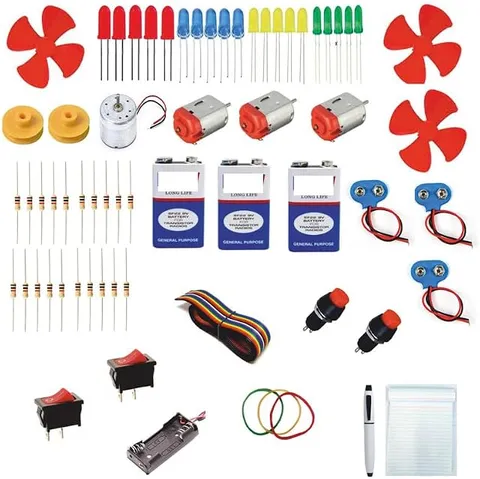
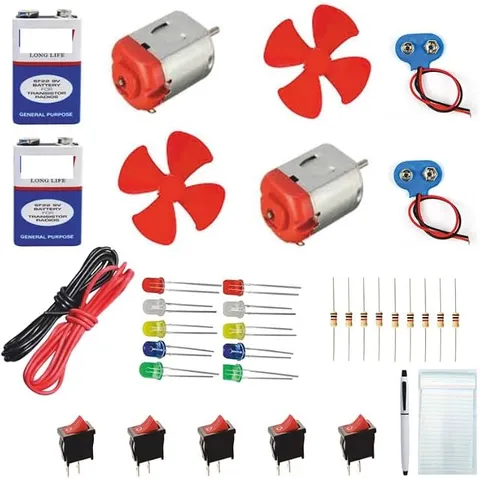
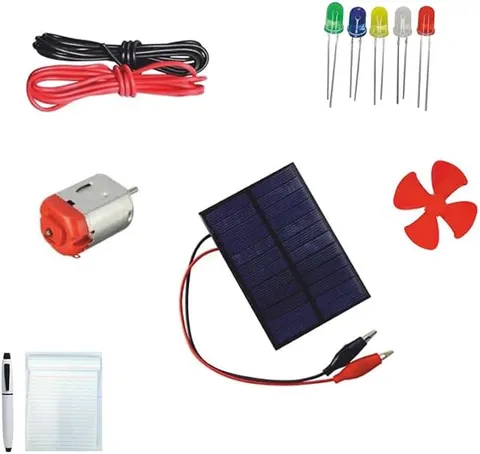
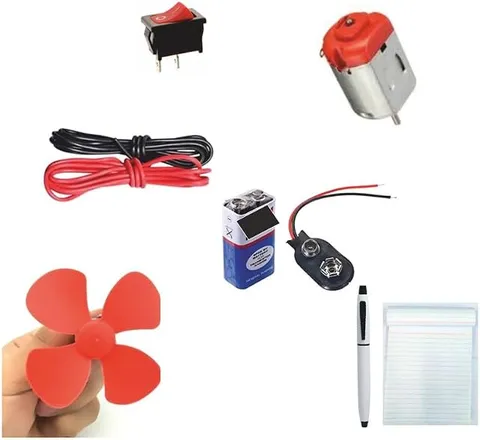
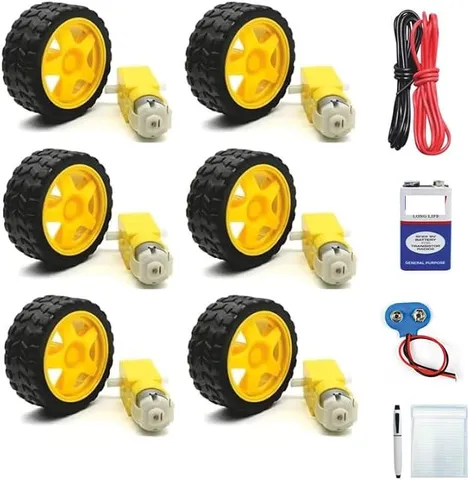
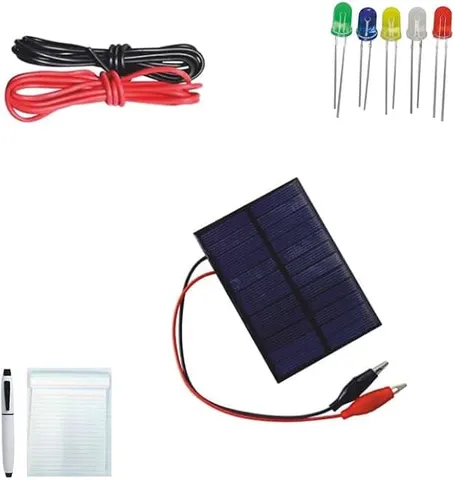
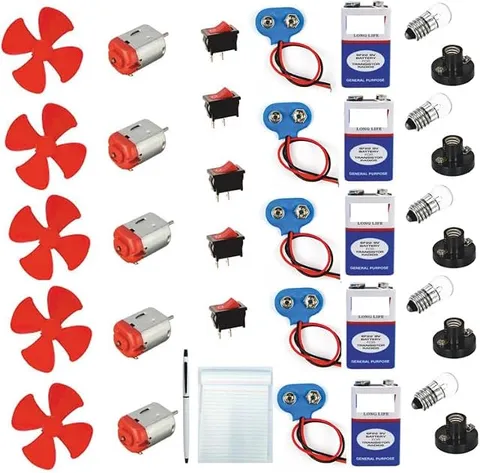
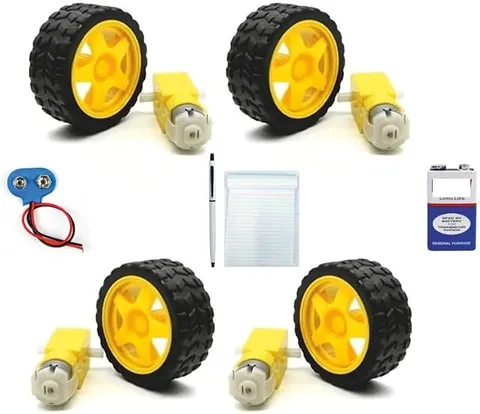
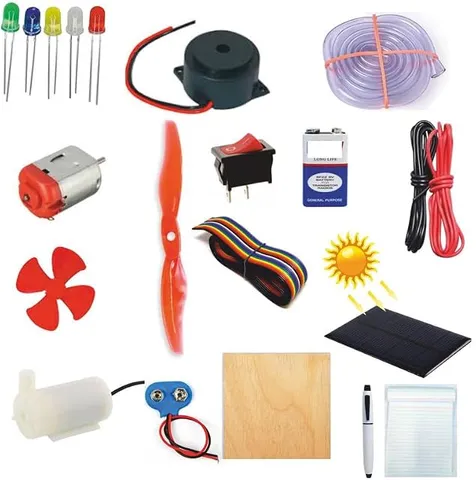
Submersible Pump DC Toy Motor Solar Panel with 9V Battery & Fan Blades DIY Kit
Code B0FGV37RHF
- Paid for and delivered by Amazon. The current price and the delivery date for your PIN code are shown there.
- Sold by Gurukul Technicals Institute, Delhi.
- Need a different topic, a custom version or a school order? Ask on WhatsApp.
In this project guide
Component
About this part
This is a DIY kit for solar and water projects; the listing names a submersible pump, a DC toy motor, a solar panel, a 9V battery and fan blades. With parts like these a student can build models such as a solar water pump for irrigation, a small fountain or a solar fan.
How it works
The science behind it
The idea the part demonstrates, in words you can use in your report and when you explain it.
Projects with these parts bring together three ideas. A solar panel uses the photovoltaic effect to turn sunlight into DC electricity; its output rises with the brightness of the light and is highest when sunlight falls straight on it, which is why fixed panels in India are usually tilted to face south. A DC motor turns electrical energy into rotation, which can spin fan blades. A small submersible pump is a motor sealed so it can run under water; its impeller spins and throws water outward by centrifugal action, pushing it up a pipe. The pump should not be run dry, because the surrounding water keeps it cool. The energy chain for a solar pump is light → electrical → kinetic → potential energy of the lifted water. Joining panels in series raises the voltage, while joining them in parallel raises the current. Many Indian farmers now use solar pumps to irrigate fields without diesel.
Make it yourself
Make a solar water pump and fan model yourself
Everything you need and the order to do it in. Tick off the materials as you collect them.
What you need 10
Step by step 9 steps
Read the voltage printed on the pump and the motor, or given in the listing. Many small pumps are made for 3 to 6 V, so check before you connect the 9 V battery.
Test the motor first by connecting it to the panel in sunlight, then press the fan blade firmly onto its shaft.
Put the pump fully under water in a bowl, fit the tube, and connect it briefly to check that water comes out. Never run it in air.
Fix the solar panel on a stand on the base, tilted to face the sun.
Wire the panel and the battery to the two-way switch so the pump can run from either; use the 9 V battery only if the pump's rating allows it.
- Build the scene
The lower tank as a well, the field above it with channels shaped in clay, and the tube running from the pump to the top of the field.
Tape every wire joint and keep the switch, battery and panel well away from the water.
Fix the fan on a small stand beside the field, wired to the panel, as a solar fan.
Run the pump in sunlight and let the water flow through the channels back into the tank, so the same water is used again.
Read this first
Safety first
Go through these points before you build or switch anything on. Younger students should do this with an adult.
- Never run the pump dry; switch it off before the tank empties.
- Keep the battery, switch and wire joints dry and above the water, with every joint taped.
- Keep fingers and hair away from the spinning fan blades, and fit a card guard around them for exhibitions.
- Ask an adult to use the glue gun and to cut the tube.
Troubleshooting
If something does not work
The usual problems with this part and how to fix them. Open a problem to see the fix.
The pump hums but no water comes out
Air is trapped inside it. Hold the pump fully under water and tilt it to let the bubble out, and check that the tube is not kinked.
It works with the battery but not with the panel
Indoor light is far too weak. Take the panel into direct sunlight and point it straight at the sun.
Water comes out only as a weak trickle
The tube may be too long or raised too high for the pump. Shorten it and lower the field, or use more cells within the pump's rated voltage.
The fan blows air the wrong way
Swap the motor's two wires to reverse its direction of rotation.
Exhibition day
How to present it
A running order for the exhibition table or the practical, step by step.
Build one complete project, such as a solar irrigation model, instead of showing the parts separately.
Keep the pump fully under water in a clear container so visitors can watch the flow.
Compare running the motor on the battery with running it on the panel under a lamp or sunlight.
Explain the energy chain from sunlight to lifted water on a small chart.
Practice
Viva questions
Practice questions on this part, with short answers. Try each one aloud before you open the answer.
Why should a submersible pump not be run without water?
The surrounding water keeps the pump cool, so running it dry can overheat and damage it.
What energy change takes place in a solar panel?
Light energy from the Sun is converted directly into electrical energy.
How does a centrifugal pump push water?
Its spinning impeller throws water outward, which builds up pressure that pushes the water up the outlet pipe.
Why does a solar fan slow down when a cloud covers the Sun?
Less light reaches the panel, so it produces less voltage and current for the motor.
Project file
Project file outline
The headings of the project file, in order. Give each heading its own section and write it in your own words.
Free ebook: Writing a Science Project FileContents
- Aim: to show how sunlight can run a water pump for irrigation
- Materials
- Energy conversion from sunlight to moving water
- Circuit diagram with the panel, switch, battery, pump and fan
- Construction of the model
- Observations: cups of water pumped per minute in sun, in shade and on the battery
- Benefits of solar pumps for farmers
- Conclusion
- Precautions
Buying checklist
Before you buy
What to check before you order the part, and what to do when it arrives.
1Before you order
- Check the listing for the voltage of the pump, the motor and the panel, so you know what each part can safely be connected to.
- Check in the listing whether a tube for the pump is included; if not, buy one that fits its outlet.
- Decide which model you will build, such as an irrigation pump, a fountain or a fan, and collect the containers before you start.
- Keep the box to store the parts, so the panel's surface is not scratched.
- Check the delivery date for your PIN code on the marketplace, and order well before the exhibition or practical.
- Building it yourself: younger students should build with an adult, especially with motors, batteries and small parts.
2When it arrives
- Test every part when it arrives, in a bowl of water and in sunlight, and again a few days before the exhibition.
Next steps
Take it further
Ways to turn this part into a bigger investigation or a stronger exhibition entry.
Measure how much water is pumped per minute to different heights and plot a graph.
Add a soil moisture sensor with a transistor switch so the pump runs only when the soil is dry.
Compare the flow at different panel angles at different times of day.
Audience
Who it suits
Suits Class 6 to 10 students building renewable-energy and smart-irrigation models for science fairs.
- CategoryComponents and Spares
- TypeComponent
Free to read
Free ebooks for this topic
Free PDF ebooks from Gurukul Technicals Institute on the science, the making and the presenting of projects like this one.
- Free PDF ebook
Electronic Components Handbook
Resistors, capacitors, LEDs, diodes, transistors and more, with how to use each
- Free PDF ebook
Electricity and Magnetism Experiments
Hands-on experiments with cells, wires, bulbs and magnets
- Free PDF ebook
Your Science Exhibition Guide
Choose a project, build it, present it and answer the judges with confidence