- Components and Spares
- Component
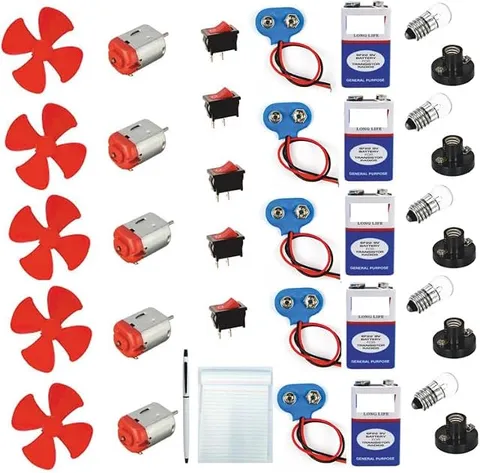
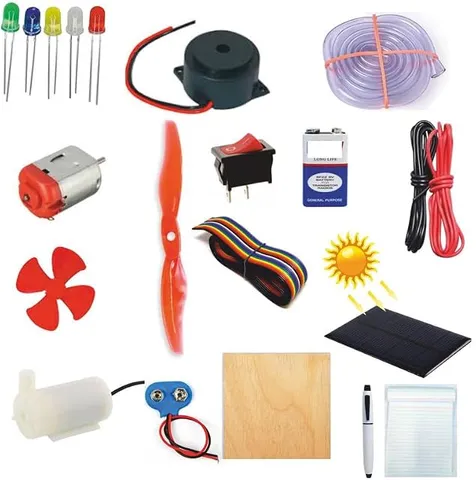
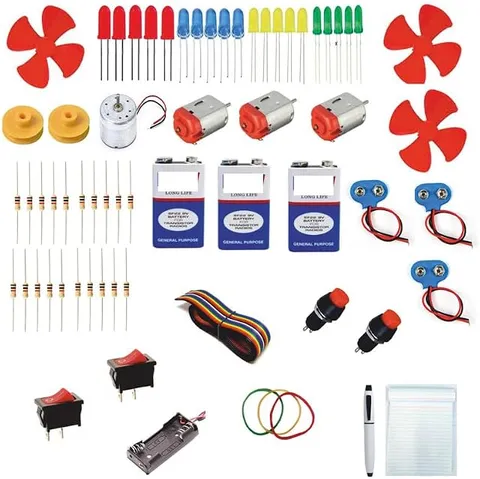
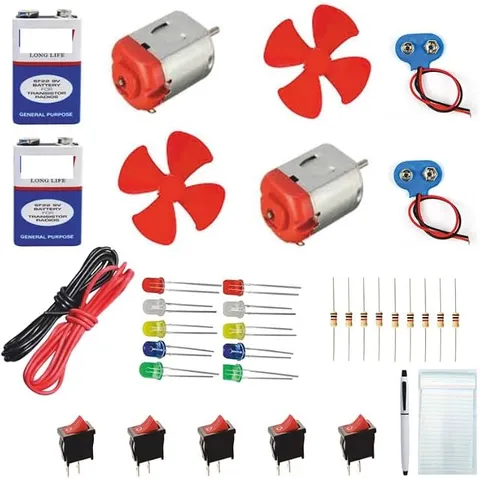
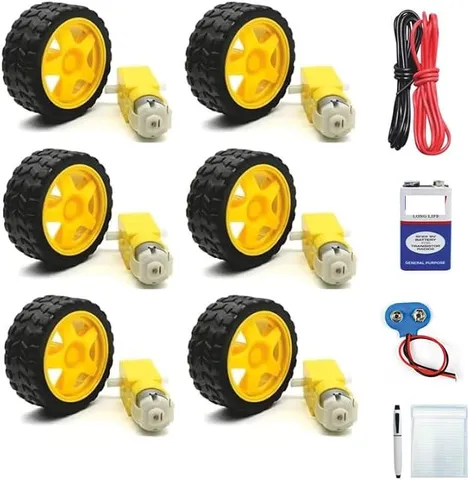
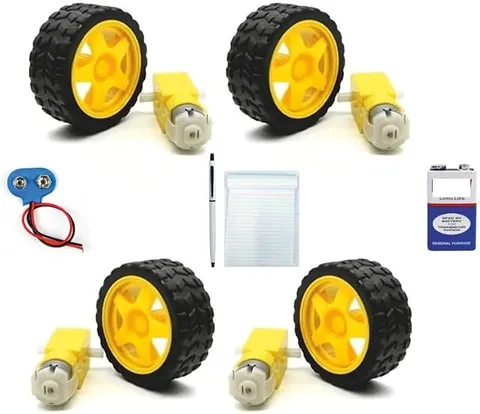
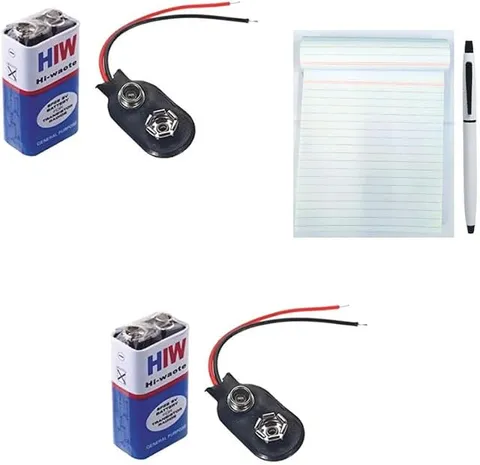
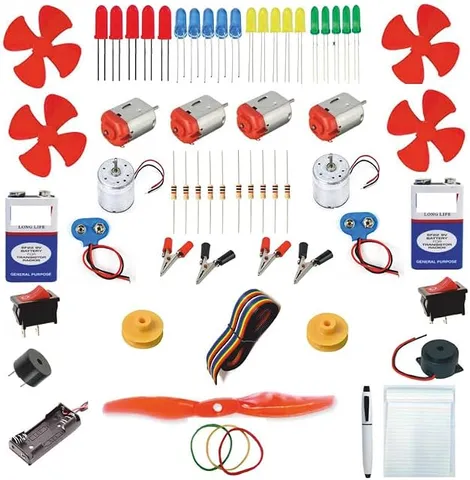
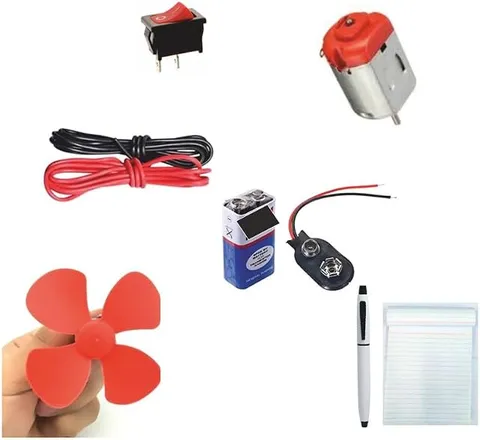
Toy Motor Kit with 9V HW Battery DC Motor Fan Blade with Pad and Pen
Code B0FGV5BRRF
- Paid for and delivered by Amazon. The current price and the delivery date for your PIN code are shown there.
- Sold by Gurukul Technicals Institute, Delhi.
- Need a different topic, a custom version or a school order? Ask on WhatsApp.
In this project guide
Component
About this part
A small starter kit that, according to its title, has a toy DC motor, a fan blade and a 9V battery, enough to build a simple battery-powered fan. It is a low-cost first project for children learning how electricity can make things move.
How it works
The science behind it
The idea the part demonstrates, in words you can use in your report and when you explain it.
A DC motor changes electrical energy into mechanical energy. Inside it, a coil sits between magnets. When current flows through the coil, the magnetic field pushes one side of the coil up and the other side down, so the coil turns. A part called the commutator reverses the current every half turn, which keeps the coil spinning in the same direction. If you swap the two battery wires, the current reverses and the motor spins the other way. When the fan blade spins, its tilted surfaces push air in one direction, and by Newton's third law the air pushes back on the blade with an equal and opposite force; this is how a fan drives a stream of air. A battery stores chemical energy, so the full chain is chemical to electrical to mechanical energy. The table fan in Indian homes works on a related idea, magnetic forces turning a rotor, though it runs on AC mains.
Make it yourself
Make a battery-powered hand fan yourself
Everything you need and the order to do it in. Tick off the materials as you collect them.
What you need 9
Step by step 8 steps
Check the motor's rated voltage if it is marked. Touch the battery leads to the motor's two terminals for a second: the shaft should spin.
Push the fan blade fully and straight onto the shaft so it does not wobble.
Fix the motor at the top of the handle with hot glue, with the shaft pointing forward and the blade well clear of the handle.
Cut a slot in the handle where your thumb rests and fix the switch there.
- Wire it in a loop
Battery red lead to the switch, switch to one motor terminal, the other motor terminal to the battery black lead. Twist and tape each joint, or solder it with an adult.
Hold the battery against the handle with the rubber band, or slide it inside the tube.
Switch on and feel the air. If it blows backwards, towards the handle, swap the two wires on the motor.
Make a ring-shaped finger guard from the card strip round the blade, then decorate the handle.
Read this first
Safety first
Go through these points before you build or switch anything on. Younger students should do this with an adult.
- The blade spins fast: keep fingers, hair and eyes away from it, and do not hold the fan close to anyone's face.
- Use hot glue only with an adult, and let it cool before touching.
- Never let the battery's terminals touch coins or keys in a pocket or bag; a shorted 9 V battery gets hot.
- Switch off if the motor gets hot, and do not hold the blade still while the motor is on.
Troubleshooting
If something does not work
The usual problems with this part and how to fix them. Open a problem to see the fix.
The motor hums but does not turn
The blade may be rubbing on the handle or guard, or the battery may be weak. Free the blade, spin it by hand, and try a fresh battery.
The fan blows air backwards
The motor is turning the wrong way. Swap its two wires to reverse it.
The fan wobbles and buzzes
The blade is tilted on the shaft. Pull it off and push it on again straight, all the way down.
The battery runs down quickly
A motor takes far more current than an LED. Switch off when you are not using the fan; AA cells last longer than a 9 V battery for motors.
Exhibition day
How to present it
A running order for the exhibition table or the practical, step by step.
Swap the battery wires during the demonstration to show the fan reversing direction, and explain why.
Trace the energy chain aloud: chemical energy in the battery, electrical energy in the wires, mechanical energy in the blade.
Disconnect the battery when you are not demonstrating, because a motor drains a small 9V battery quickly.
Keep fingers away from the spinning blade, and let younger visitors watch rather than touch.
Practice
Viva questions
Practice questions on this part, with short answers. Try each one aloud before you open the answer.
What energy conversion happens in an electric motor?
An electric motor converts electrical energy into the mechanical energy of rotation.
What happens if you reverse the battery connections?
The current through the coil reverses, so the force reverses and the motor spins the opposite way.
What is the function of the commutator?
It reverses the current in the coil every half turn so that the coil keeps rotating in the same direction.
How does a fan blade push air?
The tilted blade pushes air one way and the air pushes back equally on the blade, so a steady stream of air is driven forward.
Project file
Project file outline
The headings of the project file, in order. Give each heading its own section and write it in your own words.
Free ebook: Writing a Science Project FileContents
- Aim: to make a battery-powered fan and show how electrical energy is changed into motion
- Introduction: electric motors around us in fans, mixers and toys
- Parts used and the job of each: battery, switch, motor and fan blade
- Circuit diagram drawn with standard symbols
- How a DC motor works: magnets, coil and commutator
- How the blade pushes air, explained with Newton's third law
- Observations: reversing the wires reverses the airflow
- Precautions and conclusion
Buying checklist
Before you buy
What to check before you order the part, and what to do when it arrives.
1Before you order
- This makes a good first circuit project for younger classes; check what your teacher has asked for.
- Read the listing for the parts named, and check that the motor's rating suits the battery before connecting.
- Keep small parts away from younger brothers and sisters.
- Check the delivery date for your PIN code on the marketplace, and order well before the exhibition or practical.
- Check what is in the box on the marketplace listing, including any batteries or tools you need to add.
- Building it yourself: younger students should build with an adult, especially with motors, batteries and small parts.
2When it arrives
- Test the motor and battery as soon as the pack arrives.
Next steps
Take it further
Ways to turn this part into a bigger investigation or a stronger exhibition entry.
Compare blades with two, three and four wings by how far a strip of paper held in front of the fan bends.
Add an LED with a resistor that lights whenever the fan is switched on.
Use the motor as a generator: spin its shaft quickly by hand and measure the small voltage with a multimeter.
Audience
Who it suits
Suits Class 5 to 8 students making a first electricity project, with adult help for younger children.
- CategoryComponents and Spares
- TypeComponent
Free to read
Free ebooks for this topic
Free PDF ebooks from Gurukul Technicals Institute on the science, the making and the presenting of projects like this one.
- Free PDF ebook
Electronic Components Handbook
Resistors, capacitors, LEDs, diodes, transistors and more, with how to use each
- Free PDF ebook
Electricity and Magnetism Experiments
Hands-on experiments with cells, wires, bulbs and magnets
- Free PDF ebook
Your Science Exhibition Guide
Choose a project, build it, present it and answer the judges with confidence
- Free PDF ebook
Writing a Science Project File
How to write the report, from the cover page to the bibliography