- Components and Spares
- Component
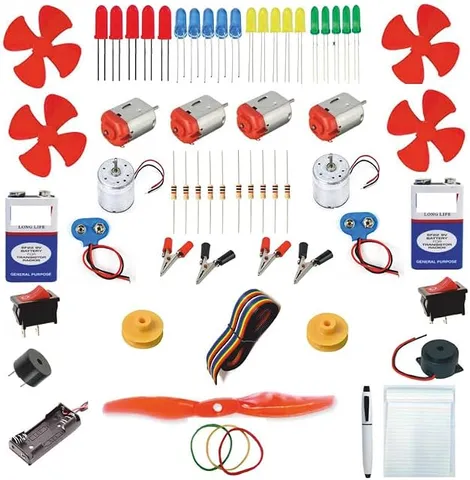
Dynamo Motor & Pulley & 70+ Necessary Electronic Components with Free Pen & Pad
Code B0FGV37H3Z
- Paid for and delivered by Amazon. The current price and the delivery date for your PIN code are shown there.
- Sold by Gurukul Technicals Institute, Delhi.
- Need a different topic, a custom version or a school order? Ask on WhatsApp.
Component
About this part
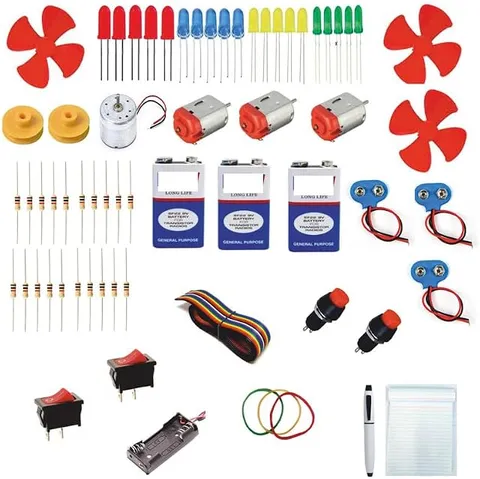
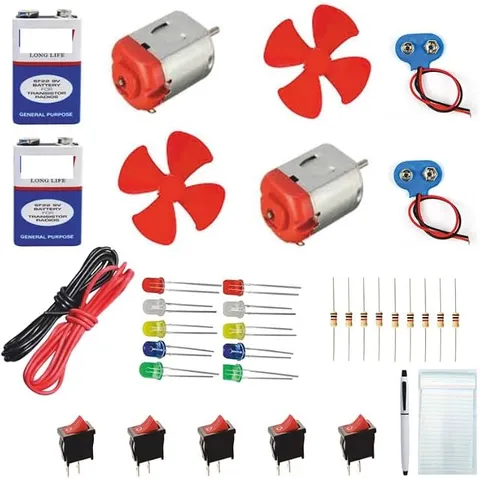
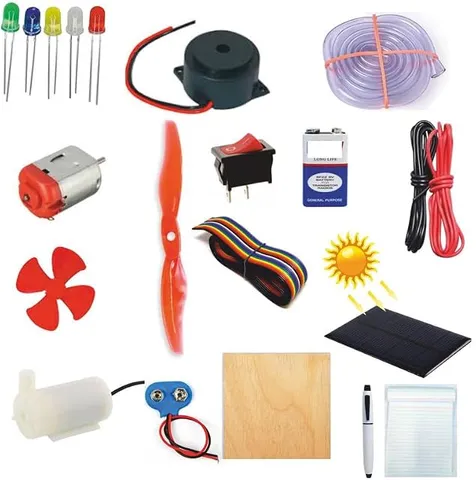
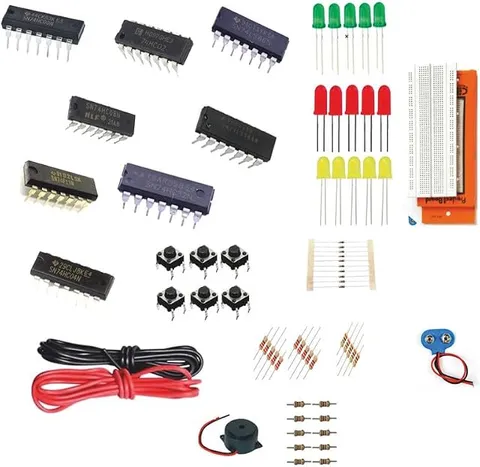
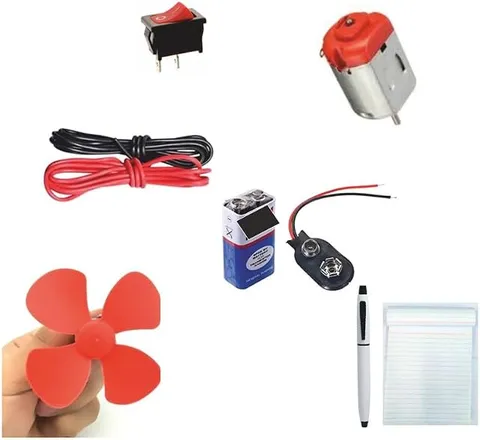
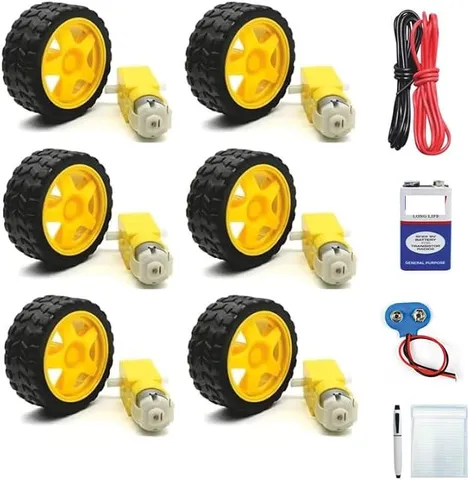
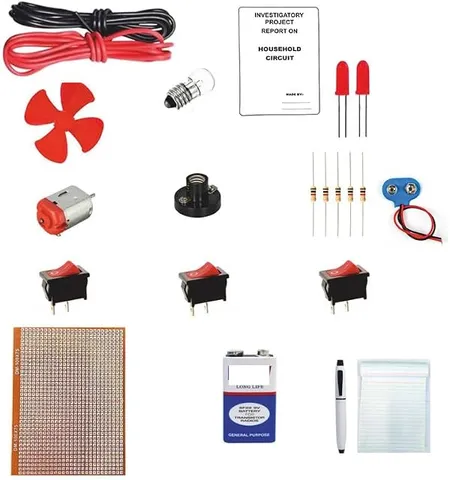
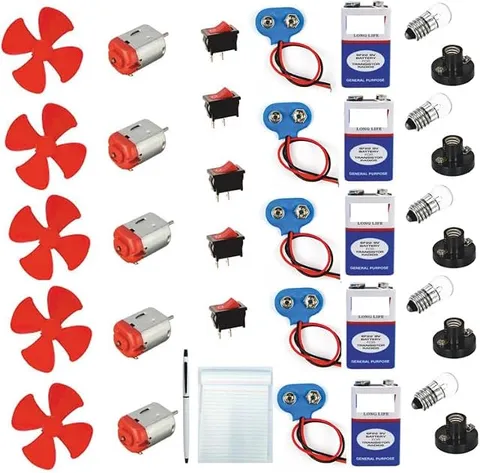
This parts set is built around a dynamo motor and pulley, and the listing says it also has 70+ electronic components. It lets a student build generator models such as a hand-crank torch or a mini windmill, and then go on to other circuits with the same set.
How it works
The science behind it
The idea the part demonstrates, in words you can use in your report and when you explain it.
A pulley and belt let you change speed. If a belt runs between two pulleys without slipping, the rim of each pulley moves at the same speed, so N1 × D1 = N2 × D2, where N is the rotation speed and D the diameter. A large pulley driving a small one makes the small one spin faster: a 6 cm pulley turned once a second drives a 2 cm pulley three times a second. This matters because a dynamo gives more voltage the faster it turns. By Faraday's law, the induced EMF depends on how quickly the magnetic flux through the coil changes, so doubling the speed roughly doubles the voltage. The same trick, a motor driving a machine through a belt and pulleys, runs the atta chakki in many Indian neighbourhoods, where the belt drive sets the speed of the grinding stones.
Using it in your projects
Using the dynamo motor, pulley and parts set in your projects
What this part is good for, what else you need with it and how to connect it.
Projects you can build with it 7
- Hand-crank torch using the pulley and an LED
- Mini windmill generator with light plastic blades
- Water wheel generator turned by a tap stream, with the electrics kept dry
- Pulley speed-ratio experiment with wheels of different sizes
- Bicycle dynamo model showing a wheel driving a generator
- Motor versus generator: one motor doing both jobs
- Small conveyor belt driven by the motor and pulley
What else you need 8
How to connect it 8 steps
- Check the motor first
Connect it to two AA cells for a moment and watch the shaft spin, then disconnect the cells.
Fit the small pulley on the motor shaft and fix the motor to the board so it cannot move.
Mount the large wheel on its axle beside the motor, with a handle near its rim, and join the two with a band that is snug but not tight.
Connect the multimeter on DC volts across the motor's terminals and turn the handle; note the reading for slow and fast turning.
Connect a red LED, with the 100 Ω resistor in series, across the terminals and turn quickly; if it stays dark, turn the other way, because the LED lights for only one direction of turning.
Fit two LEDs facing opposite ways, sharing the 100 Ω resistor, across the terminals so one glows whichever way you turn.
Use the meter to find which terminal is positive when you turn one way. Connect the diode from that terminal to the capacitor's positive leg (diode stripe towards the capacitor), the capacitor's striped negative leg to the other terminal, and one LED with the resistor across the capacitor. A quick burst of turning that way keeps the LED glowing for a moment after you stop.
Measure the diameters of both wheels and work out how many times faster the motor spins than your hand turns.
Read this first
Safety first
Go through these points before you build or switch anything on. Younger students should do this with an adult.
- Keep fingers out of the belt and wheels while turning; they can pinch.
- Remove the cells before any generator test, and never connect the dynamo's output to cells while turning it.
- Fit electrolytic capacitors the right way round (the stripe marks negative); reversed, they can swell or burst.
- Small parts from the set can be swallowed by younger children, so store them in a closed box.
Troubleshooting
If something does not work
The usual problems with this part and how to fix them. Open a problem to see the fix.
The LED stays dark however fast I turn
The voltage is below what the LED needs, or the LED is the wrong way round for your turning direction. Turn the other way, use a red LED, and use a bigger wheel so the motor spins faster.
The belt slips on the small pulley
The band is too loose or the pulley is smooth. Use a shorter band, or wrap the pulley with a strip of tape for grip.
The meter reads zero
Check the meter is set to DC volts and the probes touch bare metal. If it still reads zero, the motor may be faulty; test it again as a motor with the cells.
The voltage drops when I connect the LED
This is normal: the load draws current and makes the dynamo harder to turn. Turn faster, or use a load that needs less current.
Exhibition day
How to present it
A running order for the exhibition table or the practical, step by step.
If you run a belt between two pulleys, put a sticker on each so judges can count how many turns the small one makes for each turn of the big one.
If you have pulleys of different sizes, swap the belt between them and compare the output for the same hand speed.
Explain why the generators in power stations are driven by turbines at high, steady speeds.
Keep the components sorted and labelled so you can build a second circuit quickly if asked.
Practice
Viva questions
Practice questions on this part, with short answers. Try each one aloud before you open the answer.
What is the relation between the speeds and diameters of two pulleys joined by a belt?
N1 × D1 = N2 × D2, so the smaller pulley turns faster.
Why does the dynamo give more voltage when it turns faster?
The magnetic flux through its coil changes faster, and by Faraday's law the induced EMF is proportional to the rate of change of flux.
What is a belt drive used for?
To pass rotation from one shaft to another and to change the speed between them.
Name one device that uses a dynamo.
A hand-crank emergency torch, or a bicycle dynamo light.
Buying checklist
Before you buy
What to check before you order the part, and what to do when it arrives.
1Before you order
- Read the listing for the exact parts and quantities, since the title only says 70+ components.
- Check the motor's rated voltage in the listing and match your cells or battery to it.
- Test the motor with cells on the first day, so any fault is found well before your project is due.
- Keep the packaging until you have checked every part.
- Check the delivery date for your PIN code on the marketplace, and order well before the exhibition or practical.
- Building it yourself: younger students should build with an adult, especially with motors, batteries and small parts.
2When it arrives
- Sort the parts into a box with compartments when they arrive and tick them off against the listing.
Next steps
Take it further
Ways to turn this part into a bigger investigation or a stronger exhibition entry.
Count the turns of the handle in 10 seconds and plot the voltage against turning speed.
Compare wheel ratios such as 2:1, 3:1 and 5:1 and record the voltage for each.
Charge the capacitor by hand-cranking and time how long it keeps an LED lit.
Audience
Who it suits
Suits Class 6 to 10 students building energy and generator models, and hobbyists who want a broad parts set.
- CategoryComponents and Spares
- TypeComponent
Free to read
Free ebooks for this topic
Free PDF ebooks from Gurukul Technicals Institute on the science, the making and the presenting of projects like this one.
- Free PDF ebook
Electronic Components Handbook
Resistors, capacitors, LEDs, diodes, transistors and more, with how to use each
- Free PDF ebook
Electricity and Magnetism Experiments
Hands-on experiments with cells, wires, bulbs and magnets
- Free PDF ebook
Motors, Gears and Motor Drivers
Make things move: DC motors, servos, steppers and how to drive them