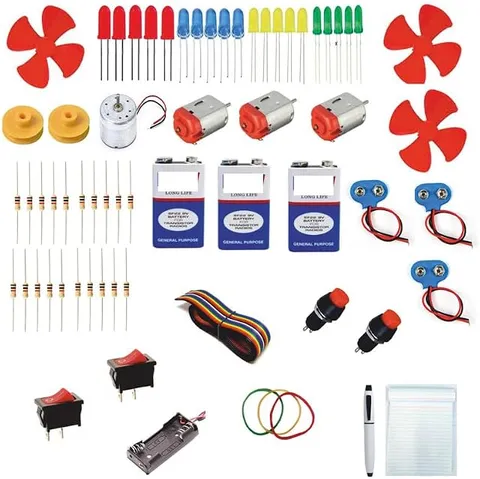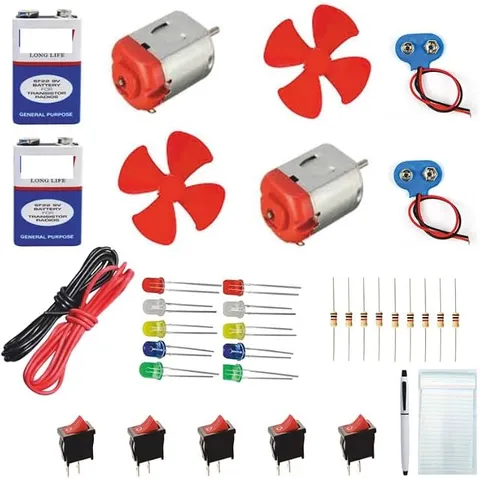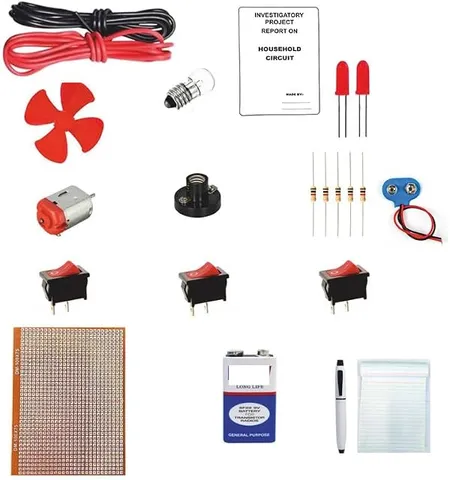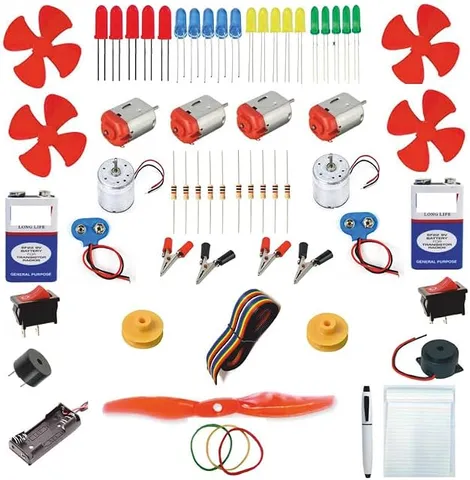
- Components and Spares
- Component
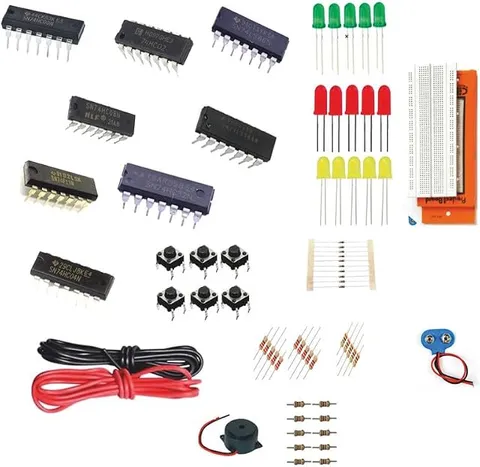
110+ Logic Gates Electronics Basic Components NAND
Code B0FGV4915H
- Paid for and delivered by Amazon. The current price and the delivery date for your PIN code are shown there.
- Sold by Gurukul Technicals Institute, Delhi.
- Need a different topic, a custom version or a school order? Ask on WhatsApp.
Component
About this part
This is a basic electronics set for building and studying logic gates; the listing describes it as 110+ components for NAND, AND, OR, NOT, NOR, XOR and XNOR circuits. It suits learners who want to see digital logic working in a real circuit instead of only drawing truth tables.
How it works
The science behind it
The idea the part demonstrates, in words you can use in your report and when you explain it.
A logic gate is a circuit that takes one or more binary inputs, 0 (low voltage) or 1 (high voltage), and gives a single output according to a fixed rule written as a truth table. An AND gate gives 1 only when all its inputs are 1 (Y = A·B). An OR gate gives 1 when any input is 1 (Y = A + B). A NOT gate inverts its input. NAND and NOR are AND and OR followed by NOT, and they are called universal gates because any other gate can be built from them alone. XOR gives 1 when its inputs are different, and XNOR gives 1 when they are the same. Gates can be made from switches, diodes and transistors, or bought as ICs such as the 7400, which holds four NAND gates. The two-way switch on many Indian staircases behaves like an XOR gate: changing either switch changes the state of the light.
Using it in your projects
Using a logic gate component set in your projects
What this part is good for, what else you need with it and how to connect it.
Projects you can build with it 7
- A burglar alarm that sounds only when the system is switched on AND a door is opened
- A two-way staircase switch, which behaves exactly like an XOR gate
- A half adder that adds two binary digits using an XOR and an AND gate
- A majority voting circuit for three judges
- A seat-belt reminder that sounds when a seat is occupied AND the belt is NOT fastened
- An automatic night lamp using a light sensor and a NOT gate
- A water tank alarm that warns when the tank is full OR the pump runs dry
What else you need 9
How to connect it 8 steps
Sort the parts into small boxes and identify each one. If the set has 74-series chips, read the number on each: 7400 is NAND, 7402 NOR, 7404 NOT, 7408 AND, 7432 OR and 7486 XOR.
Decide which supply each circuit needs: 74-series chips need a steady 5 V, while transistor and diode gates can run from a 9 V battery with suitable resistors.
Place a chip across the centre gap of the breadboard. For most 14-pin gate chips, pin 14 goes to +5 V and pin 7 to negative; check the pin diagram, because the NOR chip places its inputs and outputs differently.
Connect two switches as inputs A and B: each switch joins its input to +5 V, and a 1 kΩ resistor from the input to negative makes it read 0 when the switch is off. Use 1 kΩ, not 10 kΩ, because a 74LS input pushes out enough current to read a 10 kΩ pull-down as 1.
Connect the gate's output pin through a 470 Ω resistor to an LED, with the LED's short leg to negative.
Try all four input combinations, write down whether the LED is on or off each time, and compare your table with the expected truth table.
Build a NOT gate with one NPN transistor: input through a 10 kΩ resistor to the base, emitter to negative, collector to positive through 1 kΩ, and an LED with its resistor from collector to negative as the output.
- Show that NAND is universal
Join both inputs of one NAND gate to make a NOT gate, then combine NAND gates to make AND and OR.
Read this first
Safety first
Go through these points before you build or switch anything on. Younger students should do this with an adult.
- Never power a 74-series chip directly from a 9 V battery; more than about 7 V can destroy it.
- Fit each chip the right way round, with its notch or dot at pin 1; a reversed chip can get hot enough to burn a finger.
- Touch a metal tap or table frame before handling chips, since static can damage them.
- Keep small parts away from young children.
Troubleshooting
If something does not work
The usual problems with this part and how to fix them. Open a problem to see the fix.
The output LED is on when it should be off
An input is probably floating, and a floating 74-series input often reads as 1. Add a 1 kΩ pull-down resistor to each input; with 74LS chips a 10 kΩ pull-down is too weak and still reads as 1.
A chip gets hot
It is in backwards or getting too high a voltage. Disconnect at once, let it cool, and check its orientation and that the supply is 5 V.
Nothing works on one half of the breadboard
On many long breadboards the power rails are split in the middle. Bridge the gap with a short wire on both rails.
The transistor NOT gate's LED never turns off
The base resistor may be missing or the transistor's legs may be in the wrong order. Check the emitter, base and collector positions in its datasheet.
Exhibition day
How to present it
A running order for the exhibition table or the practical, step by step.
Build one gate at a time and fill in its truth table in front of the examiner, using an LED or a multimeter to read the output.
Show how a NOT gate is made from a NAND gate by joining its two inputs.
Label every input switch and output clearly so visitors can follow the 0s and 1s.
Use the staircase light example to connect XOR with something everyone has used.
Practice
Viva questions
Practice questions on this part, with short answers. Try each one aloud before you open the answer.
Why are NAND and NOR called universal gates?
Because any logic gate, and therefore any digital circuit, can be built using only NAND gates or only NOR gates.
When is the output of an XOR gate 1?
When its two inputs are different, that is, 0 and 1 or 1 and 0.
How can you make a NOT gate from a NAND gate?
Connect both inputs of the NAND gate together; the output is then the inverse of the input.
What is a truth table?
A table that lists every possible combination of inputs to a gate along with the output for each.
Buying checklist
Before you buy
What to check before you order the part, and what to do when it arrives.
1Before you order
- Read the listing to see whether the gates are built from chips or from transistors and diodes, and what supply voltage it expects.
- Check that logic gates are part of your current syllabus or project brief, since syllabuses change from year to year.
- Plan for a breadboard and a multimeter if the listing does not mention them.
- Keep the chips in their tube or foam to protect their pins.
- Check the delivery date for your PIN code on the marketplace, and order well before the exhibition or practical.
- Check what is in the box on the marketplace listing, including any batteries or tools you need to add.
- Building it yourself: younger students should build with an adult, especially with motors, batteries and small parts.
2When it arrives
- Sort and check the parts against the listing's description soon after they arrive, and note the seller's return terms in case anything is missing.
Next steps
Take it further
Ways to turn this part into a bigger investigation or a stronger exhibition entry.
Build a half adder and then a full adder, and show the sum in binary on LEDs.
Prove De Morgan's theorems with truth tables and with real circuits on the breadboard.
Make every basic gate from NAND gates only, and compare how many chips each design needs.
Audience
Who it suits
Suits Class 11 and 12 computer science and physics students, ITI and diploma electronics learners, and hobbyists starting digital electronics.
- CategoryComponents and Spares
- TypeComponent
Free to read
Free ebooks for this topic
Free PDF ebooks from Gurukul Technicals Institute on the science, the making and the presenting of projects like this one.
- Free PDF ebook
Electronic Components Handbook
Resistors, capacitors, LEDs, diodes, transistors and more, with how to use each
- Free PDF ebook
Your Science Exhibition Guide
Choose a project, build it, present it and answer the judges with confidence
- Free PDF ebook
Writing a Science Project File
How to write the report, from the cover page to the bibliography