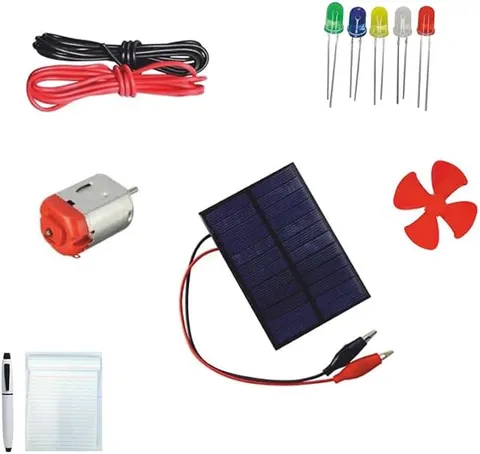
- Components and Spares
- Component
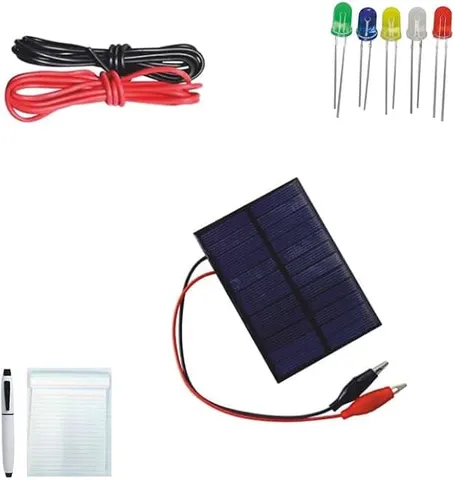
Mini Solar Panel Cell Fan & Light LED DIY Kit with Wires
Code B0FGV3Q3LH
- Paid for and delivered by Amazon. The current price and the delivery date for your PIN code are shown there.
- Sold by Gurukul Technicals Institute, Delhi.
- Need a different topic, a custom version or a school order? Ask on WhatsApp.
In this project guide
Component
About this part
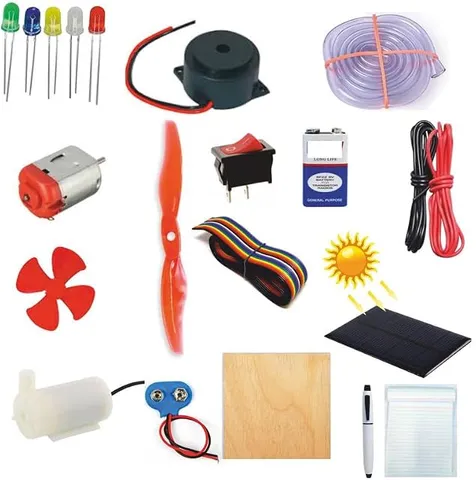
This is a beginner DIY kit for building a small solar-powered fan and LED light; the listing says it comes with wires and that a pen and pad are free. It is a simple way for young students to see sunlight turned into motion and light in a model they wire themselves.
What the listing says
- Pen and Pad Free
How it works
The science behind it
The idea the part demonstrates, in words you can use in your report and when you explain it.
This kit shows a chain of energy changes. The solar panel converts light energy into electrical energy by the photovoltaic effect. The fan's motor then converts electrical energy into kinetic energy of rotation, while the LED converts electrical energy back into light. An LED is a PN junction diode that glows when it is forward biased, as electrons recombine with holes and give out energy as light. It does not glow if connected the wrong way round, so its longer leg, the anode, must go towards the positive side. The fan spins faster in bright sunlight and slows down when a cloud passes, because less light means less current from the panel. Typical silicon solar panels turn only about 15 to 22 percent of the sunlight falling on them into electricity. Solar lanterns used during power cuts in many villages work on the same chain of energy changes.
Make it yourself
Make a solar-powered fan and LED light yourself
Everything you need and the order to do it in. Tick off the materials as you collect them.
What you need 9
Step by step 8 steps
Take the panel into bright sunlight and connect its leads to the multimeter on the DC volts range. Note the reading, then shade half the panel with your hand and watch it fall.
Fix the panel to the wedge stand so it can face the Sun squarely; in India, tilting it towards the south works best for most of the day.
Fit the blade on the motor shaft and mount the motor on a short tower on the base, so the blade clears everything by at least 1 cm.
- Wire the fan branch
Panel positive to the first switch, the switch to the motor, and the motor back to panel negative.
Wire the LED branch from the same panel leads: positive to the second switch, then the 220 Ω resistor, then the LED's long leg; its short leg goes to panel negative.
Take the model into sunshine and switch on the fan alone: it should start spinning. Then switch on the LED alone and check that it glows.
Switch on both together and notice that the fan slows down, because the small panel has to share its current between two loads.
Pass a sheet of paper over the panel like a cloud and watch the fan slow down and speed up again.
Read this first
Safety first
Go through these points before you build or switch anything on. Younger students should do this with an adult.
- Never look straight at the Sun while lining up the panel; watch the panel's shadow instead.
- Hold the panel by its edges and do not press on its face; small panels can crack, and cracked edges can be sharp.
- Use the glue gun only with an adult, and keep fingers away from the blade while it spins.
- If you test indoors under a lamp, let an adult set up the lamp and keep the panel and any paper away from the hot bulb.
Troubleshooting
If something does not work
The usual problems with this part and how to fix them. Open a problem to see the fix.
The fan does not move indoors
Room lights, especially LED and tube lights, give far less energy than sunlight. Test in direct sunshine; a small panel often cannot start a motor in shade.
The fan twitches but does not start
Give the blade a gentle flick; if it then keeps running, the motor needs a little more current to start than the panel gives. Use a lighter blade and point the panel straight at the Sun.
The LED does not glow
It may be the wrong way round: the long leg must go towards the panel's positive lead. Also check that the resistor's wires are firmly joined.
The fan spins the wrong way
Swap the two motor wires; reversing the current reverses the direction of rotation.
Exhibition day
How to present it
A running order for the exhibition table or the practical, step by step.
Draw the energy chain on a card: light energy to electrical energy, then to kinetic energy in the fan and light energy in the LED.
Run the fan in sunlight and then shade the panel with your hand so visitors see it slow down.
Connect the LED the wrong way round once to show that it will not glow, then explain why.
Explain why solar energy is clean and renewable, and also its limits, such as no output at night.
Practice
Viva questions
Practice questions on this part, with short answers. Try each one aloud before you open the answer.
What energy changes happen when a solar panel runs a fan?
Light energy changes into electrical energy in the panel, and the motor changes electrical energy into kinetic energy of the fan.
Why does an LED not glow when it is connected the wrong way?
An LED is a diode, so it conducts and glows only when forward biased; in reverse bias almost no current flows.
Why does the fan slow down when a cloud covers the Sun?
Less light falls on the panel, so it produces less current and the motor gets less power.
Give one advantage and one limitation of solar energy.
It is clean and renewable, but it produces nothing at night and less on cloudy days unless the energy is stored in a battery.
Project file
Project file outline
The headings of the project file, in order. Give each heading its own section and write it in your own words.
Free ebook: Writing a Science Project FileContents
- Aim: to make a fan and a light that run on sunlight alone
- Introduction: solar energy as a renewable source
- How a solar cell works: the photovoltaic effect
- Energy changes: light to electrical to kinetic, and electrical back to light
- Circuit diagram with the fan and the LED as two switched branches
- Observations: fan speed and LED brightness in sunshine, in shade and under room lights
- Uses of solar energy in India, from street lights to water pumps
- Conclusion and precautions
Buying checklist
Before you buy
What to check before you order the part, and what to do when it arrives.
1Before you order
- This is a beginner kit, so check it suits your class; older students may want to add measurements or a battery to score well.
- Read the listing to see exactly which parts are named, so you know whether you need to arrange a stand or a base.
- Ask your teacher where you will display it; a place near a sunny window, or a lamp set up by an adult, may be needed on the day.
- Keep the panel in its packing when not in use so its face is not scratched.
- Check the delivery date for your PIN code on the marketplace, and order well before the exhibition or practical.
- Check what is in the box on the marketplace listing, including any batteries or tools you need to add.
2When it arrives
- Test it in sunshine as soon as it arrives, since a model that only works outdoors needs a plan for an indoor exhibition hall.
Next steps
Take it further
Ways to turn this part into a bigger investigation or a stronger exhibition entry.
Measure the panel's voltage at different tilt angles with a protractor and find the angle that gives the most at noon.
Add a rechargeable cell pack and a diode so the LED keeps glowing after sunset, and explain why the diode is needed.
Measure the panel's output in the morning, at noon and in the evening, and plot a graph of the day.
Audience
Who it suits
Suits Class 5 to 9 students making their first solar energy project for a science exhibition or school activity.
- CategoryComponents and Spares
- TypeComponent
Free to read
Free ebooks for this topic
Free PDF ebooks from Gurukul Technicals Institute on the science, the making and the presenting of projects like this one.
- Free PDF ebook
Electronic Components Handbook
Resistors, capacitors, LEDs, diodes, transistors and more, with how to use each
- Free PDF ebook
Biology Models Guide
Make the heart, lungs, kidney, eye, cell and more, and explain them well
- Free PDF ebook
Electricity and Magnetism Experiments
Hands-on experiments with cells, wires, bulbs and magnets