- Components and Spares
- Component
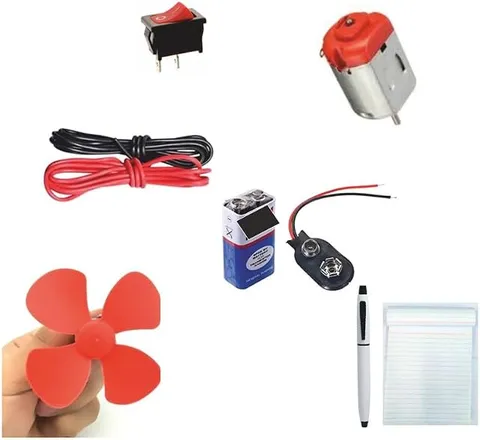
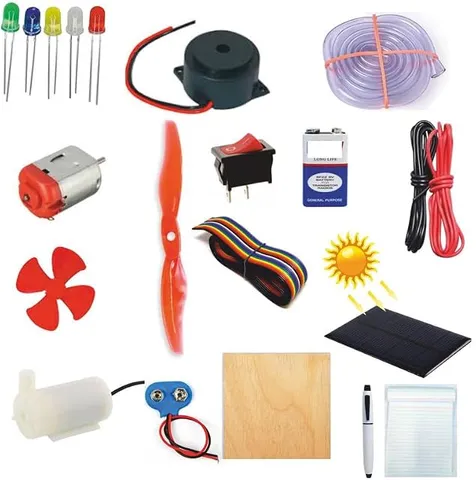
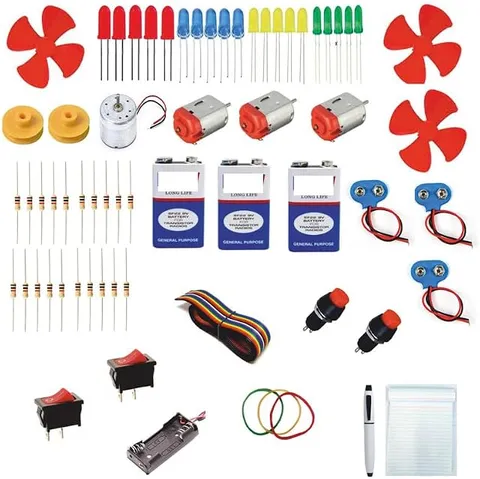
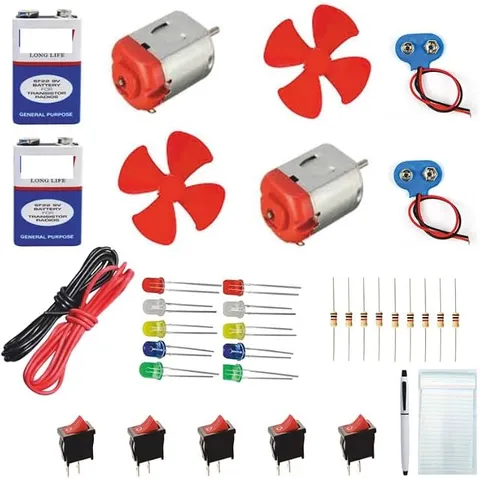
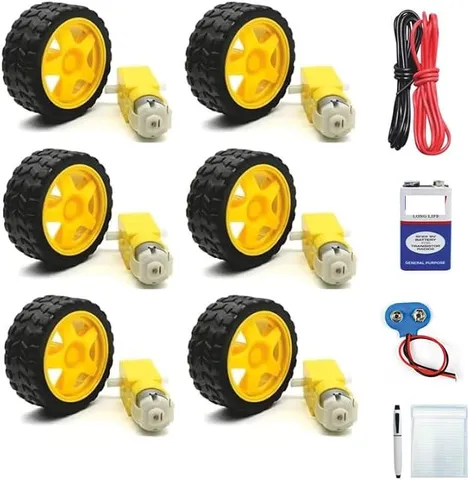
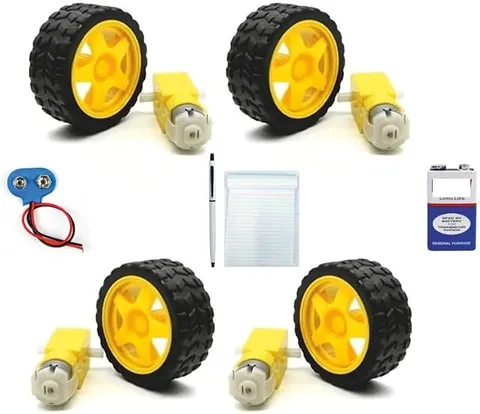
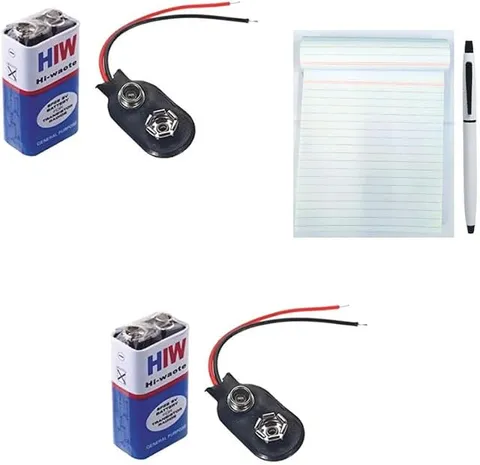
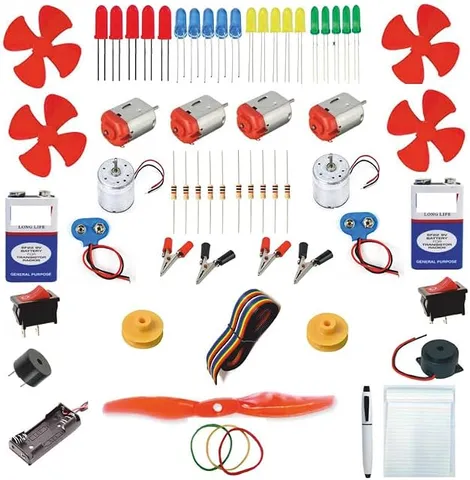
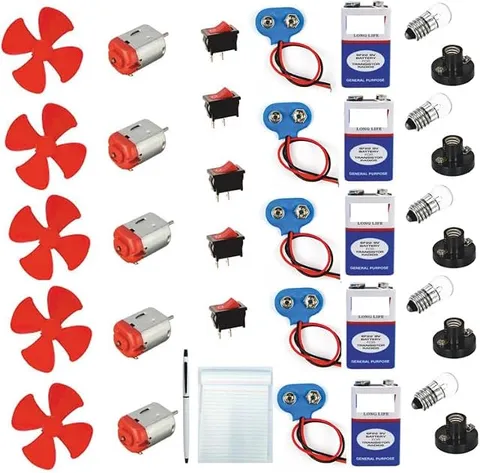
32 Items DC Motor with Fan Blade 9V Battery 3V Bulb with Holder
Code B0FGV1GQSR
- Paid for and delivered by Amazon. The current price and the delivery date for your PIN code are shown there.
- Sold by Gurukul Technicals Institute, Delhi.
- Need a different topic, a custom version or a school order? Ask on WhatsApp.
Component
About this part
This is a starter pack of basic electrical parts; the listing names a DC motor with fan blade, a 9V battery and a 3V bulb with holder. It is meant for building first circuits such as a mini fan or a bulb circuit, and for learning how electricity is turned into motion and light.
What the listing says
- Pen and Pad
How it works
The science behind it
The idea the part demonstrates, in words you can use in your report and when you explain it.
A simple circuit needs a source, a load and a closed path. In a DC motor, current flows through a coil placed between magnets; the magnetic field pushes on the current-carrying wire (Fleming's left-hand rule gives the direction), so the coil turns, and a commutator keeps it turning the same way. Reverse the battery and the motor spins the other way. A bulb is made for a particular voltage. A 3 V bulb connected straight to a 9 V battery would get about three times the voltage it is made for, so it would flash very brightly and most likely burn out. Use the correct cell, or add a resistor in series to drop the extra voltage (V = IR). The ceiling fan in every Indian home also turns electrical energy into motion using magnetic forces, though it runs on AC.
Using it in your projects
Using a DC motor, battery and bulb set in your projects
What this part is good for, what else you need with it and how to connect it.
Projects you can build with it 6
- A mini table fan in a decorated box
- A simple circuit board with a switch and bulb for the electricity chapter
- A model windmill in which the motor works as a generator when the blades turn
- A conductor and insulator tester using the bulb
- A steady-hand buzz-wire game with the bulb as the indicator
- A small boat or cart driven by the motor and a propeller
What else you need 7
How to connect it 7 steps
Check the voltage written on each part or in the listing. The bulb is a 3 V bulb, so it needs two 1.5 V cells, not the 9 V battery.
- Make a bulb circuit
Cell holder, switch and bulb holder joined in a loop. Close the switch and the bulb lights.
Push the fan blade firmly onto the motor shaft.
Connect the motor through the switch to a battery that matches its rating and watch the fan spin. Swap the wires and it spins the other way.
- Make a mini table fan
Fix the motor on top of the box or tube with glue, and put the battery and switch inside.
- Make a conductor tester
Leave a gap in the bulb circuit and touch the two loose wire ends to a spoon, a pencil lead, an eraser and a plastic ruler; the bulb lights only for conductors.
Disconnect the batteries after each experiment so they do not run down.
Read this first
Safety first
Go through these points before you build or switch anything on. Younger students should do this with an adult.
- Never connect the 3 V bulb to the 9 V battery; it will flash and burn out, and the glass can get very hot.
- Keep fingers and hair away from the spinning fan blade.
- Never join a battery's terminals directly with a wire; a 9 V battery gets hot when shorted.
- Use hot glue only with an adult.
Troubleshooting
If something does not work
The usual problems with this part and how to fix them. Open a problem to see the fix.
The 3 V bulb does not light
Tighten it in its holder, check the cells are the right way round, and make sure the switch contacts are clean.
The motor runs very fast and gets hot on the 9 V battery
The battery may be giving more voltage than the motor is made for. If its rating is lower, run it on two or three cells instead.
The fan blade slips on the shaft
Push it further on. A drop of glue on the hub, put on by an adult, can hold a loose blade.
The 9 V battery runs down quickly
A motor draws much more current than an LED. Switch off when not demonstrating and use AA cells for long runs.
Exhibition day
How to present it
A running order for the exhibition table or the practical, step by step.
Build the mini fan first and show how swapping the battery leads reverses its direction.
Explain why a 3 V bulb should not be connected directly to a 9 V battery, and show the correct setup.
Draw each circuit with standard symbols for the cell, switch, bulb and motor.
End with a short list of safe habits, such as disconnecting the battery when it is not in use.
Practice
Viva questions
Practice questions on this part, with short answers. Try each one aloud before you open the answer.
What makes a DC motor rotate?
A current-carrying coil in a magnetic field experiences a force, which produces a turning effect on the coil.
How can the direction of rotation of a DC motor be reversed?
By reversing the direction of the current, that is, by swapping the battery connections.
What would happen if a 3 V bulb is connected to a 9 V battery?
Much more current than it is designed for would flow through it, and it would most likely burn out.
What is the function of the commutator in a DC motor?
It reverses the current in the coil every half turn so that the coil keeps rotating in the same direction.
Buying checklist
Before you buy
What to check before you order the part, and what to do when it arrives.
1Before you order
- Note the voltages of the bulb, motor and battery before connecting anything.
- A pack like this suits early electricity chapters and first circuits; check it fits your class.
- Keep small parts in a box, away from young children.
- Check the delivery date for your PIN code on the marketplace, and order well before the exhibition or practical.
- Building it yourself: younger students should build with an adult, especially with motors, batteries and small parts.
2When it arrives
- Read the listing for the item count and what each part is, and tick them off when the pack arrives.
Next steps
Take it further
Ways to turn this part into a bigger investigation or a stronger exhibition entry.
Measure the current the motor draws with and without the fan blade, and explain the difference.
Use the motor as a generator: spin its shaft fast and measure the voltage with a multimeter.
Draw every circuit you made with standard circuit symbols.
Audience
Who it suits
Suits Class 4 to 8 students for home experiments and simple science fair models such as a mini fan.
- CategoryComponents and Spares
- TypeComponent
Free to read
Free ebooks for this topic
Free PDF ebooks from Gurukul Technicals Institute on the science, the making and the presenting of projects like this one.
- Free PDF ebook
Electronic Components Handbook
Resistors, capacitors, LEDs, diodes, transistors and more, with how to use each
- Free PDF ebook
Electricity and Magnetism Experiments
Hands-on experiments with cells, wires, bulbs and magnets
- Free PDF ebook
Motors, Gears and Motor Drivers
Make things move: DC motors, servos, steppers and how to drive them