- Science
- Ready-made model
- Class 1 to 9
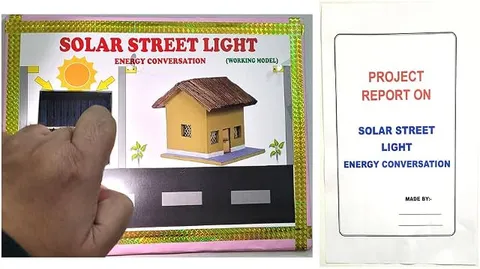
Solar Street Light House Energy Conversation Science Working Project Model Educational Electronic Hobby Kit
Code B0DTYPRLN8
- Paid for and delivered by Amazon. The current price and the delivery date for your PIN code are shown there.
- Sold by Gurukul Technicals Institute, Delhi.
- Need a different topic, a custom version or a school order? Ask on WhatsApp.
In this project guide
Ready-made model
About this model
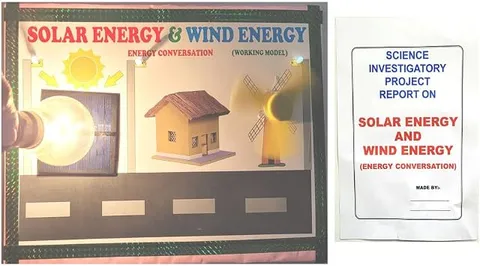
This working model of a solar street light and house is about how sunlight can be turned into electricity, stored and used at night. It demonstrates energy conversion and energy conservation, making it a good fit for renewable energy exhibitions.
How it works
The science behind it
The idea the model demonstrates, in words you can use in your report and when you explain it.
A solar panel is made of solar cells, usually silicon p-n junctions. When sunlight falls on a cell, light energy frees electrons and creates a voltage across the junction; this is the photovoltaic effect, and it produces direct current. In a real solar street light, the panel charges a rechargeable battery during the day, storing the energy in chemical form. At night the battery powers the lamp, so the energy chain is light → electrical → chemical → electrical → light. Such lights often switch on by themselves at dusk, either with a light sensor such as an LDR, whose resistance is low in bright light and high in the dark, or by sensing that the panel's voltage has dropped. LED lamps are used because they give much more light per watt than filament bulbs, so a smaller panel and battery are enough. Solar street lights now brighten many village roads across India, far from the grid.
Make it yourself
Make a solar street light and house model yourself
Build your own version from scratch, or use the steps to understand how the ready-made model is put together before you present it.
What you need 9
Step by step 9 steps
Build the house and the street light pole on the base, leaving a channel inside the pole for the LED wires.
Fix the solar panel on the roof, tilted towards the sun, with its leads running inside the house.
Connect the panel's positive lead to the plain end of the diode and the banded end to the battery's positive, then join the panel negative to the battery negative.
On a breadboard, connect the 10 kΩ preset from the battery positive to one leg of the LDR, and the LDR's other leg to negative. Join the point between them to the transistor's base through the 1 kΩ resistor, which protects the transistor if the preset is turned right down.
Connect the LEDs, each with its 220 ohm resistor, between the battery positive and the transistor's collector, join the emitter to negative, and put the switch in the battery lead.
Cover the LDR with your hand and the LEDs should light. Uncover it in daylight and adjust the preset until they just switch off.
Fit the LEDs in the street lamp and the house, and place the LDR on the roof facing the sky, where the LEDs' own light cannot reach it.
Put the model in sunlight and measure the panel voltage and the battery voltage with the multimeter to show the battery charging.
Draw and label the energy chain on the board, from sunlight to stored chemical energy and back to light.
Read this first
Safety first
Go through these points before you build or switch anything on. Younger students should do this with an adult.
- Use only NiMH rechargeable cells in this simple circuit; never connect a loose lithium cell to a solar panel without a proper charging module.
- Never short the battery terminals, because rechargeable cells can push a large current and heat the wires.
- Do not look at the sun while aiming the panel, and keep the battery holder shaded so it does not overheat.
- Ask an adult to use the cutter and the glue gun.
Troubleshooting
If something does not work
The usual problems with this model and how to fix them. Open a problem to see the fix.
The LEDs stay on even in daylight
The preset is set to too low a resistance, so the base gets current even when light falls on the LDR, or part of the roof shades the LDR. Turn the preset to a higher resistance until the LEDs just go off in daylight, and move the LDR so it faces the open sky.
The LEDs flicker on and off at dusk
Light from the LEDs is reaching the LDR and switching them off again. Shield the LDR with a short paper tube or move it away from the lamps.
The battery does not seem to charge
Check the diode's direction and test in real sunlight; indoor tube lights are far too weak for a solar panel.
The battery is flat by morning
Without the diode, the battery discharges back through the panel in the dark. Fit the diode, and switch the model off when it is not on show.
Exhibition day
How to present it
A running order for the exhibition table or the practical, step by step.
Trace the energy chain from sunlight to night-time light on a chart with arrows.
Cover the panel with a card to show how its output depends on light.
Explain how a solar light knows when to switch on, using the LDR or panel-voltage idea.
Link the model to saving electricity at home, for example by switching to LED bulbs and using daylight.
Practice
Viva questions
Practice questions on this model, with short answers. Try each one aloud before you open the answer.
What is the photovoltaic effect?
It is the production of a voltage and current in a material, such as silicon, when light falls on it.
Why does a solar street light need a battery?
The panel produces electricity only in daylight, so the battery stores it for use at night.
Why are LEDs used in solar lights instead of filament bulbs?
LEDs turn much more of the electrical energy into light and waste less as heat, so the stored energy lasts longer.
What is an LDR?
A light dependent resistor, whose resistance decreases as more light falls on it.
Project file
Project file outline
The headings of the project file, in order. Give each heading its own section and write it in your own words.
Free ebook: Writing a Science Project FileContents
- Aim: to show how a solar street light stores sunlight as electrical energy and switches on automatically at night
- Materials
- Energy conversion chain of a solar street light
- Circuit diagram: panel, blocking diode, battery and LDR switch
- Construction of the model
- Observations: panel and battery voltage in sunlight, in shade and under room light
- Advantages and limitations of solar street lights
- Conclusion
- Precautions
Buying checklist
Before you buy
What to check before you order the model.
1Check these first
- Renewable energy is a common exhibition theme at many class levels; check whether your teacher wants a working circuit or a display model.
- Check in the listing what powers the lights and whether a battery or rechargeable cell is included.
- Test the model in real sunlight a few days before the exhibition, because indoor light will not charge it.
- If the exhibition hall has no sunlight, charge the model in the sun before you set out.
- Keep the box, as the street light pole and the panel are easy to snap.
- Check the delivery date for your PIN code on the marketplace, and order well before the exhibition or practical.
- Practise explaining it. Judges ask what the model shows and why; knowing the science matters as much as the model. The viva questions above are a good place to start.
Next steps
Take it further
Ways to turn this model into a bigger investigation or a stronger exhibition entry.
Measure the panel voltage at different tilt angles and plot a graph to find the best angle.
Add a small indicator LED that glows only while the battery is charging.
Compare how long the lights stay on after one, two and three hours of sunshine.
Audience
Who it suits
Suits Class 6 to 10 science exhibitions on energy sources and conservation, and eco-club or renewable energy projects.
- ClassClass 1 to 9
- SubjectScience
- TypeReady-made model
Free to read
Free ebooks for this topic
Free PDF ebooks from Gurukul Technicals Institute on the science, the making and the presenting of projects like this one.
- Free PDF ebook
Your Science Exhibition Guide
Choose a project, build it, present it and answer the judges with confidence
- Free PDF ebook
Writing a Science Project File
How to write the report, from the cover page to the bibliography
- Free PDF ebook
Viva Questions for Science Projects
How to answer examiner questions, with sample questions for popular projects