- Science
- Ready-made model
- Class 1 to 9
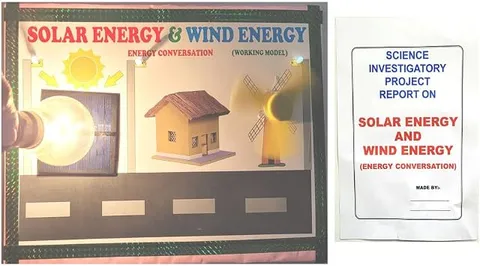
Solar Energy and Wind Energy Conversation Working Model Project Educational Electronic Hobby Kit
Code B0DTYM35Z8
- Paid for and delivered by Amazon. The current price and the delivery date for your PIN code are shown there.
- Sold by Gurukul Technicals Institute, Delhi.
- Need a different topic, a custom version or a school order? Ask on WhatsApp.
In this project guide
Ready-made model
About this model
This working model shows how solar energy and wind energy can both be converted into electricity, the two renewable sources now seen on rooftops and hillsides across India. It helps students explain clean energy at an exhibition with a working demonstration rather than a poster. It suits school projects on sources of energy and the environment.
How it works
The science behind it
The idea the model demonstrates, in words you can use in your report and when you explain it.
A solar cell is a large p-n junction made of silicon. When light falls on it, photons give energy to electrons and create electron-hole pairs, and the electric field at the junction pushes them apart, producing a voltage. This is the photovoltaic effect, and it gives DC directly. A wind turbine works differently: moving air has kinetic energy that turns the blades, and a generator connected to them produces electricity by electromagnetic induction. In many school models a small DC motor, turned by the blades, works as this generator. Power from the wind rises very quickly with speed, as the cube of the wind speed (P = ½ρAv³), so doubling the wind speed gives about eight times the power. The two sources support each other: in India the windy monsoon months are the cloudy months when solar output dips. Wind farms in Tamil Nadu and Gujarat and rooftop solar panels in Indian cities use exactly these principles.
Make it yourself
Make a solar and wind energy model yourself
Build your own version from scratch, or use the steps to understand how the ready-made model is put together before you present it.
What you need 9
Step by step 8 steps
Fix the solar panel on one side of the base, tilted towards where the light will come from, and label it 'Solar'.
Mount the motor at the top of the tower with its shaft pointing forward, push on the propeller, and fix the tower on the other side as the 'Wind' section.
Connect the solar panel through the switch to the two LEDs, each with its resistor.
Connect the motor's terminals to the red LED, long leg to the terminal that turns positive when the blades spin the right way.
Put the panel in sunlight and show the LEDs glowing; shade it with your hand to show the output stopping.
Turn on the table fan in front of the turbine and show the red LED lighting as the blades spin.
Measure each source's voltage with the multimeter and record how it changes with light strength and fan speed.
- Label each energy change
Light to electrical, and the kinetic energy of wind to electrical.
Read this first
Safety first
Go through these points before you build or switch anything on. Younger students should do this with an adult.
- Keep fingers away from the spinning blades and the table fan, and make sure the blades are fixed firmly.
- Never look at the sun while angling the panel.
- The table fan runs on mains: an adult should plug it in and keep its cable away from the model.
- Use the glue gun to fix the tower, and any cutter for the blades, only with an adult.
Troubleshooting
If something does not work
The usual problems with this model and how to fix them. Open a problem to see the fix.
The solar LEDs do not glow indoors
Room lights give a panel very little energy. Use direct sunlight, or a spot by a bright window.
The blades spin but the red LED stays dark
The motor is not turning fast enough, or the LED is the wrong way round for the turning direction. Move the fan closer, or swap the LED's legs.
The blades will not start turning
They are too heavy or set flat to the wind. Use lighter blades, each twisted at an angle so the wind pushes it round.
The readings keep changing
Light and wind are never perfectly steady. Take three readings and use the average.
Exhibition day
How to present it
A running order for the exhibition table or the practical, step by step.
Show the two energy chains on a chart: light to electrical, and wind (kinetic) to mechanical to electrical.
Use a table fan for wind and a lamp or sunlight for the panel, and show the output change when you block each.
Explain why wind power rises so sharply with wind speed using P ∝ v³.
End with where these sources are used in India to connect the model to real life.
Practice
Viva questions
Practice questions on this model, with short answers. Try each one aloud before you open the answer.
What is the photovoltaic effect?
It is the generation of a voltage when light falls on a p-n junction, as in a solar cell.
What energy changes take place in a wind turbine?
The kinetic energy of the wind becomes mechanical energy of the rotating blades, which the generator converts into electrical energy.
Does a solar cell give AC or DC?
A solar cell gives DC. An inverter is needed to change it to AC for household appliances.
Why are solar and wind called renewable sources?
Because they are replenished naturally and will not run out, unlike coal or petroleum.
Project file
Project file outline
The headings of the project file, in order. Give each heading its own section and write it in your own words.
Free ebook: Writing a Science Project FileContents
- Aim: to show how solar and wind energy are converted into electricity
- The photovoltaic effect in a solar cell
- How a wind turbine and its generator work
- Construction of the model and circuit diagram
- Observation table: panel voltage in shade and sun, and turbine voltage at different fan speeds
- Rooftop solar and wind farms in India
- Advantages and limits of solar and wind power
- Conclusion on which source suits your area better, and references
Buying checklist
Before you buy
What to check before you order the model.
1Check these first
- Check in the listing what the model uses to show its output (LEDs, a motor or a meter) and plan your demonstration around it.
- Plan for a fan or a sunny window at the exhibition if the hall has neither; check with your teacher what is allowed.
- Test it outdoors in sunlight and in front of a fan a few days before the exhibition.
- Keep the box, and protect the blades and the panel's surface on the way to school.
- Check the delivery date for your PIN code on the marketplace, and order well before the exhibition or practical.
- Practise explaining it. Judges ask what the model shows and why; knowing the science matters as much as the model. The viva questions above are a good place to start.
Next steps
Take it further
Ways to turn this model into a bigger investigation or a stronger exhibition entry.
Measure voltage and current from each source at different times of day, calculate power with P = VI, and plot it.
Store energy from both sources in a pack of AA nickel-metal hydride (NiMH) rechargeable cells through diodes, with an adult, and use it to light an LED at night; never connect a lithium cell straight to a panel.
Compare two, three and four blades and different blade angles to find the design that gives the highest voltage.
Audience
Who it suits
Class 6 to 10 science exhibitions on renewable energy and environment-themed projects.
- ClassClass 1 to 9
- SubjectScience
- TypeReady-made model
Free to read
Free ebooks for this topic
Free PDF ebooks from Gurukul Technicals Institute on the science, the making and the presenting of projects like this one.
- Free PDF ebook
Your Science Exhibition Guide
Choose a project, build it, present it and answer the judges with confidence
- Free PDF ebook
Writing a Science Project File
How to write the report, from the cover page to the bibliography
- Free PDF ebook
Viva Questions for Science Projects
How to answer examiner questions, with sample questions for popular projects