- Science
- Ready-made model
- Class 1 to 9
Earthquake Sensing Alarm
Code B0G2T9DWBD
- Paid for and delivered by Amazon. The current price and the delivery date for your PIN code are shown there.
- Sold by Gurukul Technicals Institute, Delhi.
- Need a different topic, a custom version or a school order? Ask on WhatsApp.
In this project guide
Ready-made model
About this model
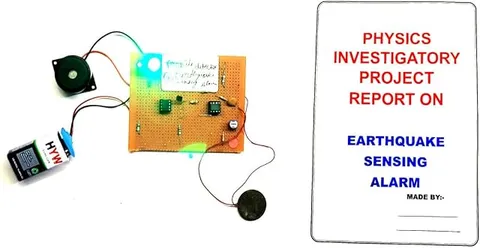
This disaster-management project senses ground vibration and raises an alarm, to show how earthquake warning systems work. It combines a vibration sensor with basic electronics to make a simple alert device for a science or social science exhibition.
What the listing says
- Disaster Management & Vibration Sensor Physics Project
How it works
The science behind it
The idea the model demonstrates, in words you can use in your report and when you explain it.
An earthquake is a sudden shaking of the ground caused when stress built up in rocks is released, usually along a fault. The point inside the Earth where it starts is the focus, and the point on the surface directly above it is the epicentre. Energy spreads out as seismic waves. P-waves (primary) are compressional, travel fastest and pass through solids and liquids; S-waves (secondary) are transverse, slower and pass only through solids; surface waves arrive later and cause most of the damage. A vibration sensor changes its electrical state when it is shaken, and the circuit uses this change to sound an alarm. Real early-warning systems detect the first fast waves and send a warning before stronger shaking arrives. Magnitude scales are logarithmic: each step of one means about ten times larger ground motion and roughly 32 times more energy. Delhi-NCR and the Himalayan states feel tremors from time to time, so safety drills matter.
Make it yourself
Make an earthquake sensing alarm yourself
Build your own version from scratch, or use the steps to understand how the ready-made model is put together before you present it.
What you need 9
Step by step 8 steps
Fix the stand on the base and hang the copper wire with the nut from its arm so it hangs straight down and stays still.
Fix the metal ring around the hanging wire, centred so the wire does not touch it when still. A gap of a few millimetres sets the sensitivity.
- Wire it up
Battery positive to the switch, then to the top of the pendulum wire. Connect the ring to the buzzer's positive lead and to the LED's long leg through the resistor; join the buzzer's negative lead and the LED's short leg to the battery negative.
Switch on and tap the base. The wire swings, touches the ring, and the buzzer sounds while the LED flashes.
- Adjust the gap
A smaller gap makes it more sensitive but may cause false alarms when someone walks past.
Make the shake table and stand the model building and alarm on it, so you can push it gently from side to side to imitate ground shaking.
Add a poster showing what to do during an earthquake: Drop, Cover and Hold On.
If you build the sensor-module version, power it from 5 V through the 7805 regulator fed by the 9 V battery (these modules are made for 3.3 to 5 V), join its ground to the battery negative, and let its digital output switch the buzzer through a transistor.
Read this first
Safety first
Go through these points before you build or switch anything on. Younger students should do this with an adult.
- Keep bare wire ends tidy and taped so they cannot touch the battery terminals and short it.
- Shake the table gently by hand; do not let the heavy nut swing hard towards anyone.
- Buzzers can be very loud, so never hold one close to anyone's ear.
- Use a cutter or saw for the stand only with an adult.
Troubleshooting
If something does not work
The usual problems with this model and how to fix them. Open a problem to see the fix.
The buzzer sounds all the time
The wire is touching the ring even when still. Level the base and move the ring so the wire hangs exactly in its centre.
Nothing happens when the base is shaken
The gap may be too big, the wire or ring may be dirty or oxidised, or the buzzer may be connected the wrong way round. Narrow the gap, rub the contact points with sandpaper and check the buzzer's red lead goes to positive.
The alarm gives only a very short beep
The wire touches the ring for only a moment. Add a latching circuit that keeps the alarm on until a reset button is pressed (see the extension ideas).
The sensor-module version keeps triggering by itself
Its sensitivity is set too high. Turn the small adjustment screw on the module until it triggers only when tapped.
Exhibition day
How to present it
A running order for the exhibition table or the practical, step by step.
Tap the table gently and then firmly to show how much shaking is needed to set off the alarm.
Admit that a door slam can also trigger it, and explain how real systems use several sensors to avoid false alarms.
Show a chart comparing P-waves, S-waves and surface waves.
Finish with the Drop, Cover and Hold On safety steps.
Practice
Viva questions
Practice questions on this model, with short answers. Try each one aloud before you open the answer.
What is the difference between the focus and the epicentre?
The focus is the point inside the Earth where an earthquake starts, and the epicentre is the point on the surface directly above it.
Which seismic waves arrive first?
P-waves, because they are the fastest seismic waves.
Which instrument records earthquakes?
A seismograph, which records ground motion as a trace called a seismogram.
Why do false alarms happen in a simple vibration alarm?
The sensor cannot tell an earthquake from other shaking, such as a heavy vehicle or a door slam, so any strong enough vibration sets it off.
Project file
Project file outline
The headings of the project file, in order. Give each heading its own section and write it in your own words.
Free ebook: Writing a Science Project FileContents
- Aim: to make an alarm that senses ground vibration and warns of an earthquake
- Introduction: what causes earthquakes, the focus and the epicentre
- Seismic waves: P-waves, S-waves and surface waves
- How seismographs and early-warning systems work
- Circuit diagram and working of the pendulum vibration switch
- Construction and testing on a shake table
- Observations: sensitivity with different gaps
- Earthquake safety and earthquake-prone areas of India
- Conclusion
Buying checklist
Before you buy
What to check before you order the model, and what to do when it arrives.
1Before you order
- Check whether your teacher wants this as a science project or a disaster-management project, as the report focus differs.
- Read the listing to see what is mentioned with the model and whether a battery is needed.
- Ask for a steady table at the exhibition, as a wobbly one will set the alarm off constantly.
- Keep the box so the sensor is not knocked out of adjustment on the way.
- Check the delivery date for your PIN code on the marketplace, and order well before the exhibition or practical.
- Practise explaining it. Judges ask what the model shows and why; knowing the science matters as much as the model. The viva questions above are a good place to start.
2When it arrives
- Test it as soon as it arrives by tapping the table, and again a few days before the exhibition.
Next steps
Take it further
Ways to turn this model into a bigger investigation or a stronger exhibition entry.
Add a latch so the alarm keeps ringing until reset, using a small thyristor (SCR) or a transistor latch.
Explain why an early-warning system can give a few seconds' notice: fast P-waves arrive before the more damaging S-waves.
Compare a plain block building with one on a flexible base on your shake table to show earthquake-resistant design.
Log vibrations with a microcontroller board and an accelerometer and plot them like a seismograph trace.
Audience
Who it suits
Suits Class 8 to 12 physics and disaster-management exhibitions and science fairs on safety technology.
- ClassClass 1 to 9
- SubjectScience
- TypeReady-made model
Free to read
Free ebooks for this topic
Free PDF ebooks from Gurukul Technicals Institute on the science, the making and the presenting of projects like this one.
- Free PDF ebook
Physics Working Models Explained
Twenty classic models, how each works and how to make it
- Free PDF ebook
Your Science Exhibition Guide
Choose a project, build it, present it and answer the judges with confidence
- Free PDF ebook
Writing a Science Project File
How to write the report, from the cover page to the bibliography
- Free PDF ebook
Viva Questions for Science Projects
How to answer examiner questions, with sample questions for popular projects