- Science
- Ready-made model
- Class 1 to 9
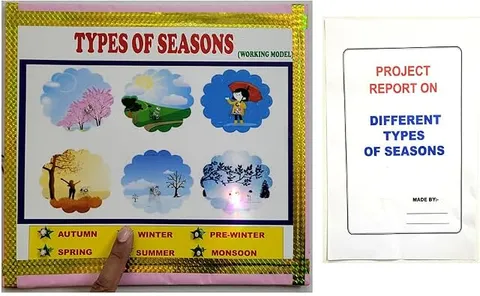
Types of Seasons Working Model and Project and Science Teaching Aid Educational Electronic Hobby Kit
Code B0DTY8PR2R
- Paid for and delivered by Amazon. The current price and the delivery date for your PIN code are shown there.
- Sold by Gurukul Technicals Institute, Delhi.
- Need a different topic, a custom version or a school order? Ask on WhatsApp.
In this project guide
Ready-made model
About this model
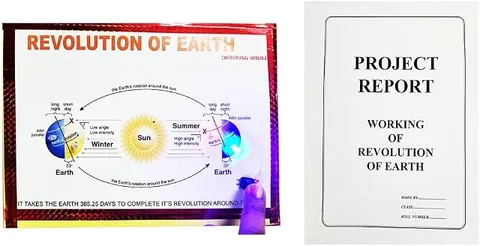
This teaching model shows how the tilt of the Earth's axis and its yearly journey around the Sun give us summer, winter, spring and autumn. It helps students see why the seasons change through the year and why they are opposite in the northern and southern hemispheres.
How it works
The science behind it
The idea the model demonstrates, in words you can use in your report and when you explain it.
The Earth's axis is tilted by about 23.5° from the perpendicular to the plane of its orbit, and it keeps pointing in the same direction in space as the Earth revolves around the Sun once a year. Around 21 June, the northern hemisphere leans towards the Sun, so sunlight falls on it more directly and days are longer: it is summer there and winter in the southern hemisphere. Around 22 December the situation is reversed. Around 21 March and 23 September, neither hemisphere leans towards the Sun, so day and night are nearly equal everywhere; these are the equinoxes. Distance is not the cause: the Earth is actually closest to the Sun in early January, during the north Indian winter. On about 21 June the noon Sun is directly overhead along the Tropic of Cancer, which passes through states such as Gujarat, Madhya Pradesh and West Bengal.
Make it yourself
Make a seasons working model yourself
Build your own version from scratch, or use the steps to understand how the ready-made model is put together before you present it.
What you need 9
Step by step 8 steps
Paint the thermocol ball blue and green, draw the equator in black, and mark India, the northern hemisphere and the southern hemisphere.
Push the skewer through the poles and fix it in the stand so the axis leans about 23.5° from the vertical, checking with the protractor.
Fix the Sun light at the centre of the base and wire it to the battery through the switch, with the resistor in series if you use an LED.
Draw four positions around the Sun at equal distances and label them for about 21 June, 23 September, 22 December and 21 March, in that order going anticlockwise as seen from above.
Place the Earth stand on each position in turn, making sure the top (North Pole) of the axis always leans towards the same wall of the room, never towards the Sun each time. Put the 21 June position on the side of the Sun farthest from that wall, so the North Pole leans towards the Sun there.
Darken the room and switch on the Sun. At the June position, show that the northern hemisphere leans towards the light and gets more direct rays.
At each position, fix a small label naming the season in the northern hemisphere and the opposite season in the southern hemisphere.
Practise moving the Earth smoothly from one position to the next while explaining, so the axis direction never changes.
Read this first
Safety first
Go through these points before you build or switch anything on. Younger students should do this with an adult.
- Prefer an LED for the Sun; a torch bulb gets hot and must not touch the thermocol or paper.
- The skewer is sharp, so cap its ends with a small bead or clay ball and push it through the ball with care.
- Switch off the light when the model is not being shown, so the battery does not run down or overheat.
- Ask an adult to help with any cutting of the base.
Troubleshooting
If something does not work
The usual problems with this model and how to fix them. Open a problem to see the fix.
The tilt points towards the Sun at every position
The Earth was turned along with the orbit, like a chair being carried round a table. The axis must stay parallel to itself, always pointing the same way in the room, as the Earth moves around the Sun.
The lit and dark halves of the Earth are hard to see
The room is too bright or the light is spread too widely. Darken the room, use a brighter LED pointing at the Earth, or put a small paper tube around the LED.
The ball slips round on the skewer
The hole is too big. Put a drop of glue where the skewer enters the ball, or wrap a little tape round the skewer to make it fit tightly.
The LED does not light
Check that its long leg goes towards the battery positive through the resistor, that the switch is on, and that the battery is not flat.
Exhibition day
How to present it
A running order for the exhibition table or the practical, step by step.
Walk the judges through four positions of the Earth (June, September, December and March) and name the season in India at each.
Keep the axis pointing the same way all round the orbit; tilting it differently at each position is a common mistake.
Tackle the distance myth directly by pointing out that the Earth is closest to the Sun in January.
If you can, shine a torch on a ball to show how slanting rays spread the same light over a bigger area.
Practice
Viva questions
Practice questions on this model, with short answers. Try each one aloud before you open the answer.
What causes seasons on Earth?
The tilt of the Earth's axis, about 23.5°, together with its revolution around the Sun, changes how directly sunlight falls on each hemisphere during the year.
If the Earth is closest to the Sun in January, why is it winter in north India then?
In January the northern hemisphere is tilted away from the Sun, so sunlight is slanting and days are short; the tilt matters far more than the small change in distance.
What is an equinox?
A day, around 21 March or 23 September, when the Sun is overhead at the equator and day and night are nearly equal all over the Earth.
When is the longest day in the northern hemisphere?
Around 21 June, the summer solstice, when the northern hemisphere is tilted most towards the Sun.
Project file
Project file outline
The headings of the project file, in order. Give each heading its own section and write it in your own words.
Free ebook: Writing a Science Project FileContents
- Aim: to show how the tilt of the Earth's axis and its revolution around the Sun cause the seasons
- Introduction: rotation, revolution and the tilted axis
- Materials and construction of the Sun and Earth model
- The Earth's position around 21 June, 23 September, 22 December and 21 March
- Why the seasons are opposite in the two hemispheres
- Why the distance from the Sun is not the cause of the seasons
- Observations: directness of sunlight and length of day at each position
- Seasons as we experience them in India
- Conclusion and references
Buying checklist
Before you buy
What to check before you order the model, and what to do when it arrives.
1Before you order
- Check that the seasons topic matches your class syllabus and the type of model your teacher wants.
- Read the listing to see whether batteries are mentioned, and keep a spare one ready.
- Practise in a dim room, because the lit and dark halves show far better without strong daylight.
- Keep the box to protect the Earth ball and axis on the way to school.
- Check the delivery date for your PIN code on the marketplace, and order well before the exhibition or practical.
2When it arrives
- Test the light as soon as it arrives and again a few days before the exhibition.
Next steps
Take it further
Ways to turn this model into a bigger investigation or a stronger exhibition entry.
Make the Earth move around the Sun on an arm using a fixed pulley at the centre and an equal pulley on the Earth's stand joined by a belt, which keeps the axis pointing the same way automatically.
Use a light sensor (LDR) and a multimeter to measure how bright the light is on a small card held at different angles, to show why slanting rays heat less.
Compare with an imaginary Earth with no tilt and explain what would happen to the seasons.
Audience
Who it suits
Suits Class 5 to 9 geography and science exhibitions and lessons on the motions of the Earth.
- ClassClass 1 to 9
- SubjectScience
- TypeReady-made model
Free to read
Free ebooks for this topic
Free PDF ebooks from Gurukul Technicals Institute on the science, the making and the presenting of projects like this one.
- Free PDF ebook
Earth, Space and Geography Models
Solar system, seasons, eclipses, volcanoes and the water cycle explained
- Free PDF ebook
Your Science Exhibition Guide
Choose a project, build it, present it and answer the judges with confidence
- Free PDF ebook
Writing a Science Project File
How to write the report, from the cover page to the bibliography
- Free PDF ebook
Viva Questions for Science Projects
How to answer examiner questions, with sample questions for popular projects