- Science
- Ready-made model
- Class 1 to 9
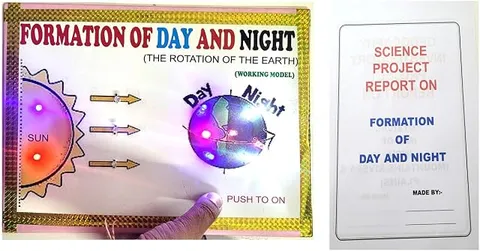
Formation of Day and Night Working Model
Code B0G2TGNFM4
- Paid for and delivered by Amazon. The current price and the delivery date for your PIN code are shown there.
- Sold by Gurukul Technicals Institute, Delhi.
- Need a different topic, a custom version or a school order? Ask on WhatsApp.
In this project guide
Ready-made model
About this model
This working model shows how the rotation of the Earth on its axis causes day and night, with one half of the globe lit by the Sun while the other half is in darkness. It is a clear way to explain sunrise, sunset and time differences to younger students.
What the listing says
- Earth Rotation Science Project Educational Electronic Hobby Kit
How it works
The science behind it
The idea the model demonstrates, in words you can use in your report and when you explain it.
The Earth spins on its axis, an imaginary line through the North and South Poles, from west to east. One complete rotation takes about 24 hours. At any moment, the half of the Earth facing the Sun has day and the other half has night; the line dividing them is called the circle of illumination. As the Earth turns, places move from the dark half into the light, which we see as sunrise, and later out of it, which we see as sunset. Because the Earth turns from west to east, the Sun appears to rise in the east and set in the west. The Earth turns through 360° in 24 hours, so every 15° of longitude makes a difference of one hour. That is why the Sun rises in Arunachal Pradesh nearly two hours before it rises in western Gujarat, even though all of India follows one time, IST.
Make it yourself
Make a day and night model with a turning Earth yourself
Build your own version from scratch, or use the steps to understand how the ready-made model is put together before you present it.
What you need 10
Step by step 8 steps
Push the rod through the globe from the North Pole to the South Pole and glue it so the globe turns with the rod.
Fix the motor on the block so the rod leans about 23.5° from upright, checked with the protractor, and join the rod to the motor shaft with the rubber tube.
Wire the motor to the cells through the switch and check its direction: seen from above the North Pole, the Earth must turn anticlockwise, that is from west to east. Swap the motor wires if it turns the other way.
Fix the torch about 50 cm away at the height of the globe's equator, pointing straight at it.
Put up the black backdrop and darken the room, so the lit half and the dark half of the globe are clearly separated by the circle of illumination.
Pin a flag on India and switch on: India moves out of the dark half into light (sunrise), across the middle of the lit half (noon), and back into darkness (sunset).
Pin the second flag on the opposite side of the globe and show that when it is day in India, it is night there.
Add a card explaining that the Earth turns 360° in about 24 hours, so every 15° of longitude makes one hour of time difference, and that Indian Standard Time is set by the 82.5° E line.
Read this first
Safety first
Go through these points before you build or switch anything on. Younger students should do this with an adult.
- Use the glue gun and any cutting tool only with an adult.
- Keep fingers and hair away from the motor and rod while the globe is turning.
- Do not shine the torch into anyone's eyes; if you use a lamp instead, let an adult set it up, as bulbs get hot.
- Cover the sharp ends of the rod with a bead or a piece of cork.
Troubleshooting
If something does not work
The usual problems with this model and how to fix them. Open a problem to see the fix.
The Earth turns the wrong way
Swap the two motor wires. The Sun rises in the east because the Earth turns from west to east, which is anticlockwise when seen from above the North Pole.
The globe wobbles as it turns
The rod is not through the exact centre, or the joint to the motor is loose. Re-centre the rod and use a tighter piece of tube.
The globe turns too fast to explain anything
Use a motor with more gear reduction, run it on fewer cells, or turn the globe by hand with a crank while you talk.
The light and dark halves are not clear
The room is too bright or the torch beam is too narrow. Darken the room, move the torch back so its beam covers the whole globe, and use the black backdrop.
Exhibition day
How to present it
A running order for the exhibition table or the practical, step by step.
As the Earth on the model turns from west to east, follow a city such as Delhi as it passes from night into day.
Explain why the Sun seems to move across the sky even though it is the Earth that turns.
Mark the circle of illumination and ask visitors where it is sunrise and where it is sunset at that moment.
Show the 15° per hour rule using the example of sunrise in Arunachal Pradesh and Gujarat.
Practice
Viva questions
Practice questions on this model, with short answers. Try each one aloud before you open the answer.
What causes day and night?
The rotation of the Earth on its axis, which turns each place towards the Sun and then away from it.
In which direction does the Earth rotate?
From west to east, which is why the Sun appears to rise in the east.
How long does the Earth take to complete one rotation?
About 24 hours, which makes one day.
What is the circle of illumination?
It is the circle that divides the half of the Earth having day from the half having night.
Project file
Project file outline
The headings of the project file, in order. Give each heading its own section and write it in your own words.
Free ebook: Writing a Science Project FileContents
- Aim: to show how the rotation of the Earth on its axis causes day and night
- Introduction: rotation and revolution of the Earth
- The axis, its tilt, and the direction of rotation
- The circle of illumination, sunrise and sunset
- Construction of the model and its motor drive
- Observations: day and night in India and in a country on the opposite side
- Longitude and time: 15° per hour and Indian Standard Time
- Conclusion and bibliography
Buying checklist
Before you buy
What to check before you order the model, and what to do when it arrives.
1Before you order
- Check that rotation and day and night are in your class syllabus, and decide whether you also want to show the seasons.
- Read the listing to see how the model is powered and whether you need to arrange cells or a light source.
- Practise explaining why the Sun appears to rise in the east.
- Keep the box to carry the globe without denting it.
- Check the delivery date for your PIN code on the marketplace, and order well before the exhibition or practical.
2When it arrives
- Try it in a darkened room as soon as it arrives, so you know how dark your exhibition corner needs to be.
Next steps
Take it further
Ways to turn this model into a bigger investigation or a stronger exhibition entry.
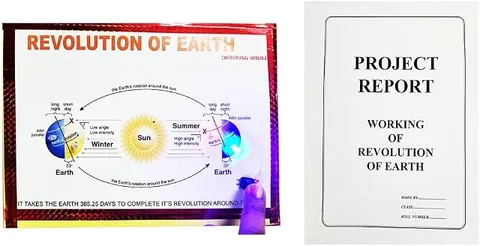
Add revolution around the Sun, keeping the axis pointing the same way, and show how the length of the day changes through the seasons.
Mark the Arctic Circle and show why places inside it have daylight all day around 21 June.
Work out the time in London, Tokyo and New York when it is noon in India from their longitudes, and compare with their actual time zones.
Audience
Who it suits
Suits Class 5 to 8 geography and science exhibitions and classroom lessons on the motions of the Earth.
- ClassClass 1 to 9
- SubjectScience
- TypeReady-made model
Free to read
Free ebooks for this topic
Free PDF ebooks from Gurukul Technicals Institute on the science, the making and the presenting of projects like this one.
- Free PDF ebook
Earth, Space and Geography Models
Solar system, seasons, eclipses, volcanoes and the water cycle explained
- Free PDF ebook
Your Science Exhibition Guide
Choose a project, build it, present it and answer the judges with confidence
- Free PDF ebook
Writing a Science Project File
How to write the report, from the cover page to the bibliography
- Free PDF ebook
Viva Questions for Science Projects
How to answer examiner questions, with sample questions for popular projects