- Science
- Ready-made model
- Class 1 to 9
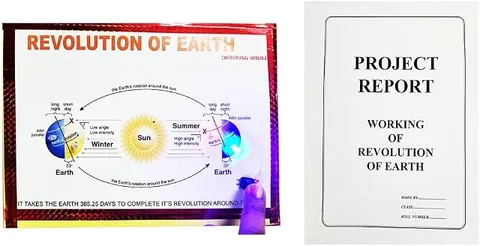
Revolution of Earth Physics Working Model Educational Science Project
Code B0BN2GWNJ7
- Paid for and delivered by Amazon. The current price and the delivery date for your PIN code are shown there.
- Sold by Gurukul Technicals Institute, Delhi.
- Need a different topic, a custom version or a school order? Ask on WhatsApp.
In this project guide
Ready-made model
About this model
This working model shows the Earth revolving around the Sun, the motion that gives us the year and, together with the tilt of the Earth's axis, the seasons. A moving model makes it far easier to understand why summer and winter happen. It suits primary and middle school geography and science projects.
How it works
The science behind it
The idea the model demonstrates, in words you can use in your report and when you explain it.
The Earth moves in two ways. It rotates on its axis once a day, which gives day and night, and it revolves around the Sun in an orbit that takes about 365¼ days, which gives the year. The extra quarter day is why a leap year with 29 February comes every fourth year. The Earth's axis is tilted about 23.5° from the perpendicular to its orbit, and it keeps pointing the same way in space all year. So for part of the year the northern hemisphere leans towards the Sun, gets more direct sunlight and longer days, and has summer; six months later it leans away and has winter. Distance is not the cause: the Earth is actually closest to the Sun in early January, during the Indian winter. Around 21 June the Sun is overhead at the Tropic of Cancer, which passes through India, and Delhi has its longest day of the year.
Make it yourself
Make a revolution of the Earth model yourself
Build your own version from scratch, or use the steps to understand how the ready-made model is put together before you present it.
What you need 9
Step by step 8 steps
Fix the geared motor under the centre of the base with its shaft pointing up through a hole, and glue the first bottle cap flat on the base round the shaft hole, without touching the shaft, so that the cap stays still while the shaft turns inside it.
Fix one end of the arm to the motor shaft so the arm sweeps round above the base, and mount the Sun on top of the shaft.
Near the far end of the arm, fit the second bottle cap on a screw so it turns freely, and stretch the rubber band round both caps.
Push the skewer through the Earth and fix it on the free cap, tilted about 23.5° from the vertical, measured with a protractor.
Turn the arm slowly by hand: because the caps are equal, the axis keeps pointing the same way all round the orbit; if it swings round, tighten the band.
Wire the motor through the switch to the cell holder and switch on, starting with two cells and adding more only if the arm moves too slowly.
Mark four places on the base: around 21 June, around 23 September, around 22 December and around 21 March, according to whether the northern hemisphere leans towards or away from the Sun.
Stop the Earth at each label and show which hemisphere gets the more direct light and has summer.
Read this first
Safety first
Go through these points before you build or switch anything on. Younger students should do this with an adult.
- Keep fingers and hair away from the moving arm, and switch off before adjusting anything.
- Use an LED for the Sun, not a hot bulb, so the ball cannot scorch or melt.
- Cover the sharp tip of the skewer with a bead or a drop of glue.
- Use the glue gun and any cutter only with an adult.
Troubleshooting
If something does not work
The usual problems with this model and how to fix them. Open a problem to see the fix.
The arm moves in jerks or stops on one side
The arm is unbalanced or the motor is too weak for it. Add a small counterweight on the short side and check that the Earth end is not rubbing on the base.
The Earth's axis swings round as it revolves
The rubber band is slipping or the caps are not the same size. Use two identical caps, wrap their edges with tape for grip, and fit a tighter band.
The Earth goes round too fast to explain anything
Use a slower geared motor or fewer cells, so one revolution takes several seconds.
The Earth revolves the wrong way
Swap the two motor wires at the cell holder. Seen from above the North Pole, the Earth goes round the Sun anticlockwise.
Exhibition day
How to present it
A running order for the exhibition table or the practical, step by step.
Keep the Earth's axis pointing the same direction all the way around the orbit, and point this out to the judges.
Stop the model at the June and December positions and explain which hemisphere has summer.
Show the difference between rotation and revolution with a simple demonstration.
Mention that India's longest day is around 21 June and its shortest around 22 December.
Practice
Viva questions
Practice questions on this model, with short answers. Try each one aloud before you open the answer.
What is the revolution of the Earth?
It is the movement of the Earth around the Sun in a fixed orbit, taking about 365¼ days.
Why do we have a leap year?
Because one revolution takes about 365¼ days, and the extra quarter days add up to one full day every four years.
What causes the seasons?
The tilt of the Earth's axis together with its revolution around the Sun, which changes how directly sunlight falls on each hemisphere.
By how much is the Earth's axis tilted?
About 23.5° from the perpendicular to the plane of its orbit, which is the same as about 66.5° with the orbital plane.
Project file
Project file outline
The headings of the project file, in order. Give each heading its own section and write it in your own words.
Free ebook: Writing a Science Project FileContents
- Aim: to show the revolution of the Earth round the Sun and how it causes the seasons
- Rotation and revolution compared: day and night, and the year
- The tilt of the Earth's axis and why it keeps pointing the same way
- Positions of the Earth in June, September, December and March, with a diagram
- Why the distance from the Sun is not the cause of the seasons
- The leap year and the extra quarter day
- How the model was built, including the belt that keeps the axis fixed
- Observations, conclusion and sources used
Buying checklist
Before you buy
What to check before you order the model, and what to do when it arrives.
1Before you order
- Check the class level in the listing and confirm the model suits your chapter on the motions of the Earth.
- Read the listing to see whether cells are mentioned; do not assume they are in the box.
- Practise pointing out the four seasons on the model a few days before the exhibition.
- Keep the box and padding, as the arm and the axis can bend on the way to school.
- Check the delivery date for your PIN code on the marketplace, and order well before the exhibition or practical.
2When it arrives
- When it arrives, run it for a while and check that the Earth's tilt has not been bent in transit.
Next steps
Take it further
Ways to turn this model into a bigger investigation or a stronger exhibition entry.
Add a Moon on a small arm round the Earth and use it to explain the phases of the Moon.
Measure the length of a stick's noon shadow once a week for a month and link the change to the Earth's place in its orbit.
Add a panel showing that when India has summer, countries in the southern hemisphere such as Australia have winter.
Audience
Who it suits
Class 3 to 8 geography and science exhibitions on the solar system and the motions of the Earth.
- ClassClass 1 to 9
- SubjectScience
- TypeReady-made model
Free to read
Free ebooks for this topic
Free PDF ebooks from Gurukul Technicals Institute on the science, the making and the presenting of projects like this one.
- Free PDF ebook
Earth, Space and Geography Models
Solar system, seasons, eclipses, volcanoes and the water cycle explained
- Free PDF ebook
Physics Working Models Explained
Twenty classic models, how each works and how to make it
- Free PDF ebook
Your Science Exhibition Guide
Choose a project, build it, present it and answer the judges with confidence
- Free PDF ebook
Writing a Science Project File
How to write the report, from the cover page to the bibliography