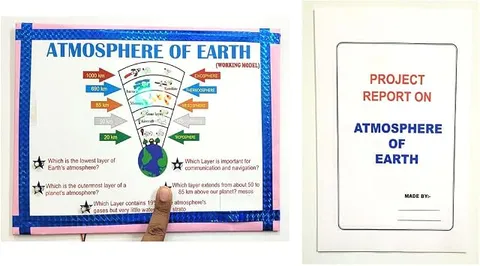
- Science
- Ready-made model
- Class 1 to 9
- Printed report included
Atmosphere and Environment of Earth with Layers Educational Science Physics Working Model Project with Report
Code B0DK26JQ92
- Paid for and delivered by Amazon. The current price and the delivery date for your PIN code are shown there.
- Sold by Gurukul Technicals Institute, Delhi.
- Need a different topic, a custom version or a school order? Ask on WhatsApp.
In this project guide
Ready-made model
About this model
This science model shows the Earth's atmosphere divided into its layers, from the troposphere near the ground to the exosphere at the edge of space, and explains why each layer matters for life and the environment. The listing says a report is included alongside the model.
How it works
The science behind it
The idea the model demonstrates, in words you can use in your report and when you explain it.
The atmosphere is a blanket of gases held around the Earth by gravity; dry air is about 78% nitrogen, 21% oxygen, nearly 1% argon and about 0.04% carbon dioxide. Scientists divide it into layers by how temperature changes with height. The troposphere, the lowest layer, reaches about 8 km at the poles and about 18 km at the equator; almost all weather happens here and temperature falls with height. In the stratosphere, up to about 50 km, the ozone layer absorbs harmful ultraviolet rays, so temperature rises with height. The mesosphere, up to about 80 km, is the coldest layer, and most meteors burn up here. The thermosphere above contains the ionosphere, which reflects some radio waves, and the exosphere slowly fades into space. Air also gets thinner with height, which is why people feel breathless in high places such as Ladakh.
Make it yourself
Make a layers of the atmosphere model yourself
Build your own version from scratch, or use the steps to understand how the ready-made model is put together before you present it.
What you need 8
Step by step 8 steps
Look up each layer's boundary heights in your textbook and choose a scale. The upper layers are far thicker than the troposphere, so you may need a broken scale; if you use one, say so on the board.
Draw the Earth's curved surface at the bottom and cut a strip of coloured paper for each layer, darkest at the top.
Glue on the troposphere first, with cotton clouds, mountains and a plane.
Add the stratosphere above it, with a highlighted ozone band and a weather balloon.
Add the mesosphere with a meteor, the thermosphere with the aurora and a space station, and the exosphere with a satellite.
Fix the LEDs from behind the board at the aurora and the meteor, wired through the switch to the battery.
Draw a temperature line beside the layers showing where temperature falls and where it rises with height.
Label each layer with its height range and one key fact.
Read this first
Safety first
Go through these points before you build or switch anything on. Younger students should do this with an adult.
- Ask an adult to cut the board with a cutter and to use any glue gun.
- Fit each LED with a resistor, and switch the battery off after the display.
- Tuck the battery and wires behind the board so nobody catches them.
Troubleshooting
If something does not work
The usual problems with this model and how to fix them. Open a problem to see the fix.
The layers all look the same thickness
The scale does not follow the real heights. Recalculate each boundary from your textbook and redraw.
The model would be far too tall at true scale
Use a broken scale for the upper layers and mark the break clearly.
The LEDs do not light
Check that the long legs face positive, each LED has its resistor, and the switch is on.
My temperature line does not match the textbook
Temperature falls with height in the troposphere and mesosphere and rises in the stratosphere and thermosphere. Redraw the line to follow that pattern.
Exhibition day
How to present it
A running order for the exhibition table or the practical, step by step.
Start at the ground and move upward, giving each layer's approximate height and one key fact.
Draw a small graph of temperature against height to show why the layers are divided where they are.
Explain how CFCs damaged the ozone layer, and mention that it is slowly recovering since they were phased out under the Montreal Protocol.
Relate the layers to things visitors know, such as weather, aeroplanes, shooting stars and satellites.
Practice
Viva questions
Practice questions on this model, with short answers. Try each one aloud before you open the answer.
In which layer of the atmosphere does weather occur?
In the troposphere, the lowest layer, which holds most of the air's water vapour.
Why is the ozone layer important?
The ozone layer in the stratosphere absorbs most of the Sun's harmful ultraviolet radiation, protecting living things from skin damage and other harm.
In which layer do most meteors burn up?
In the mesosphere, where they heat up and burn because of their very fast collision with air particles.
Which gas makes up the largest part of the air?
Nitrogen, which makes up about 78% of dry air.
Project file
Project file outline
The headings of the project file, in order. Give each heading its own section and write it in your own words.
The listing includes a printed project report: use this outline to check that your own file covers every part.
Free ebook: Writing a Science Project FileContents
- Aim: to show the layers of the Earth's atmosphere and why each matters
- Materials
- Composition of air
- The five layers and their main features
- Graph of temperature against height
- The ozone layer and how to protect it
- Effects of air pollution and climate change on the atmosphere
- Conclusion
- Bibliography
Buying checklist
Before you buy
What to check before you order the model.
1Check these first
- The atmosphere is covered in middle-school science and geography; check which layers and facts your teacher expects.
- Check in the listing whether any lights are fitted and what batteries they need.
- If a report is included, check its figures against your textbook, because sources give slightly different heights for the layers.
- Keep the box so the board does not bend or tear.
- Check the delivery date for your PIN code on the marketplace, and order well before the exhibition or practical.
- The project report is a learning aid. Read it, understand how the model works, and write your own observations; schools expect your own work.
- Practise explaining it. Judges ask what the model shows and why; knowing the science matters as much as the model. The viva questions above are a good place to start.
Next steps
Take it further
Ways to turn this model into a bigger investigation or a stronger exhibition entry.
Show the greenhouse effect with two thermometers in the sun, one inside a covered glass jar, and explain how it compares with the atmosphere trapping heat.
Add a panel on how the ozone hole was discovered and how controlling harmful chemicals is helping it recover.
Explain how air pressure falls with height, using a sealed snack packet that puffs up on a hill journey.
Audience
Who it suits
Suits Class 7 to 9 science and geography exhibitions and Class 11 geography lessons on the structure of the atmosphere.
- ClassClass 1 to 9
- SubjectScience
- TypeReady-made model
- Project reportPrinted report included
Free to read
Free ebooks for this topic
Free PDF ebooks from Gurukul Technicals Institute on the science, the making and the presenting of projects like this one.
- Free PDF ebook
Earth, Space and Geography Models
Solar system, seasons, eclipses, volcanoes and the water cycle explained
- Free PDF ebook
Physics Working Models Explained
Twenty classic models, how each works and how to make it
- Free PDF ebook
Your Science Exhibition Guide
Choose a project, build it, present it and answer the judges with confidence
- Free PDF ebook
Writing a Science Project File
How to write the report, from the cover page to the bibliography