- Biology
- Ready-made model
- Class 1 to 9
- Printed report included
Volcano Science Working Project & Model in Chemistry & Biology with Red Lava Running Lights(with Printed Report)
Code B099QYTGXK
- Paid for and delivered by Amazon. The current price and the delivery date for your PIN code are shown there.
- Sold by Gurukul Technicals Institute, Delhi.
- Need a different topic, a custom version or a school order? Ask on WhatsApp.
In this project guide
Ready-made model
About this model
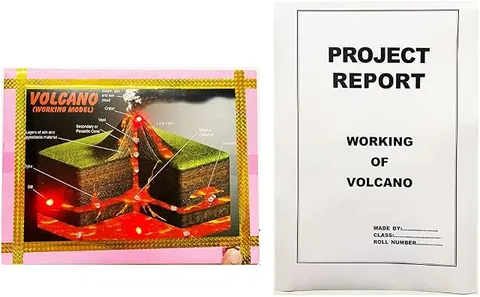
This volcano model shows how a volcano erupts, and the listing says it uses red running lights to represent flowing lava. The listing also says a printed report is included, which helps a student explain the process at a school exhibition.
How it works
The science behind it
The idea the model demonstrates, in words you can use in your report and when you explain it.
The Earth's crust is broken into large plates resting on the hot, slowly flowing rock of the mantle. Deep below the surface, rock melts to form magma, which is lighter than the solid rock around it and rises through cracks and weak zones. It collects in a magma chamber, and when the pressure of the gases dissolved in it becomes too great, it bursts out through a vent. Once it reaches the surface it is called lava. An eruption can also throw out ash, rock fragments and gases such as water vapour, carbon dioxide and sulphur dioxide. Volcanoes are grouped as active, dormant or extinct, and India's only active volcano is on Barren Island in the Andaman and Nicobar Islands. Many students also make a kitchen volcano, in which baking soda reacts with vinegar: NaHCO₃ + CH₃COOH → CH₃COONa + H₂O + CO₂, and the carbon dioxide gas causes the fizzing.
Make it yourself
Make an erupting volcano model with lava lights yourself
Build your own version from scratch, or use the steps to understand how the ready-made model is put together before you present it.
What you need 10
Step by step 9 steps
Tape the bottle upright in the centre of the base; it becomes the vent and crater.
Build a cone around the bottle from crumpled newspaper taped in place, leaving the bottle's mouth open at the top.
Cover the cone with three or four layers of papier-mâché strips, letting each layer dry, and press two or three shallow grooves down the slope for lava channels.
Paint the cone brown and grey with darker ash streaks, and paint the grooves red and orange.
Lay the red LED string along the grooves from the crater to the base with the battery box hidden behind the volcano, and cover the LEDs with crumpled cellophane so they glow like lava.
On a separate card, draw a cross-section showing the magma chamber, main vent, side vent, crater, layers of ash and lava, and the crust and mantle below, and stand it beside the model.
For the fizzing eruption, stand the model in the tray, put two spoons of baking soda in the bottle with a drop of soap and food colour, and pour in about half a cup of vinegar.
Switch on the lights in chasing mode and explain, using the cross-section, how gas pressure in the magma pushes it up and out.
Wipe the bottle and tray after each demonstration so the paper cone does not go soggy.
Read this first
Safety first
Go through these points before you build or switch anything on. Younger students should do this with an adult.
- Do the vinegar eruption only with an adult, in a tray, and keep it away from eyes; rinse with plenty of water if any splashes into an eye.
- Keep the battery box and wires dry and well above the tray, away from the fizzing liquid.
- Use scissors or a cutter on the bottle and card only with an adult nearby.
- Let the paint and glue dry fully before fitting the lights, and wash your hands after painting.
Troubleshooting
If something does not work
The usual problems with this model and how to fix them. Open a problem to see the fix.
The eruption is weak and stops quickly
There is too little baking soda or it is old. Put in fresh soda first, add a drop of dish soap to make more foam, then pour the vinegar in quickly.
The cone has gone soft or started to smell
The papier-mâché did not dry fully or got wet during eruptions. Dry it in the sun, then brush on a coat of white glue or varnish to seal it.
The lava lights look like separate dots
Cover them with crumpled cellophane or tissue to spread the light, place them closer together, and use the chasing mode if your string has one.
The lights have stopped working
The cells may be flat, a wire may be pinched under the base, or damp may have got into the battery box. Fit fresh cells, free the wire and dry the box.
Exhibition day
How to present it
A running order for the exhibition table or the practical, step by step.
Switch on the lava lights and explain each stage, from magma chamber to vent to lava flow.
Label the parts on a chart: magma chamber, vent, crater, lava and ash cloud.
Be ready to explain the difference between magma and lava, a very common question.
Mention Barren Island as India's active volcano to link the model with geography.
Practice
Viva questions
Practice questions on this model, with short answers. Try each one aloud before you open the answer.
What is the difference between magma and lava?
Magma is molten rock below the Earth's surface; it is called lava once it comes out onto the surface.
Name India's only active volcano.
Barren Island, in the Andaman and Nicobar Islands.
What is a dormant volcano?
A volcano that has not erupted for a long time but may erupt again in the future.
Which gas is produced when baking soda reacts with vinegar?
Carbon dioxide.
Project file
Project file outline
The headings of the project file, in order. Give each heading its own section and write it in your own words.
The listing includes a printed project report: use this outline to check that your own file covers every part.
Free ebook: Writing a Science Project FileContents
- Aim: to show how and why a volcano erupts
- Introduction: the Earth's crust, mantle and moving plates
- How magma forms, rises and collects in a magma chamber
- Parts of a volcano, with a labelled cross-section
- Types of volcanoes: active, dormant and extinct, and shield and cone shapes
- Barren Island in the Andaman Sea, India's active volcano
- Effects of eruptions on people and the environment, and benefits such as fertile soil
- How the model works: the lava lights and the fizzing reaction
- Conclusion and bibliography
Buying checklist
Before you buy
What to check before you order the model, and what to do when it arrives.
1Before you order
- Check that the model matches the topic your teacher set, whether volcanoes, landforms or natural disasters.
- Check in the listing what powers the running lights, and keep spare batteries ready for the exhibition day.
- Keep the box and padding, as the cone and wires can be damaged on the way to school.
- Check the delivery date for your PIN code on the marketplace, and order well before the exhibition or practical.
- Practise explaining it. Judges ask what the model shows and why; knowing the science matters as much as the model. The viva questions above are a good place to start.
2When it arrives
- The listing says a printed report is included; check that it is in the parcel when it arrives, and add your own observations and drawings to it.
- Switch the lights on as soon as it arrives and again a few days before the exhibition.
Next steps
Take it further
Ways to turn this model into a bigger investigation or a stronger exhibition entry.
Make a second, flatter cone to compare a shield volcano with a steep composite volcano and explain the difference in lava thickness.
Mark the Pacific Ring of Fire on a world map beside the model and explain why volcanoes form along plate boundaries.
Write the word equation for the baking soda and vinegar reaction, and test how the amount of vinegar changes the height of the foam.
Audience
Who it suits
Class 4 to 8 students preparing a science or geography exhibition model on the Earth and volcanoes.
- ClassClass 1 to 9
- SubjectBiology
- TypeReady-made model
- Project reportPrinted report included
Free to read
Free ebooks for this topic
Free PDF ebooks from Gurukul Technicals Institute on the science, the making and the presenting of projects like this one.
- Free PDF ebook
Safe Chemistry Projects for School
Experiments and models with kitchen materials and proper safety
- Free PDF ebook
Biology Models Guide
Make the heart, lungs, kidney, eye, cell and more, and explain them well
- Free PDF ebook
Earth, Space and Geography Models
Solar system, seasons, eclipses, volcanoes and the water cycle explained
- Free PDF ebook
Your Science Exhibition Guide
Choose a project, build it, present it and answer the judges with confidence