- Physics
- Ready-made model
- Class 1 to 9
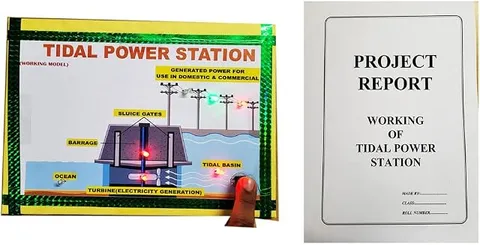
Tidal Power Station Physics Working Model Educational Science Project
Code B0BN2HQTJ5
- Paid for and delivered by Amazon. The current price and the delivery date for your PIN code are shown there.
- Sold by Gurukul Technicals Institute, Delhi.
- Need a different topic, a custom version or a school order? Ask on WhatsApp.
In this project guide
Ready-made model
About this model
A working model of a tidal power station that shows how the regular rise and fall of the sea can be used to generate electricity. It helps students explain a renewable energy source that comes mainly from the gravitational pull of the Moon rather than from sunlight.
How it works
The science behind it
The idea the model demonstrates, in words you can use in your report and when you explain it.
Tides are caused mainly by the gravitational pull of the Moon, with a smaller effect from the Sun. As the Earth rotates, most coasts get two high tides and two low tides in a little over 24 hours. A tidal power station builds a dam, called a barrage, across a narrow bay or river mouth. At high tide, water flows into the basin behind the barrage through gates; at low tide, it is released back to the sea through turbines. The falling water turns the turbines, which drive generators, so the potential energy of stored water becomes kinetic energy and then electrical energy. For a basin of area A and tidal range h, the energy available per tide is about ½ρgAh², so it grows with the square of the tidal range. So only sites with a large tidal range are suitable. In India, the Gulf of Khambhat and the Gulf of Kutch in Gujarat have been studied for tidal power.
Make it yourself
Make a tidal power station model yourself
Build your own version from scratch, or use the steps to understand how the ready-made model is put together before you present it.
What you need 10
Step by step 9 steps
Fix the barrage across the tray so it divides it into a large sea and a smaller basin, and seal every edge with glue so it does not leak. Let it dry fully before adding water.
Make a hole low down in the barrage and fit the short pipe through it, so water can flow from the basin into the sea. Keep the plug in for now.
- Make the turbine
Cut six to eight small blades from bottle plastic, glue them into slots round the bottle cap, and push the cap onto the motor shaft.
Fix the motor on a bracket above the sea side so only the paddle wheel dips into the stream from the pipe. Wrap the motor in plastic to keep it dry.
Run the motor's wires to the multimeter and LED on a dry board beside the tray.
- High tide
Pour water into the sea side, then into the basin until both are at the same high level.
- Low tide
Scoop water out of the sea side with the jug until it is much lower than the basin.
- Pull out the plug
Water rushes from the basin through the pipe onto the paddle wheel, the wheel spins and the meter shows a voltage.
Repeat with different differences in water level and record the highest reading each time.
Read this first
Safety first
Go through these points before you build or switch anything on. Younger students should do this with an adult.
- Keep water away from the multimeter, batteries and any mains-powered device; do not add a mains-powered pump to this model.
- Wipe up spills at once, because a wet floor at an exhibition is slippery.
- Cut bottle plastic only with an adult nearby, and sand the cut edges.
- Use hot glue or sealant only with an adult, in a room with fresh air.
Troubleshooting
If something does not work
The usual problems with this model and how to fix them. Open a problem to see the fix.
The wheel turns but the meter shows almost nothing
The wheel is turning too slowly. Increase the difference in water level, narrow the pipe's outlet to make a faster jet, and set the blades right in the jet. Use the meter's lowest DC range; an LED needs about 1.8 V and may not light with a small motor.
Water leaks round the barrage
Empty the tray, dry it, reseal the edges and let the sealant set for a day before refilling.
The motor stopped working after a few runs
Water has probably got inside it. Let it dry completely, wrap it better and mount it higher above the water.
The basin empties too fast to show the effect
Use a narrower pipe or a larger basin so the flow lasts longer.
Exhibition day
How to present it
A running order for the exhibition table or the practical, step by step.
Show high tide and low tide on the model and explain when the gates open and when water passes through the turbine.
Explain on a chart why tidal energy is renewable and predictable, unlike wind.
List one advantage and one limitation, such as reliable timing against very few suitable sites and high building cost.
Use a simple diagram of the Earth, the Moon and the two tidal bulges to explain why tides happen.
Practice
Viva questions
Practice questions on this model, with short answers. Try each one aloud before you open the answer.
What causes tides?
Tides are caused mainly by the gravitational pull of the Moon on the Earth's oceans, with a smaller effect from the Sun.
What energy conversion takes place in a tidal power station?
The potential energy of water stored behind the barrage becomes kinetic energy as it flows, and turbines with generators convert that into electrical energy.
Why are very few places suitable for tidal power?
A large difference between high and low tide and a narrow bay to dam are both needed, and such sites are rare.
Why is tidal energy more predictable than wind energy?
Tide timings follow the Moon's motion and can be calculated years ahead, while wind changes from day to day.
Project file
Project file outline
The headings of the project file, in order. Give each heading its own section and write it in your own words.
Free ebook: Writing a Science Project FileContents
- Aim: to show how the rise and fall of the tides can be used to generate electricity
- Introduction: what tides are and how the Moon and the Sun cause them
- Parts of a tidal power station: barrage, basin, sluice gates, turbines and generators
- Working: filling the basin at high tide and generating at low tide
- Energy conversion: potential energy of stored water to kinetic energy to electrical energy
- Observations: voltage produced for different differences in water level
- Advantages and limitations: predictable tides, high building cost and effects on estuary life
- Places in India studied for tidal power, such as the Gulf of Khambhat and the Gulf of Kutch
- Conclusion and bibliography
Buying checklist
Before you buy
What to check before you order the model.
1Check these first
- Check that a renewable energy model suits your class syllabus and your teacher's instructions.
- Read the listing to see whether the model works with water or lights, and what power it needs, so you can plan the demonstration.
- Test it a few days before the exhibition and practise explaining high tide and low tide with it.
- If your demonstration uses water, carry the model empty, fill it at the venue, and bring a towel.
- Keep the box and packing to carry the model safely.
- Check the delivery date for your PIN code on the marketplace, and order well before the exhibition or practical.
Next steps
Take it further
Ways to turn this model into a bigger investigation or a stronger exhibition entry.
Calculate the energy stored in a basin of area A with a tidal range h using E = ½ρgAh², first for a real bay and then for your model.
Compare a tidal barrage with tidal stream turbines, which work like underwater windmills.
Look up high and low tide times for a coastal city for two weeks and relate the size of the tides to the phases of the Moon (spring and neap tides).
Audience
Who it suits
Suits Class 7 to 10 science and geography exhibitions on renewable energy.
- ClassClass 1 to 9
- SubjectPhysics
- TypeReady-made model
Free to read
Free ebooks for this topic
Free PDF ebooks from Gurukul Technicals Institute on the science, the making and the presenting of projects like this one.
- Free PDF ebook
Physics Working Models Explained
Twenty classic models, how each works and how to make it
- Free PDF ebook
Your Science Exhibition Guide
Choose a project, build it, present it and answer the judges with confidence
- Free PDF ebook
Writing a Science Project File
How to write the report, from the cover page to the bibliography
- Free PDF ebook
Viva Questions for Science Projects
How to answer examiner questions, with sample questions for popular projects