- Maths
- Ready-made model
- Class 10 to 12
Surface Area of Cone Mathematics Geometry Working Project Model
Code B0G2TBDM91
- Paid for and delivered by Amazon. The current price and the delivery date for your PIN code are shown there.
- Sold by Gurukul Technicals Institute, Delhi.
- Need a different topic, a custom version or a school order? Ask on WhatsApp.
In this project guide
Ready-made model
About this model
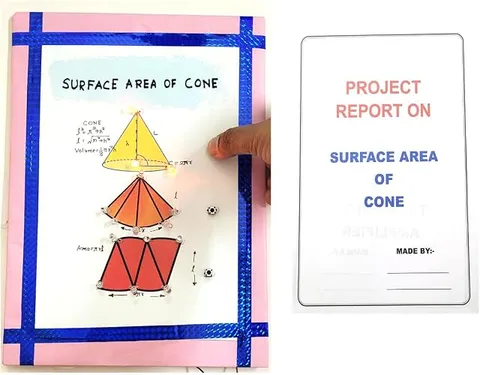
This maths working model is about the surface area of a cone and helps show how its curved surface opens out into a sector of a circle, which is where the formula πrl comes from. As its title says, it is aimed at CBSE investigatory work, and it gives a hands-on reason for a formula students usually just memorise.
What the listing says
- CBSE Investigatory
How it works
The science behind it
The idea the model demonstrates, in words you can use in your report and when you explain it.
A right circular cone has base radius r, height h and slant height l, and by Pythagoras' theorem l = √(r² + h²). If the curved surface is cut along a slant line and opened out flat, it becomes a sector of a circle of radius l, and the arc length of this sector equals the circumference of the base, 2πr. The area of a sector is half of arc length × radius, so the curved surface area is ½ × 2πr × l = πrl. Adding the base gives the total surface area, πrl + πr² = πr(l + r). For example, with r = 7 cm and h = 24 cm, l = 25 cm, so the curved surface area is 22/7 × 7 × 25 = 550 cm² and the total surface area is 550 + 154 = 704 cm². A paper birthday cap has no base, so it uses only the curved surface area.
Make it yourself
Make a surface area of a cone model yourself
Build your own version from scratch, or use the steps to understand how the ready-made model is put together before you present it.
What you need 9
Step by step 8 steps
Choose a cone with base radius r = 6 cm and slant height l = 10 cm, so its height is h = 8 cm by Pythagoras' theorem (6² + 8² = 10²).
- Work out the sector angle
The arc must equal the base circumference, so the angle is 360° × r ÷ l = 216°. Draw a circle of radius 10 cm on card and mark a 216° sector with the protractor.
Cut out the sector and roll it into a cone, joining the straight edges with hook-and-loop fastener dots, so visitors can watch it open flat and close again.
Cut a circle of radius 6 cm as the base and show that it fits exactly in the open end of the cone.
Draw an identical sector on the other colour and divide it into 16 thin slices by lines from the centre to the arc.
Cut the slices apart and lay them in a row, pointing alternately up and down: they form a shape close to a parallelogram whose length is half the arc, πr, and whose height is l, so its area is πrl.
Check by laying a flat sector on graph paper and counting the squares; compare your count with π × 6 × 10 ≈ 188.5 cm².
Mount the opening cone, the base circle and the slice parallelogram on the board, with CSA = πrl, TSA = πr(l + r) and the worked answers.
Read this first
Safety first
Go through these points before you build or switch anything on. Younger students should do this with an adult.
- Use the cutter only with an adult, on a cutting mat, cutting away from your fingers.
- Handle the compass point carefully and close the compasses when not in use.
- Carry scissors closed with the blades pointing down.
Troubleshooting
If something does not work
The usual problems with this model and how to fix them. Open a problem to see the fix.
The rolled cone does not fit the base circle
The sector angle or radius is wrong. Check that the angle is 360° × r ÷ l, and that the sector's radius is the slant height, not the vertical height.
The sliced shape does not look like a parallelogram
Use more, thinner slices; with 16 to 24 slices the curved edges become almost straight, which is the idea behind the proof.
The graph-paper count differs from 188.5 cm²
Partly covered squares add error. Count squares more than half covered as one and ignore the rest, and expect to be within a few square centimetres.
Visitors confuse slant height with height
Hold a ruler upright from the centre of the base to the tip (h = 8 cm) and a thread along the side (l = 10 cm), and show the right-angled triangle they make with r.
Exhibition day
How to present it
A running order for the exhibition table or the practical, step by step.
Roll a paper sector into a cone and unroll it again in front of the judges to show where πrl comes from.
Mark r, h and l on the model and show the right-angled triangle that links them.
Solve a real problem, such as the canvas needed for a conical tent or the paper needed for a birthday cap.
Explain when to use curved surface area and when to use total surface area.
Practice
Viva questions
Practice questions on this model, with short answers. Try each one aloud before you open the answer.
How do you find the slant height of a cone?
Using Pythagoras' theorem, l = √(r² + h²), since the radius, height and slant height form a right-angled triangle.
Why is the curved surface area of a cone equal to πrl?
When opened out, it is a sector of radius l with arc length 2πr, and its area is ½ × 2πr × l = πrl.
Which surface area would you use to find the paper needed for a joker cap?
The curved surface area, because the cap has no base.
A cone with base radius 7 cm and slant height 25 cm is opened into a sector. What is the sector angle?
The angle is 360° × r ÷ l = 360° × 7 ÷ 25 = 100.8°.
Project file
Project file outline
The headings of the project file, in order. Give each heading its own section and write it in your own words.
Free ebook: Writing a Science Project FileContents
- Aim: to show that the curved surface area of a cone is πrl by opening it out into a sector
- Introduction: parts of a right circular cone, and l² = r² + h²
- Construction of the opening cone and finding the sector angle
- Derivation of πrl by cutting the sector into slices
- Verification by counting squares on graph paper
- Worked examples of curved and total surface area
- Real-life uses: tents, funnels, caps and conical roofs
- Conclusion and bibliography
Buying checklist
Before you buy
What to check before you order the model, and what to do when it arrives.
1Before you order
- Check that surface areas of solids are in your syllabus (Class 9 or 10 mathematics) and that your teacher wants a working model rather than a chart.
- Look at the listing photos to see how the model shows the cone opening into a sector, so you know what to prepare.
- Practise a second worked example of your own for the viva.
- Keep the box to carry the model flat.
- Check the delivery date for your PIN code on the marketplace, and order well before the exhibition or practical.
2When it arrives
- On arrival, measure the model with a ruler and work out its surface area yourself, so your numbers match the model.
Next steps
Take it further
Ways to turn this model into a bigger investigation or a stronger exhibition entry.
Cut the top off a cone to make a frustum, open it into a ring-shaped sector, and derive its curved surface area π(r₁ + r₂)l.
Work out how much canvas a conical tent of a given size needs, adding 10% for seams, as a real-life problem.
Compare cones with the same slant height but different radii and show how the sector angle changes.
Audience
Who it suits
Suits Class 9 and 10 maths investigatory projects and exhibitions on surface areas and volumes.
- ClassClass 10 to 12
- SubjectMaths
- TypeReady-made model
Free to read
Free ebooks for this topic
Free PDF ebooks from Gurukul Technicals Institute on the science, the making and the presenting of projects like this one.
- Free PDF ebook
Maths Working Models and Activities
Make maths visible: models for number, geometry, algebra and data
- Free PDF ebook
Investigatory Projects for Class 11 and 12
Topics, method and report structure for physics, chemistry and biology
- Free PDF ebook
Your Science Exhibition Guide
Choose a project, build it, present it and answer the judges with confidence
- Free PDF ebook
Writing a Science Project File
How to write the report, from the cover page to the bibliography