- Physics
- Ready-made model
- Class 10 to 12
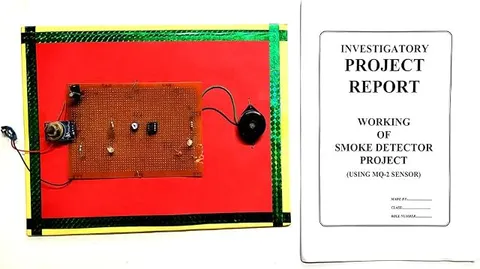
Smoke Detector Project Using MQ2 Sensor Physics Working Model and Educational Investigatory Minor Project
Code B0C3H434R6
- Paid for and delivered by Amazon. The current price and the delivery date for your PIN code are shown there.
- Sold by Gurukul Technicals Institute, Delhi.
- Need a different topic, a custom version or a school order? Ask on WhatsApp.
In this project guide
Ready-made model
About this model
This investigatory project is a smoke detector built around the MQ2 gas sensor, which raises an alarm when smoke or certain flammable gases are present in the air. It is a practical safety project that teaches how a sensor turns a chemical change into an electrical signal.
How it works
The science behind it
The idea the model demonstrates, in words you can use in your report and when you explain it.
The MQ2 is a metal-oxide semiconductor gas sensor. Its sensing layer is made of tin dioxide (SnO₂) and is kept hot by a small heater coil inside the sensor. In clean air, oxygen molecules settle on the hot tin dioxide surface and trap free electrons, so the layer's resistance is high. When smoke or a flammable gas such as LPG, propane, methane, hydrogen or alcohol vapour reaches the surface, it reacts with this oxygen and releases the trapped electrons, so the resistance falls. The sensor is connected with a load resistor as a voltage divider, so the falling resistance appears as a rising voltage across the load resistor. A comparator or microcontroller compares this voltage with a set level and switches on a buzzer when it is crossed. The sensor needs a warm-up time before its readings are steady. LPG leak detectors in kitchens use the same type of sensor.
Make it yourself
Make an MQ2 smoke detector alarm yourself
Build your own version from scratch, or use the steps to understand how the ready-made model is put together before you present it.
What you need 10
Step by step 8 steps
Connect VCC to 5 V and GND to negative. The power LED lights and the sensor's metal mesh slowly warms; leave it on for at least 5 minutes before testing, and longer the very first time.
Measure DO with the multimeter in clean air. On most modules it reads high (near 5 V) in clean air and drops near 0 V when gas or smoke passes the set level, and the module's second LED lights at that point.
Look up the BC557's pin order in its datasheet before fitting it.
Wire the alarm for a DO that goes low: transistor emitter to 5 V, base through the 1 kΩ resistor to DO, and collector to the buzzer's positive lead and, through the 330 Ω resistor, to the LED's long leg. The buzzer's negative lead and the LED's short leg go to negative.
In clean air, turn the preset slowly until the module's DO LED just goes off and the buzzer is silent.
Ask an adult to light an incense stick, blow out the flame, and hold the smoking tip about 10 cm below the sensor. Within a few seconds the alarm should sound, and it should stop once the smoke clears.
Fix the sensor near the ceiling of the model room, since smoke rises, and place the buzzer and LED where visitors can see and hear them.
Read AO with the multimeter in clean air and in smoke, and record how its voltage rises as the sensor's resistance falls.
Read this first
Safety first
Go through these points before you build or switch anything on. Younger students should do this with an adult.
- The sensor's heater makes it hot to touch; hold the module by its board edges and keep it away from paper and plastic.
- Never test with an LPG cylinder, a gas stove or lighter gas; use only a little smoke from an incense stick lit and blown out by an adult.
- This is a school model, not a certified smoke alarm; never use it in place of a real one at home.
- Run the module only from a 5 V power bank or regulated supply; 9 V connected straight to it damages the heater.
Troubleshooting
If something does not work
The usual problems with this model and how to fix them. Open a problem to see the fix.
The alarm sounds all the time
The sensor has not warmed up, or the preset is too sensitive. Wait at least 5 minutes, then turn the preset back in clean air until the alarm stops.
Smoke does not set it off
The preset is set too high, or the smoke is reaching the sensor too thinly. Bring the smoke closer, adjust the preset, and check with the multimeter that DO really changes.
The power bank switches itself off
Some power banks turn off when the current drawn is small. Use one that stays on with small loads, or use a 9 V battery with a 7805 regulator.
The module's LED changes but the buzzer stays silent
Your module's DO may go high instead of low, or the transistor pins are wrong. Check DO with the multimeter; if it rises in smoke, use an NPN BC547, with the buzzer between 5 V and its collector.
Exhibition day
How to present it
A running order for the exhibition table or the practical, step by step.
Let the sensor warm up for a few minutes before the judges arrive, so its readings are steady.
Test it safely with smoke from a blown-out incense stick (agarbatti) held at a distance, never with an open flame or a gas leak.
Explain the chemistry: the gas reacts with oxygen on the hot tin dioxide surface, lowering its resistance.
Mention where such detectors are used, such as kitchens, hotels, factories and server rooms.
Practice
Viva questions
Practice questions on this model, with short answers. Try each one aloud before you open the answer.
What material is the sensing element of the MQ2 sensor made of?
Tin dioxide (SnO₂), a metal-oxide semiconductor.
Why does the MQ2 sensor have a heater?
The reaction between the gas and the oxygen on the tin dioxide surface works well only at a high temperature, so the heater keeps the layer hot.
Name some gases the MQ2 sensor can detect.
LPG, propane, methane, hydrogen, alcohol vapour and smoke.
How does the resistance of the sensor change when smoke is present?
It decreases, because the smoke frees electrons that were trapped by oxygen on the sensor surface.
Project file
Project file outline
The headings of the project file, in order. Give each heading its own section and write it in your own words.
Free ebook: Writing a Science Project FileContents
- Aim: to make an alarm that detects smoke and flammable gases using an MQ2 sensor
- Introduction: fire safety and why early warning saves lives
- How a metal-oxide gas sensor works: tin dioxide, the heater and the change in resistance
- The comparator, preset and transistor switch
- Circuit diagram and list of components
- Construction and setting the sensitivity
- Observations: AO voltage and alarm response in clean air and in smoke
- Limitations of the model, and how real smoke alarms differ
- Conclusion, precautions and bibliography
Buying checklist
Before you buy
What to check before you order the model, and what to do when it arrives.
1Before you order
- Check that a sensor-based investigatory project suits your class, and whether your teacher wants readings as well as a working model.
- Read the listing to find how the project is powered and what you will need to arrange.
- Keep the sensor's mesh clean and dry, and store the model in its box.
- Check the delivery date for your PIN code on the marketplace, and order well before the exhibition or practical.
- Practise explaining it. Judges ask what the model shows and why; knowing the science matters as much as the model. The viva questions above are a good place to start.
2When it arrives
- Test it on arrival with a little incense smoke (lit by an adult) and set the sensitivity, remembering it needs a few minutes to warm up every time.
Next steps
Take it further
Ways to turn this model into a bigger investigation or a stronger exhibition entry.
Add a microcontroller board to read AO, show a smoke level on a display, and sound different tones for low and high levels.
Add a small low-voltage exhaust fan that a relay module switches on when smoke is detected.
Time how quickly the alarm responds with the smoke at different distances, and plot response time against distance.
Audience
Who it suits
Suits Class 10 to 12 physics investigatory projects and engineering minor projects on sensors and safety systems.
- ClassClass 10 to 12
- SubjectPhysics
- TypeReady-made model
Free to read
Free ebooks for this topic
Free PDF ebooks from Gurukul Technicals Institute on the science, the making and the presenting of projects like this one.
- Free PDF ebook
Physics Working Models Explained
Twenty classic models, how each works and how to make it
- Free PDF ebook
Investigatory Projects for Class 11 and 12
Topics, method and report structure for physics, chemistry and biology
- Free PDF ebook
Your Science Exhibition Guide
Choose a project, build it, present it and answer the judges with confidence
- Free PDF ebook
Writing a Science Project File
How to write the report, from the cover page to the bibliography