 61% off
- Chemistry
- Ready-made model
- Report shown in the photo
pH Scale Testing Using LED Chemistry Science Working Investigatory Project Model Kit
Code B0HLY56P5S
- Paid for and delivered by Amazon. The current price and the delivery date for your PIN code are shown there.
- Sold by Gurukul Technicals Institute, Delhi.
- Need a different topic, a custom version or a school order? Ask on WhatsApp.
In this project guide
Ready-made model
About this model
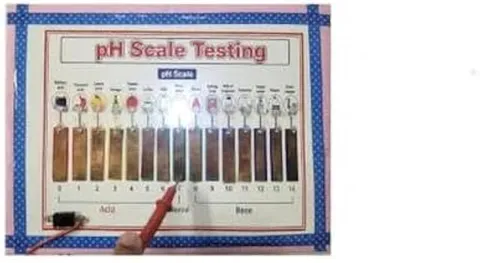
This chemistry working model shows the pH scale from 0 to 14 on a chart titled pH Scale Testing, set on a pink board with a blue border. As shown in the photo, each number has a copper-coloured strip, with an LED and a small picture of a substance above it, and the scale is marked acid, neutral and base. Touching a red probe to a strip lights the LED above that number, so the board helps explain where everyday substances sit on the scale.
How it works
The science behind it
The idea the model demonstrates, in words you can use in your report and when you explain it.
pH is a number that tells how acidic or basic a solution is, on a scale that normally runs from 0 to 14. It depends on the concentration of hydrogen ions: the more hydrogen ions, the lower the pH. A solution with pH below 7 is acidic, exactly 7 is neutral, like pure water, and above 7 is basic. Each step of one unit is a tenfold change, so a solution at pH 3 has ten times the hydrogen ion concentration of one at pH 4. pH is found with universal indicator or pH paper, which shows a different colour for each value, or with a pH meter. Our stomach makes hydrochloric acid, and an antacid such as milk of magnesia neutralises the extra acid during indigestion. Tooth decay starts when the pH in the mouth falls below 5.5. Plants need soil within a suitable pH range, so farmers treat soil that is too acidic with lime. An ant bite injects formic acid, and a mild base like baking soda eases the pain.
Make it yourself
Make a pH scale display board with LED lights yourself
Build your own version from scratch, or use the steps to understand how the ready-made model is put together before you present it.
What you need 10
Step by step 8 steps
Write the title, draw a row of fifteen boxes numbered 0 to 14, and mark 0 to 6 as acid, 7 as neutral and 8 to 14 as base.
Stick a small picture of a common substance above suitable numbers, checking each value in your textbook or a reliable reference.
Colour the boxes in the order of universal indicator colours: red at the strongly acidic end, through green near 7, to violet at the strongly basic end.
Push an LED through the board above each number.
Stick a copper strip below each number, leaving a clear gap so no two strips touch, and join a wire to the back of each.
At the back, connect each strip's wire through a 1 kΩ resistor to the long leg of the LED above it.
Join every LED's short leg to a common wire going to the battery negative, and connect the battery positive through the switch to the probe.
Touch the probe to each strip in turn and check that only the LED above it lights, then tape the wiring flat.
Read this first
Safety first
Go through these points before you build or switch anything on. Younger students should do this with an adult.
- Never short the battery, keep the probe away from the common negative wire, and unclip the battery when the board is not on show.
- Keep a resistor in series with every LED.
- Test only household liquids such as lemon juice and soap solution, and only with your teacher; never taste test liquids.
- Keep liquids well away from the board and its wiring, and wipe up any spill at once.
- Solder only with an adult and rest the hot iron in its stand.
Troubleshooting
If something does not work
The usual problems with this model and how to fix them. Open a problem to see the fix.
One number's LED does not light
Check that its long leg goes to the resistor, that the wire is joined firmly to the strip, and that the battery is fresh.
Touching one strip lights two LEDs
Two strips or their wires are touching. Cut a clear gap between the strips and tape the joints at the back.
The probe has to be pressed hard on a strip
The copper has tarnished. Rub it lightly with fine sandpaper or an eraser.
The pH paper colour is hard to read
Use a fresh strip, dip it only briefly, and compare it at once with the colour chart in good daylight.
Exhibition day
How to present it
A running order for the exhibition table or the practical, step by step.
Touch the strips from 0 to 14 and name a common substance near each end and at the middle of the scale.
Explain that the board displays the scale, and that the pH of a real liquid is found with pH paper, universal indicator or a pH meter.
With your teacher, dip pH paper into lemon juice, water and soap solution, and match the colours to the scale.
Show a natural indicator: turmeric paper turns red in soap solution, which is basic.
Practice
Viva questions
Practice questions on this model, with short answers. Try each one aloud before you open the answer.
What does a pH of 7 mean?
The solution is neutral, neither acidic nor basic, like pure water.
How many times more acidic is pH 2 than pH 4?
100 times, because each unit is a tenfold change in hydrogen ion concentration.
Why is milk of magnesia taken for acidity?
It is a mild base that neutralises the extra hydrochloric acid in the stomach.
What is a universal indicator?
It is a mixture of indicators that shows a different colour at each pH, so it gives the approximate pH and not just acid or base.
Project file
Project file outline
The headings of the project file, in order. Give each heading its own section and write it in your own words.
The listing photo shows a printed project report: if it comes with your order, use this outline to check that your own file covers every part.
Free ebook: Writing a Science Project FileContents
- Aim: to show the pH scale and the pH of common substances
- Introduction: acids, bases and indicators
- Natural indicators: litmus, turmeric and china rose
- The pH scale, hydrogen ions and neutral solutions
- Universal indicator, pH paper and the pH meter
- Importance of pH in daily life: digestion, tooth decay, soil and ant bites
- Construction of the board and its LED circuit
- Observations: pH paper results for household liquids
- Conclusion and bibliography
Buying checklist
Before you buy
What to check before you order the model, and what to do when it arrives.
1Before you order
- Check that acids, bases and the pH scale are in your syllabus and what your teacher expects.
- The photo shows a display board, so if you want to test real liquids at the exhibition, arrange pH paper or universal indicator through your school.
- Find out what battery it uses and keep a spare one ready.
- Keep the box and carry the board flat so the wires at the back are not pulled.
- Check the delivery date for your PIN code on the marketplace, and order well before the exhibition or practical.
- The listing photo shows a printed report. Confirm that it comes with your order, on the marketplace or on WhatsApp, if you need it.
- Practise explaining it. Judges ask what the model shows and why; knowing the science matters as much as the model. The viva questions above are a good place to start.
2When it arrives
- Check what arrives against the photo: the chart, the strips, the lights and the probe.
- Touch every strip soon after it arrives and note any light that does not glow.
Next steps
Take it further
Ways to turn this model into a bigger investigation or a stronger exhibition entry.
Make a red cabbage indicator by boiling the leaves with an adult, and use it to test liquids from the kitchen.
With your teacher, mix garden soil with water, let it settle, and test the clear water with pH paper.
Add a small panel on neutralisation: an acid and a base react to give a salt and water.
Audience
Who it suits
Suits Class 7 to 10 science projects and exhibitions on acids, bases and salts, and quick revision of the pH scale before Class 10 board exams.
- SubjectChemistry
- TypeReady-made model
- Project reportShown in the listing photo
Free to read
Free ebooks for this topic
Free PDF ebooks from Gurukul Technicals Institute on the science, the making and the presenting of projects like this one.
- Free PDF ebook
Safe Chemistry Projects for School
Experiments and models with kitchen materials and proper safety
- Free PDF ebook
Electricity and Magnetism Experiments
Hands-on experiments with cells, wires, bulbs and magnets
- Free PDF ebook
Your Science Exhibition Guide
Choose a project, build it, present it and answer the judges with confidence
- Free PDF ebook
Writing a Science Project File
How to write the report, from the cover page to the bibliography